Often tested
The UK and international organisations
The UK doesn't only elect representatives at home: it is also a member of many international organisations. The test often asks what each one does and how it differs from the others.
Often tested
The UK doesn't only elect representatives at home: it is also a member of many international organisations. The test often asks what each one does and how it differs from the others.
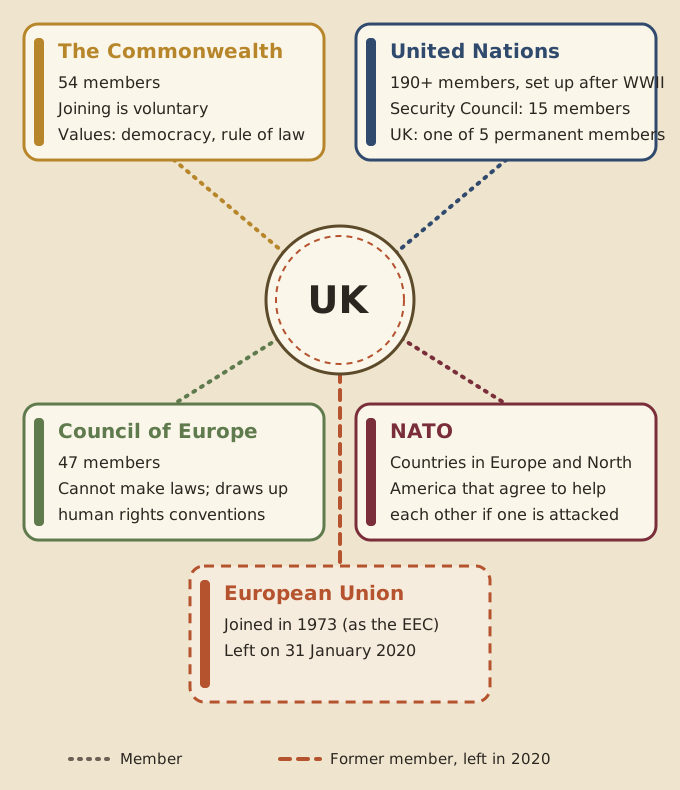
The Commonwealth is a group of countries that back one another and share the aims of democracy and development. Most of its members were once part of the British Empire, but a few countries that never were have joined too.
You don't need a British past to join. Mozambique, a former Portuguese colony, became the first member that had never been part of the British Empire when it joined in 1995. Rwanda followed in 2009.
The Council of Europe is often confused with the EU, but it is a separate organisation. It has 47 member countries, including the UK. Its job is to protect and promote human rights in its member countries. It has no power to make laws; instead it draws up conventions and charters. The best known is the European Convention on Human Rights.
The UK is a member of the United Nations (UN), which has more than 190 member countries. It was created after the Second World War, with the aim of preventing war and promoting international peace and security. The UN Security Council has 15 members and recommends what should be done when there is an international crisis or a threat to peace. The UK is one of its five permanent members.
The UN General Assembly actually met for the first time in London, on 10 January 1946, at Methodist Central Hall in Westminster. The hall stands right opposite Westminster Abbey, a short walk from Parliament.
The UK is also a member of NATO (the North Atlantic Treaty Organization). NATO is made up of countries in Europe and North America that have agreed to help one another if any of them is attacked. NATO also works to keep the peace between its members.
Quiz
When was the United Nations set up?
The UN was created after the Second World War, with the aim of preventing war and promoting international peace and security. The international body set up after the First World War was a different one, the League of Nations. 1973 is when the UK joined the EEC, which has nothing to do with the UN.
Quiz
Which of the following statements is correct?
Joining the Commonwealth is voluntary. It has no power to force its members to do anything, but it can suspend them. The body that draws up conventions is the Council of Europe, and it cannot make laws either.
Quiz
Is the statement below TRUE or FALSE? The UK is one of ten permanent members of the UN Security Council.
False. The Security Council has 15 members, but only 5 of them are permanent, and the UK is one of those 5. To remember: 15 members, 5 permanent.
Quiz
Is the statement below TRUE or FALSE? The Council of Europe can pass laws that all of its member countries must follow.
False. The Council of Europe (47 member countries, including the UK) protects and promotes human rights, but it has no power to make laws. Instead it draws up conventions and charters, the best known being the European Convention on Human Rights. Don't confuse it with the EU: they are different organisations.
Quiz
What is NATO?
NATO is a group of countries in Europe and North America that have agreed to help each other if any one of them is attacked. It also works to keep the peace between its members. Option A sounds more like the Commonwealth, C is the Council of Europe, and D is the UN Security Council.
Quiz
Which TWO of these are core values of the Commonwealth?
The Commonwealth's core values are democracy, good government and the rule of law. It is a voluntary group of countries that support each other; it has no shared currency and no common army. Defending each other is what NATO does.