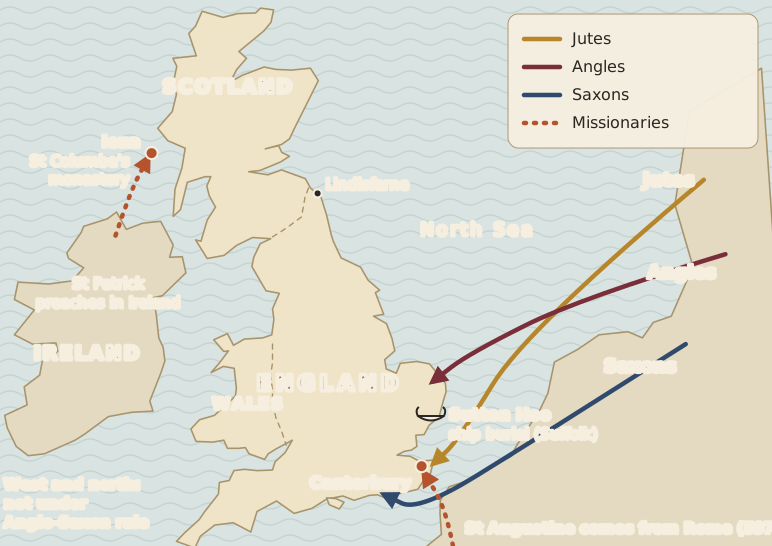
After the Roman army left in AD 410, Britain was invaded once more, this time by tribes from northern Europe:
Jutes: from Jutland, in what is now Denmark.
Angles: from the area where Germany and Denmark meet today.
Saxons: from what is now northern Germany.
Their languages are the foundation of modern English. By about AD 600, the Anglo-Saxons had set up several kingdoms in Britain, most of them in what is now England.
But the Anglo-Saxons never ruledScotland, or parts of western Britain, including most of today's Wales.
The three tribes crossed from mainland Europe (solid lines), and missionaries brought Christianity from two directions (dotted lines): from Ireland in the north and from Rome in the south. The arrows are only a rough guide. In reality, where people came from and where they settled was more mixed.
The newcomers also brought their own gods, and you still meet two of them every week. Wednesday is "Woden's day", and Thursday belongs to Thunor, the god of thunder, known in Norse myths as Thor.
Quiz
After the Romans left, Britain was invaded by tribes from northern Europe. Which TWO of the following were among them?
The three tribes were the Jutes, the Angles and the Saxons. The Normans didn't come until 1066, and the Picts already lived in what is now Scotland: they were the people Hadrian's Wall was built to keep out.
Quiz
Is the statement below TRUE or FALSE?
Scotland and large parts of Wales stayed outside Anglo-Saxon control.
True. The Anglo-Saxon kingdoms were mainly in what is now England. That is one reason why Celtic languages such as Welsh and Scottish Gaelic survived.