After the Bronze Age, people learned to make tools and weapons from iron. This was the Iron Age. People still lived in roundhouses, but now these were grouped into bigger settlements, sometimes on hilltops protected by banks and ditches. These are called hill forts.
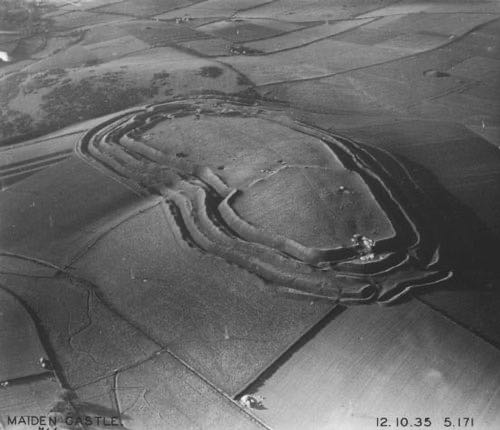
One very impressive hill fort, Maiden Castle in Dorset, England, can still be visited today. Despite its name, it isn't a medieval stone castle. It is made of rings of earth banks and ditches, one inside another.
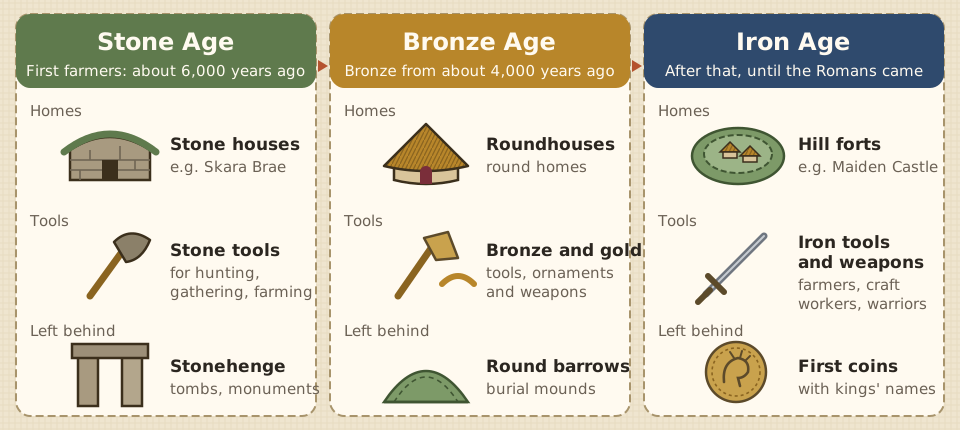
The three ages at a glance. Each one is named after its material: stone, then bronze, then iron, each harder than the one before.Maiden Castle from the air in 1935. The hilltop is surrounded by several rings of banks and ditches. After it was enlarged around 450 BC it covered about 19 hectares, roughly 27 football pitches, which makes it the largest hill fort in Britain.
Photo: Major George Allen (1891–1940), Ashmolean Museum, Oxford, public domain, via Wikimedia Commons
Most people in the Iron Age were farmers, craft workers or warriors. Their language belonged to the Celtic family of languages. Similar languages were spoken all over Europe at the time. Related languages, such as Welsh and Gaelic, are still spoken in parts of Wales, Scotland and Ireland today.
By now, people had quite an advanced society and economy. Iron Age people made the first coins ever minted in Britain (minted means made by stamping metal), and some of them carry the names of Iron Age kings. Once names were written down, we could know who some of these people were for the first time. That is why this is where British history begins.
One name turns up again and again on these coins: Cunobelinus, who ruled the land just north of today's London and had coins struck at Colchester and St Albans. He was remembered for a long time. About 1,600 years later, Shakespeare made him the hero of his play Cymbeline.
Quiz
What is Maiden Castle in Dorset?
Maiden Castle is an Iron Age hill fort. It has "castle" in its name, but it is not a Norman castle. The Stone Age village is Skara Brae, and the forts on Hadrian's Wall include Housesteads and Vindolanda.
Quiz
Which of the following statements is correct?
Britain's first home-made coins appeared in the Iron Age, before the Romans came and long before the Normans.