Shared values, good neighbours and jury service
The UK is one of the most diverse societies in the world. Even so, there is a set of values and responsibilities that everyone can sign up to:
- Keep to the law and respect it
- Know about other people's rights, and respect them
- Be fair to others
- Behave responsibly
- Help and protect your family
- Respect and look after the environment
- Treat everyone equally, whatever their race, religion, sex, age, class, disability or sexual orientation
- Work to support yourself and your family
- Help other people
- Vote in local and national elections
Accepting these values and responsibilities makes it easier to become a full and active citizen.
Quiz
Which TWO of the following are among the shared values and responsibilities that the handbook says everyone can agree with?
Looking after the environment and voting are both on the list of ten. Joining a political party is one way to take part in democracy, but it isn't a responsibility for everyone, and nobody is asked to attend religious services.
Being a good neighbour
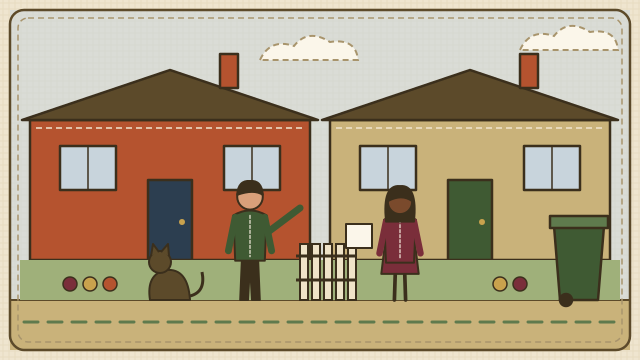
When you move into a new house or flat, go and say hello to the people living nearby. Getting to know your neighbours helps you settle into the community and make friends. Neighbours can be a real help too: they might feed your pet while you're away, or tell you which local shops and services are good.
To avoid falling out with your neighbours, here is some practical advice:
- Respect their privacy.
- Keep down the noise you make.
- Keep your garden tidy.
- Only put your rubbish bags and bins out in the street or shared areas on the day the rubbish is collected.
Taking part in local life
Giving your time as a volunteer and helping out locally are a big part of good citizenship. You fit in and get to know people, and when neighbours support each other, the whole community gets better. It is also a way of living up to your duties as a citizen, like acting responsibly and helping other people.
One well-known way of looking out for each other started in a single village. The UK's first neighbourhood watch scheme began in 1982 in Mollington, in Cheshire, where the police borrowed the idea from the United States and called it Home Watch. Today Neighbourhood Watch groups can be found all over the UK.
Quiz
Which of the following statements is correct?
The advice is to respect your neighbours' privacy, keep the noise down, keep your garden tidy, and only put your bins out on the day the rubbish is collected.
Jury service: a duty you can be picked for
If you have the right to vote, you may also be chosen to sit on a jury. People are picked at random from the electoral register to serve as jurors. Anyone on the register aged 18 to 70 may be called for jury service. In England and Wales the upper limit is 75 instead, so the range there is 18 to 75.
How many people sit on a jury, what they do and when you can be excused are explained in "Serious cases: enter the jury": 12 people in England, Wales and Northern Ireland, and 15 in Scotland. If you are summoned you must go, unless you are not eligible or have a good reason such as illness.
According to the UK government website, jury service in England and Wales usually lasts up to 10 working days, and you must reply within 7 days of getting your summons. If a trial is likely to take longer, the court will tell you in advance.
Quiz
According to the handbook, who can be called to serve on a jury in England and Wales?
The age range is 18 to 70 for people on the electoral register, but 18 to 75 in England and Wales. Jurors are ordinary members of the public; they don't need to know about the law.