The Wars of the Roses: red and white become one rose
Story 1 of 2
By the middle of the 15th century England was losing the Hundred Years War against France. Its nobles were angry and divided, and the king, Henry VI, was weak and at times mentally ill. In 1455 a civil war broke out between two noble families, each of which wanted the English crown:
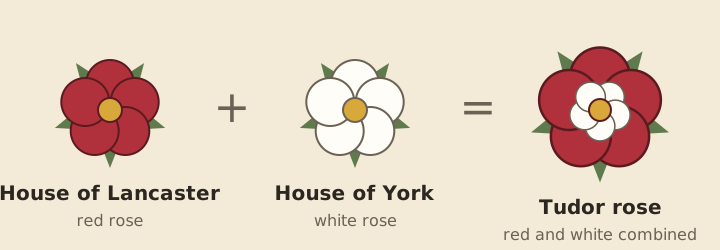
the House of Lancaster, whose symbol was a red rose
the House of York, whose symbol was a white rose
This war is known as the Wars of the Roses. At the Battle of Bosworth Field in 1485, the Yorkist king Richard III was killed. The leader of the Lancaster side, Henry Tudor, took the throne as Henry VII.
Richard III was buried in a hurry in a monastery church in Leicester, and over the centuries people forgot exactly where. In 2012 archaeologists found his skeleton under a car park in the centre of Leicester, and in 2015 he was buried again, this time in Leicester Cathedral.
Henry VII was a smart man. He married Elizabeth of York, Richard III's niece, so the two rival families became one. He became the first monarch of the House of Tudor. His family badge showed a white rose sitting inside a red one, and it was called the Tudor rose. It told everyone that York and Lancaster were now on the same side.
Bosworth is often taken as the end of the Middle Ages in England. Henry VII's family, the Tudors, would rule for more than a hundred years and give the country a new church.
The Tudor rose put the roses of two enemy families together, as a sign that the civil war was over.
Quiz
In the Wars of the Roses, which family's symbol was the red rose?
Lancaster was the red rose and York the white rose. Stuart and Windsor are royal families from later times.
Quiz
Which TWO statements about the Battle of Bosworth Field in 1485 are correct?
The king who died was Richard III, and the winner, Henry Tudor, became Henry VII. Bosworth ended the Wars of the Roses, not the Hundred Years War.
Key facts
AD 476–1485
The Middle Ages in the broad sense; told here from 1066 onwards
1215 Magna Carta
King John was forced to accept it: the king must obey the law too
1284 Rhuddlan
Edward I put Wales under the English Crown and built castles such as Conwy and Caernarvon
1314 Bannockburn
Robert the Bruce beat the English; Scotland was never conquered
the Pale
The area around Dublin that the English ruled in Ireland
Feudalism
The king gave lords land in return for soldiers in war; most peasants were serfs who could not leave
1348 Black Death
About a third of England's people died; then came higher wages, the gentry and a middle class
Parliament
Lords: nobles, great landowners, bishops. Commons: knights and wealthy townspeople
Hundred Years War
Really lasted 116 years; Henry V won at Agincourt in 1415
1400 English
By 1400, English was used for official documents and preferred at court and in Parliament
Chaucer / Caxton
Chaucer wrote The Canterbury Tales; Caxton was the first in England to print books
1455–1485 Roses
Lancaster red, York white; after Bosworth, Henry VII took the throne; the Tudor rose