The four parts, Crown dependencies and overseas territories
Reading
about 10 min
Quizzes
7 questions
What Is the UK? Four Nations, One Kingdom
At every Olympic Games, the UK's athletes compete as "Team GB", short for Team Great Britain. But the team also has athletes from Northern Ireland, and strictly speaking, Northern Ireland is not in Great Britain. Politicians from Northern Ireland have complained that the name leaves them out.
UK, Britain, Great Britain, England: what is the difference? And what about the islands that sit right next to the UK, use the pound and are loyal to the same monarch, yet don't count as part of the UK? Chapter 2 of the handbook is short, but "is it the UK or not?" questions come up often in the test. This chapter sorts them out once and for all.
Which four parts make up the UK?
The UK has four parts: England, Scotland, Wales and Northern Ireland. They are called the "countries" of the UK. Together they make up one sovereign state, which means one fully independent country.
Notice that Northern Ireland is on a different island. The rest of the island of Ireland is a separate, independent country, the Republic of Ireland. It is not part of the UK.
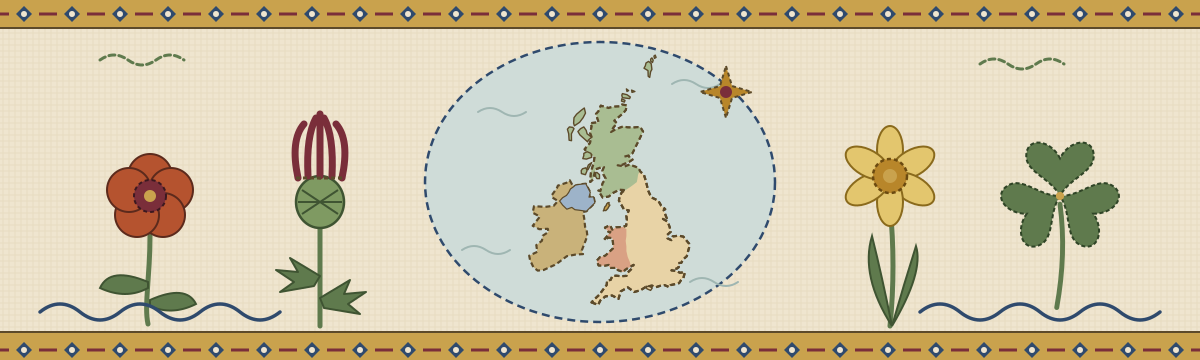
Each of the four parts has its own national flower: the rose for England, the thistle for Scotland, the daffodil for Wales and the shamrock for Northern Ireland. The UK's flag, the Union Flag, is less fair: it combines the crosses of the patron saints of England, Scotland and Ireland, but has nothing for Wales. You can find out why in the History chapter A Global Power.
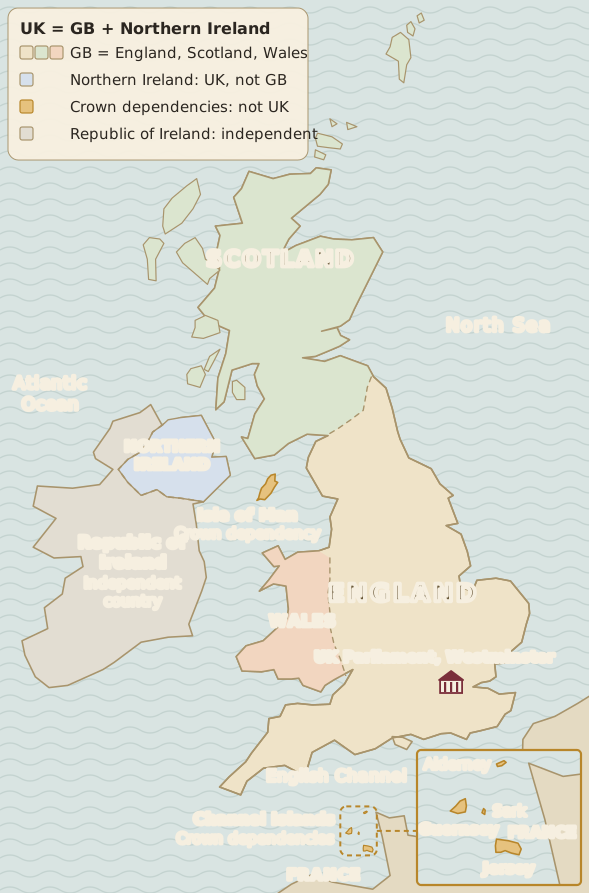
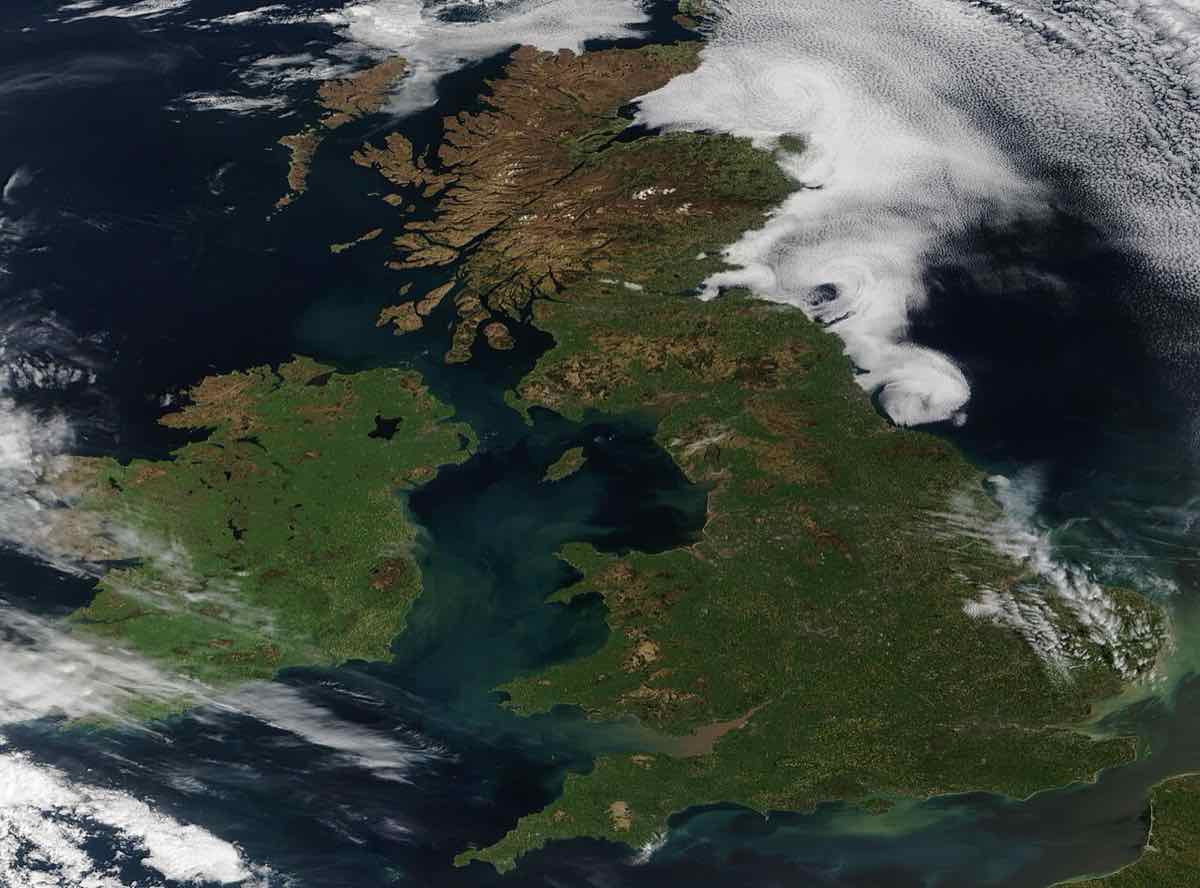
The three warm-coloured areas are Great Britain. Add pale-blue Northern Ireland and you have the UK. The Isle of Man and the Channel Islands, in gold, are Crown dependencies and are not part of the UK. The enlarged view at the bottom right shows how close the Channel Islands are to France.On 24 April 2026 a NASA satellite took this rare, almost cloud-free picture of Britain and Ireland.
MODIS Land Rapid Response Team, NASA GSFC, public domain, via Wikimedia Commons
Quiz
Is the statement below TRUE or FALSE?
England, Scotland, Wales and Northern Ireland together form the United Kingdom.
True: these four parts are the UK. The rest of the island of Ireland is an independent country and is not in the UK.
Great Britain is not the same as the UK
The UK's full official name is a long one: the United Kingdom of Great Britain and Northern Ireland. In everyday life people just say "the UK".
The "Great Britain" in that name covers only England, Scotland and Wales. It does not include Northern Ireland. So Great Britain and the UK are not the same thing:
UK = Great Britain (England + Scotland + Wales) + Northern Ireland
The "Great" in Great Britain is not a boast. It is closer to "the bigger one". In the 2nd century AD the Greek geographer Ptolemy called the larger island "Great Britain" and the smaller one, Ireland, "Little Britain". In the Middle Ages the name also helped tell Britain apart from Brittany, across the Channel in France, whose name has the same root and which was once known as "Little Britain" too. So Great Britain really means "the big island of Britain", not "glorious Britain".
And what about "Britain" and "British"? The handbook makes a special point here: in its pages, the words Britain, British Isles and British all mean all the people of the UK.
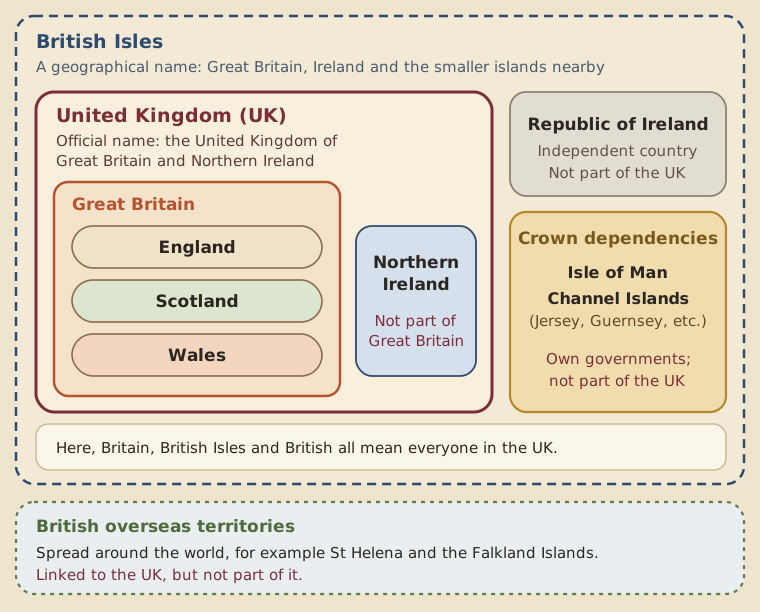
Boxes inside boxes: Great Britain is inside the UK, and the UK is inside the geographical British Isles. The Crown dependencies and the Republic of Ireland are in the British Isles but not in the UK. The overseas territories are scattered around the world.
How did the name get so long?
The UK did not always have such a long name. Every time a new member joined, or a piece of land left, the name changed with it:
1707England (which by then included Wales) and Scotland join together to form the Kingdom of Great Britain
1801A union with Ireland creates the United Kingdom of Great Britain and Ireland
1922The south of Ireland leaves the UK as the Irish Free State; the north stays and becomes Northern Ireland
1927The UK Parliament passes a law changing the name to today's United Kingdom of Great Britain and Northern Ireland
You can read about the unions of 1707 and 1801, and how Ireland was divided, in the History chapters A Global Power and The Two World Wars.
Quiz
Which countries make up Great Britain?
Great Britain is just three: England, Scotland and Wales. C is the whole UK, which also includes Northern Ireland. The most common trap in this question is treating Great Britain and the UK as the same thing.
Quiz
Complete the official name of the UK: "The United Kingdom of …"
The official name ends "of Great Britain and Northern Ireland". B, "the United Kingdom of Great Britain and Ireland", was the name from 1801 to 1922, when the whole of Ireland was in the UK.
Quiz
Is the statement below TRUE or FALSE?
Northern Ireland is part of Great Britain.
False. Northern Ireland is part of the UK, but it is not part of Great Britain. Think back to the argument about the name "Team GB" at the start of this chapter.
Next door, but not the UK: the Crown dependencies
Some islands have very close ties with the UK but are not part of it. These are the Channel Islands, in the English Channel, and the Isle of Man, in the Irish Sea. They have their own governments, and they are known as Crown dependencies.
According to GOV.UK, there are three Crown dependencies: Jersey, Guernsey (which includes smaller islands nearby, such as Alderney and Sark) and the Isle of Man. The British monarch reigns over them, but they run their own affairs. Each has its own elected parliament, and its own government, taxes and legal system. The UK government looks after their defence and foreign relations.
The Channel Islands are much closer to France than to Britain: Jersey is only about 22 km from the coast of Normandy, but around 160 km from Great Britain. They belong with Britain because of 1066. The islands were part of the Duchy of Normandy, and William I, who conquered England, was the Duke of Normandy. When King John lost mainland Normandy to France around 1204, the islands stayed with the English king, and at formal dinners there the traditional loyal toast still calls the monarch "our Duke". In the Second World War they were the only British territory in Europe occupied by Nazi Germany, from the end of June 1940 until May 1945.
Remember the last chapter? If you live in the Channel Islands or on the Isle of Man, the Life in the UK test is arranged differently for you too.
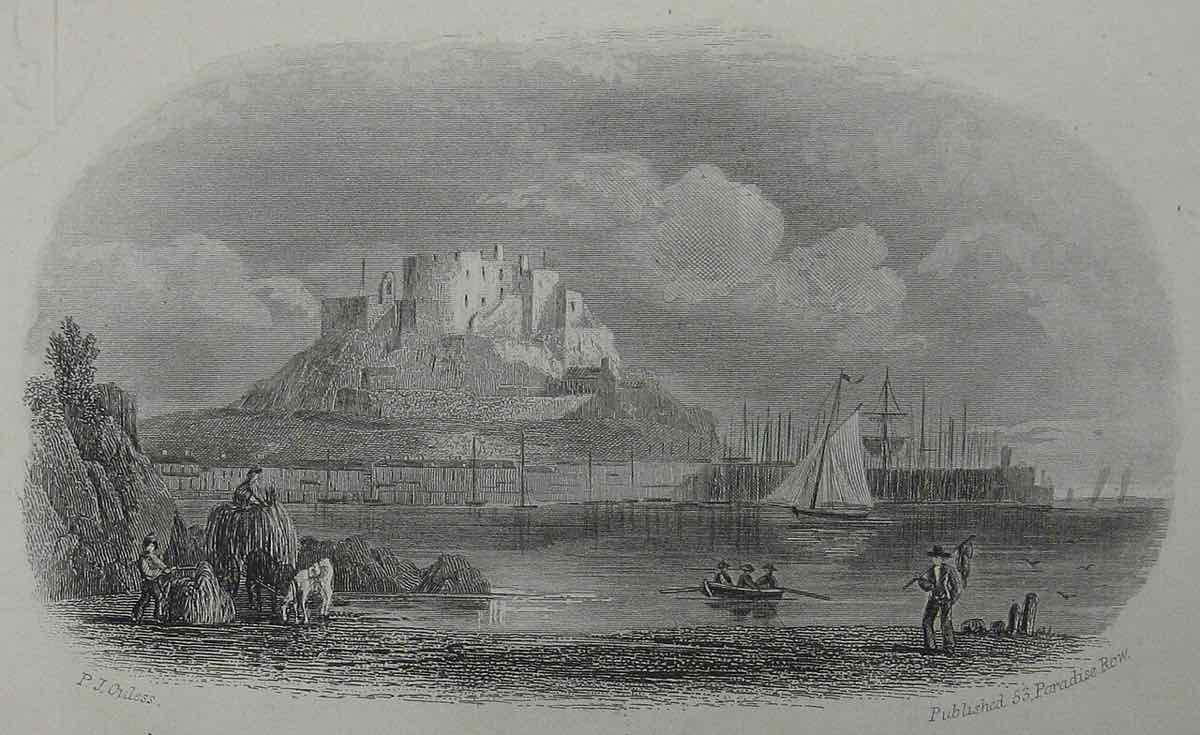
Mont Orgueil Castle in Jersey, painted by the 19th-century artist Philip John Ouless.
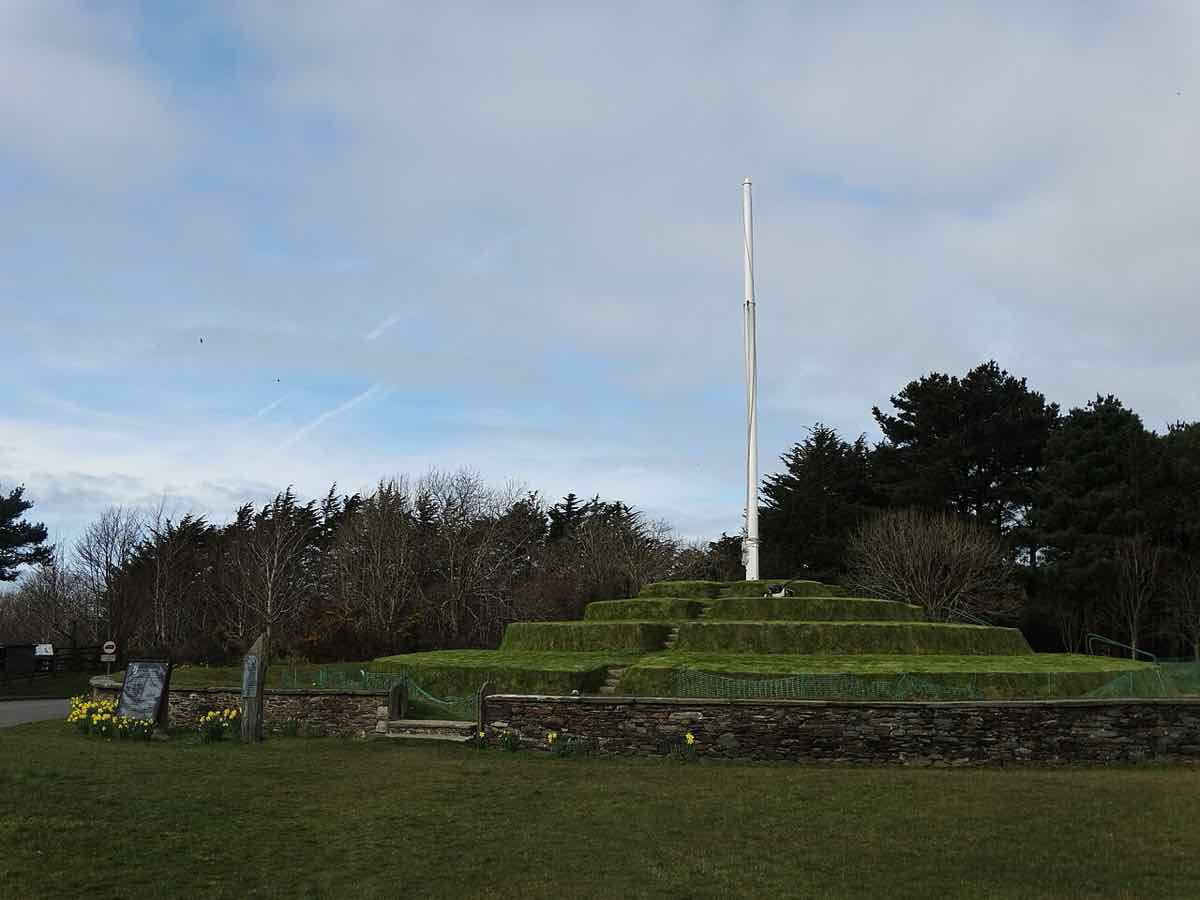
Painting: Philip John Ouless, public domain, via Wikimedia CommonsTynwald Hill in St John's on the Isle of Man. Every year on 5 July, the island's parliament reads out its new laws to the public here. The parliament's name, Tynwald, comes from Old Norse, the language of the Vikings, and means "the place where the assembly meets". Tynwald says it is the oldest parliament in the world that has never stopped meeting. Tradition dates it to 979, but that date is disputed, as no records from the time survive to prove it.
Photo: Neil Theasby / Geograph, CC BY-SA 2.0, via Wikimedia Commons
Quiz
Which of the following statements is correct?
The Isle of Man and the Channel Islands are Crown dependencies. They have their own governments and are not part of the UK.
Scattered around the world: British overseas territories
Elsewhere in the world there are several British overseas territories, such as St Helena and the Falkland Islands in the South Atlantic. They have links with the UK too, but they are not part of the UK.
Most overseas territories are left over from the British Empire. Besides these two, there are others such as Gibraltar at the southern tip of Spain, Bermuda in the Atlantic, and the Pitcairn Islands in the South Pacific. They reach as far as Antarctica.
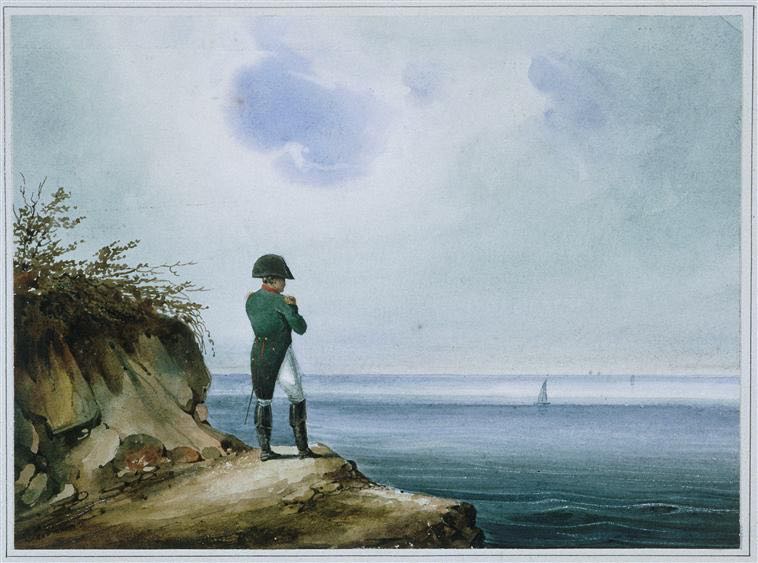
Some of these places have dramatic stories. St Helena is a lonely island in the middle of the South Atlantic, so far from any continent that Britain sent Napoleon there after defeating him at Waterloo in 1815; he died on the island in 1821 (see A Global Power). In 1982 Argentina invaded the Falkland Islands, and Britain sent a fleet of warships to take them back in the Falklands War (see Britain Since 1945). And on the Pitcairn Islands, home to only a few dozen people, many are descended from the sailors who seized the British ship HMS Bounty in a mutiny in 1789.
Napoléon à Sainte-Hélène (Napoleon on St Helena), a watercolour from around 1820.
Painting: Franz Xaver Sandmann, public domain, via Wikimedia Commons
Quiz
Which TWO of these are British overseas territories?
St Helena and the Falkland Islands are overseas territories. The Isle of Man and the Channel Islands are Crown dependencies. Neither group is part of the UK, but they have different names, and the test may try to mix them up.
Who governs the UK?
The UK is governed by the Parliament at Westminster in London. It is marked on the map with a small parliament building.
On top of that, Scotland, Wales and Northern Ireland each have their own parliament or assembly. The central government has handed over power in some areas to them. This is called devolution, and the powers they hold are called devolved powers. England has no parliament of its own; Westminster deals with England directly.
To find out how these three bodies were set up, see the History chapter Britain Since 1945. What each of them controls is explained in the topic "The UK government, the law and your role".
Quiz
Where does the parliament that governs the whole of the UK sit?
The UK Parliament sits at Westminster in London. Cardiff, Edinburgh and Belfast are home to the Welsh, Scottish and Northern Ireland parliaments or assemblies, which only have devolved powers.
Chapter summary
The UK
Four parts: England, Scotland, Wales and Northern Ireland
Rest of Ireland
The part of Ireland outside Northern Ireland is an independent country, not part of the UK
Official name
The United Kingdom of Great Britain and Northern Ireland
Great Britain
England, Scotland and Wales only; Northern Ireland is not included
Britain / British Isles / British
In the handbook, these mean everyone in the UK (the geographical British Isles also include the whole island of Ireland)
Crown dependencies
The Channel Islands and the Isle of Man: their own governments, not part of the UK
Overseas territories
For example St Helena and the Falkland Islands: linked to the UK, not part of it
Westminster
Home of the Parliament that governs the UK; Scotland, Wales and Northern Ireland have their own parliaments or assemblies with devolved powers