Every November, almost everyone in Britain seems to wear a small red paper flower: politicians, newsreaders, footballers, even the fronts of buses. It is a poppy, and it remembers the people who died in a war more than a hundred years ago. This chapter covers 1900 to 1945. In those years Britain fought two world wars, women won the vote, Ireland was divided in two, and the radio found its way into almost every home.
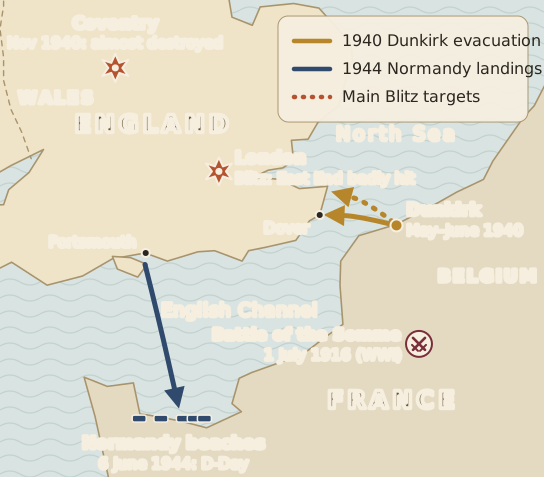
Places in this chapter. ⚔ marks the Battle of the Somme in the First World War, the gold arrows show the Dunkirk evacuation of 1940, the blue arrow shows the D-Day landings of 1944, and the red stars mark the two cities worst hit in the Blitz.
The early 1900s: a confident "superpower"
The first of those world wars was still more than ten years away when the 20th century began. In 1901 Queen Victoria died after almost 64 years on the throne. Her son Edward VII became king, followed in 1910 by George V. Britain at this time was full of confidence. It had an empire that stretched around the globe, a navy that people admired, busy industries and a stable political system. In today's language, it was a superpower.
As the country grew richer, the government began to do more for ordinary people. Many social reforms came in during these years:
Money to help people who were out of work
Old-age pensions for older people
Free school meals for children
New laws to make workplaces safer
Stricter town planning rules to stop slums from spreading
More help for mothers and children after a divorce or separation
Fairer, more democratic local government; and MPs began to be paid, so it was easier for ordinary people to go into politics
These reforms look small today, but they were a real start. The Old Age Pensions Act of 1908 paid people over 70 on low incomes 5 shillings a week; few people lived that long, but it was the first time the state gave money to older people. Free school meals began in 1906, partly because the government had found that many young men who tried to join the army were badly underfed. MPs were paid from 1911, at £400 a year; before that, being an MP was almost only for the rich.
Quiz
Which TWO social reforms were introduced in Britain in the early 20th century, before the First World War?
Old-age pensions and free school meals were both early 20th-century reforms. The NHS was only set up in 1948 (see the next chapter), and the voting age did not drop to 18 until 1969.
The First World War (1914–1918)
One shot that set Europe on fire
That confident age came to a sudden end. On 28 June 1914 Archduke Franz Ferdinand, the heir to the throne of Austria-Hungary, was shot dead in Sarajevo. Like the first domino falling, his murder led, step by step, to the First World War.
It very nearly did not happen. That morning the plotters had already failed once, when a bomb thrown at the Archduke's car missed it. In the afternoon he changed his plans to visit the people hurt by the bomb, but nobody told his driver, who took a wrong turn and stopped to reverse right in front of Gavrilo Princip, a 19-year-old member of the group. You will often read online that Princip was eating a sandwich in a shop nearby, but no record from 1914 supports this; it looks like a legend added later.
But the killing was only the spark. Several other forces had been building up for years and made war likely:
Nationalism putting your own nation first
Militarism building up big armies and navies
Imperialism competing for empires and colonies
Two rival camps Europe's great powers split into two alliances
The two sides
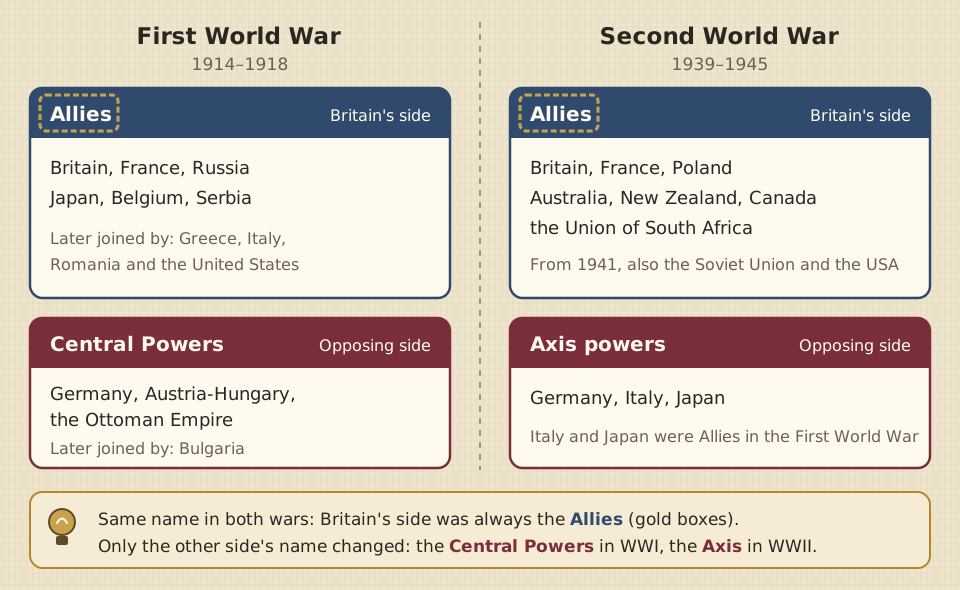
Most of the fighting was in Europe, but the war pulled in countries from all over the world. Britain's side was known as the Allies, and the other side as the Central Powers.
The two sides in each world war. Britain's side was called the Allies both times. What changed was the name of the enemy: the Central Powers in the First World War, and the Axis in the Second.
The whole Empire went to war
It was not only Britain itself that fought. The whole British Empire took part: more than a million Indian soldiers fought for Britain in many different countries, and about 40,000 of them lost their lives. Soldiers came, too, from Canada, Australia, New Zealand, Africa and the West Indies, and fought side by side with the British.
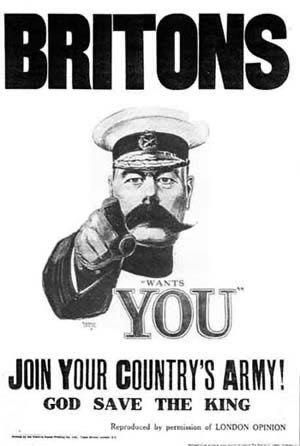
A recruitment poster from 1914. Lord Kitchener, the Secretary of State for War, points at you: your country needs you. At the start of the war, Britain's army relied entirely on volunteers.
Poster: Alfred Leete, Imperial War Museums Q 48378A, public domain, via Wikimedia Commons
The Somme: the worst day
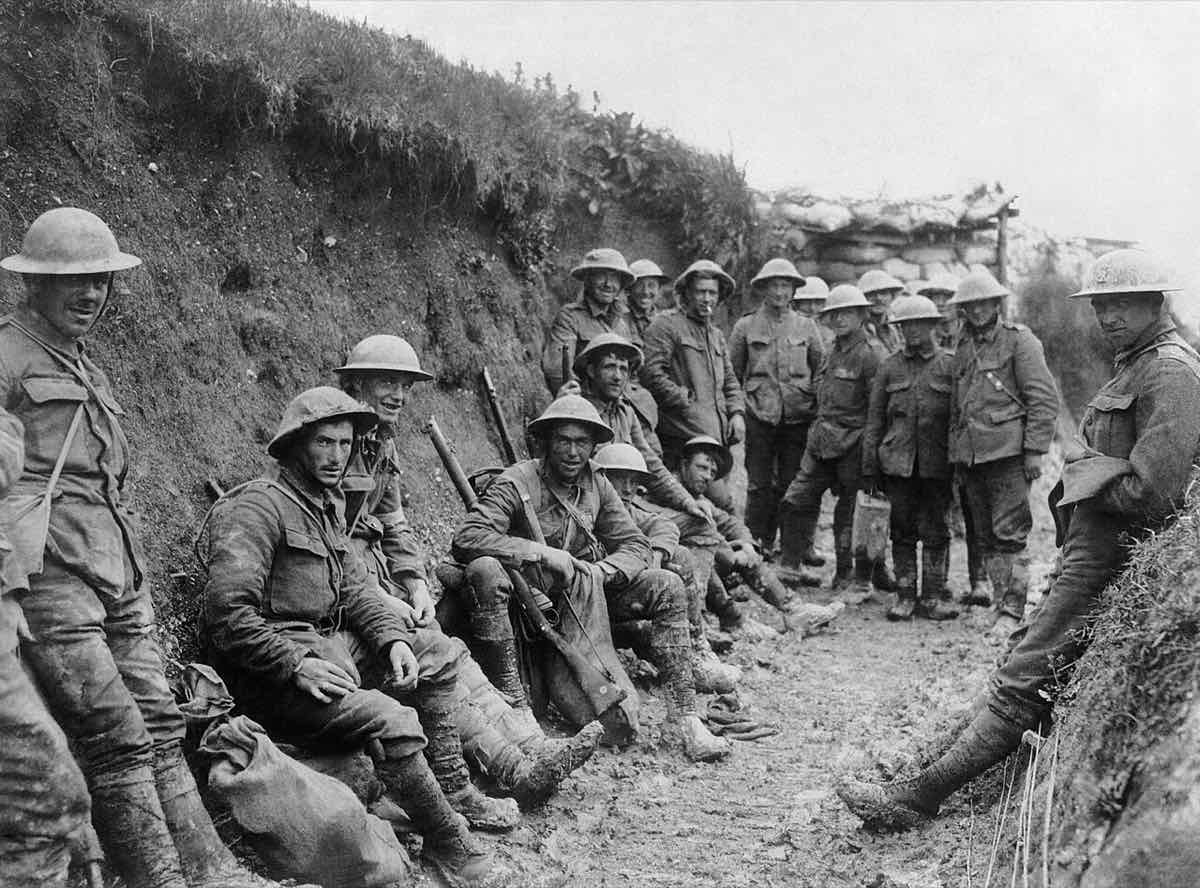
The war went on for four years, and millions of people were killed or wounded; Britain alone had more than 2 million casualties. The worst moment came in July 1916, when the British army attacked in northern France at the Battle of the Somme. On the very first day, there were about 60,000 British casualties.
Soldiers of the Royal Irish Rifles carrying supplies in a trench during the Battle of the Somme, July 1916. This photo is number one (Q 1) in the photo collection of the Imperial War Museums.
Photo: Royal Engineers No 1 Printing Company, Imperial War Museums Q 1, public domain, via Wikimedia Commons
11 o'clock on 11 November
At 11 o'clock in the morning on 11 November 1918, the armistice (the agreement to stop fighting) came into force. The First World War was over, and Britain and its allies had won.
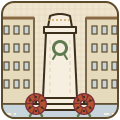
This day became Remembrance Day. People wear red poppies, because these flowers grew all over the battlefields of the First World War. At 11 am the country falls silent for two minutes. On Remembrance Sunday, the Sunday nearest to 11 November, the national ceremony is held at the Cenotaph, the war memorial in Whitehall, London, where wreaths are laid.
Poppies
Two minutes' silence at 11:00
The Cenotaph in Whitehall
The poppy became a symbol through a poem. In 1915 John McCrae, a Canadian army doctor, saw red poppies growing between the graves of fallen soldiers on the battlefields of Flanders in Belgium, and wrote In Flanders Fields. Since 1921 the Royal British Legion has sold poppies every year to raise money for former soldiers and their families, and it still does. Another memorial dates from the same years: on 11 November 1920 a soldier whose name nobody knew, the "Unknown Warrior", was buried in Westminster Abbey to stand for everyone whose body was never found.
The war even changed the royal family's name. The family was called "Saxe-Coburg and Gotha", which sounded very German at a time when Britain was fighting Germany, so in 1917 George V renamed it Windsor, after Windsor Castle. The royal family is still called Windsor today.
Quiz
Is the statement below TRUE or FALSE?
The assassination of Archduke Franz Ferdinand of Austria in 1914 triggered the events that led to the First World War.
True. Archduke Franz Ferdinand, the heir to the throne of Austria-Hungary, was shot dead on 28 June 1914, and his murder started a series of events that ended in war. The deeper causes were nationalism, militarism, imperialism and the split of Europe's great powers into two rival camps.
Quiz
Approximately how many British casualties were there on the first day of the Battle of the Somme in 1916?
About 60,000 casualties on the first day of the Somme, the worst single day in the history of the British Army. Don't confuse it with the "more than 300,000" men rescued from Dunkirk.
Quiz
Is the statement below TRUE or FALSE?
Fighting in the First World War stopped at 11 o'clock in the morning on 11 November 1918.
Remember the three elevens: the 11th hour of the 11th day of the 11th month. That is why Remembrance Day is on 11 November and the silence is at 11 am.
Quiz
Which of the following statements is correct?
In the First World War Japan was one of the Allies, on Britain's side, while the Ottoman Empire was one of the Central Powers. By the Second World War Japan had joined the Axis, which is easy to mix up.
Votes for women: 1918 and 1928
As the last chapter showed, from the late 19th century more and more women campaigned for the vote; they were known as suffragettes. During the war, huge numbers of women worked in factories, drove ambulances and farmed the land, and they kept the country going. When the war was over they finally won the vote, but in two steps:
1918
Women over 30 could vote and stand for Parliament. Men could vote from the age of 21.
1928
The voting age for women dropped to 21, at last the same as for men.
The first woman elected to the House of Commons, in the 1918 election, never actually took her seat. She was Constance Markievicz from Ireland, a member of Sinn Féin, the party that wanted Irish independence, and she refused to sit in London. The first woman to sit in the Commons was Nancy Astor, elected in 1919.
Quiz
In 1918, women over what age were given the right to vote?
30 in 1918; 21 in 1928, the same as men; and 18 for everyone in 1969. It is best to learn the three ages (30, 21, 18) together with the three years (1918, 1928, 1969).
Ireland is divided
To see how Ireland came to be divided, we need to go back to the years just before the First World War, when the Irish question was coming to a head. The British government planned to give Ireland Home Rule: a parliament of its own, while staying part of the UK. Protestants in the north were strongly against it, and even threatened to fight it by force. Over the next ten years, tension kept rising:
1913The British government promises Ireland Home Rule and puts a Home Rule bill before Parliament; Protestants in the north threaten armed resistance
1914The First World War breaks out and the government puts off reform in Ireland; Irish nationalists are not willing to wait
1916The Easter Rising against British rule breaks out in Dublin; its leaders are executed under military law, and a guerrilla war against the British army and police follows
1921The two sides sign a peace treaty
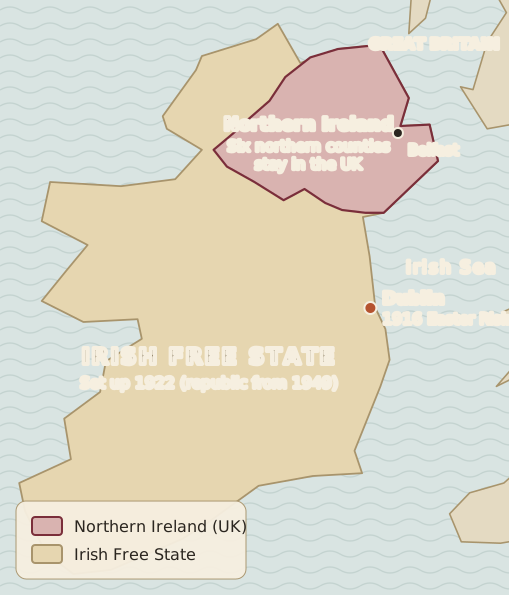
1922Ireland is split in two: six counties in the north, where most people are Protestant, stay in the UK as Northern Ireland; the rest becomes the Irish Free State
1949The Irish Free State becomes a republic
Ireland in 1922: six counties in the north-east became Northern Ireland and stayed in the UK; the rest of the island became the Irish Free State.
But some people, in both the north and the south, would not accept the split. They wanted the whole of Ireland to be one independent country. Years of division later turned into terrorist violence in Northern Ireland and elsewhere. This conflict is known as the Troubles, and you will meet it again in the next chapter.
Quiz
In which year did the Irish Free State become a republic?
1949. Keep the Irish dates in order: the Easter Rising in 1916, the peace treaty in 1921, the split into Northern Ireland and the Irish Free State in 1922, and a republic in 1949.
Quiz
Is the statement below TRUE or FALSE?
In 1922 the whole of Ireland left the United Kingdom and became the Irish Free State.
The word "whole" makes it false. The six mainly Protestant counties in the north stayed in the UK as Northern Ireland; only the rest became the Irish Free State.
Between the wars: depression, cars and radio
Back in Britain, the two decades after the First World War brought both good times and hard ones. In the 1920s life got better for many people. Public housing improved, and lots of new homes went up in towns and cities.
But in 1929 the whole world sank into the Great Depression, and some parts of Britain saw mass unemployment. The Depression of the 1930s hit different places in very different ways:
Old heavy industries such as shipbuilding suffered badly.
New industries such as cars and aviation (making aircraft) grew.
Prices generally fell, so people who still had jobs had more money to spend. Between 1930 and 1939 the number of cars in Britain doubled, from 1 million to 2 million.
It was also a lively time for culture. The novelists Graham Greene and Evelyn Waugh became famous, and the economist John Maynard Keynes published new ideas about the economy that had a big influence. The BBC began radio broadcasting in 1922, and in 1936 it started the world's first regular television service.
The BBC did not begin as a public broadcaster. In 1922 it was the British Broadcasting Company, set up by several radio makers who wanted people to buy radios. In 1927 it became the British Broadcasting Corporation, the public body we know today; both names are shortened to BBC.
A side note: television (John Logie Baird), radar (Robert Watson-Watt), the jet engine (Frank Whittle), the Turing machine (Alan Turing) and insulin (John Macleod) all came from the 1920s and 1930s. They are covered with the other 20th-century British inventions in the next chapter, under "Before the war". Alexander Fleming, who discovered penicillin, is at the end of this chapter.
Quiz
In which year did the BBC start radio broadcasts?
Radio started in 1922; the TV service came in 1936. 1901 is the year Queen Victoria died, and 1948 is when the NHS began. To remember: first sound (1922), then pictures (1936).
The Second World War (1939–1945)
Hitler and the road to war
The Depression hit Germany especially hard, and many desperate voters there turned to extreme parties. In 1933 Adolf Hitler took power in Germany. He thought the terms the Allies had forced on Germany after the First World War were unfair, and he wanted to win more land for Germans. He began to tear up and renegotiate treaties, build up Germany's weapons, and try out its military strength on neighbouring countries. At first the British government did everything it could to avoid another war.
In 1939 Hitler invaded Poland. To stop him going any further, Britain and France declared war on Germany. The British king at this time was George VI, who had come to the throne in 1936.
At the start, the war was between the Axis powers and the Allies. The Axis was made up of Fascist Germany, Italy and the Empire of Japan. The Allies included the UK, France and Poland, along with Australia, Canada, New Zealand and the Union of South Africa. (See the chart of the two sides in the First World War section above.)
Quiz
Which TWO statements about how the Second World War began are correct?
Hitler's invasion of Poland in 1939 was the turning point: Britain and France then declared war on Germany to stop him going any further. Hitler took power in 1933, but for years after that the British government tried to avoid another war. The German advance through France came in 1940, when the war had already begun.
Churchill: the Prime Minister who would not surrender
Hitler had already occupied Austria and invaded Czechoslovakia and Poland. Next he took Belgium and the Netherlands. In 1940 German forces beat the Allied armies and swept through France. At this moment of great danger for the country, Winston Churchill became Prime Minister and led Britain in the war.
Churchill (1874–1965) was the son of a politician. He had been a soldier and a newspaper reporter, and in 1900 he was elected to Parliament as a Conservative. He became Prime Minister in May 1940. He would not give in to the Nazis, and he gave the whole country courage at its hardest moment. People still quote his wartime speeches today:
1940: his first speech to MPs as Prime Minister “… nothing to offer but blood, toil, tears and sweat”
In plain words: this will be very hard, and all I can promise is hard work and sacrifice. ("Toil" means hard work.)
1940: speech to MPs after Dunkirk “We shall fight on the beaches … we shall never surrender”
In plain words: even if the enemy lands in Britain, we will keep fighting and never give up.
1940: speech to MPs during the Battle of Britain “… so much owed by so many to so few”
In plain words: never in any war have so many people owed so much to such a small group, the pilots of the RAF.
What happened to him after the war also comes up in the test. Churchill lost the general election in 1945, but he was back as Prime Minister in 1951. He stayed an MP until the 1964 general election, and when he died in 1965 he was given a state funeral. In a public vote in 2002, the British chose him as the greatest Briton of all time.
His road to the top was not a straight one. He did become a Conservative MP in 1900, but in 1904 he crossed over to the Liberals, and only went back to the Conservatives twenty years later. He is supposed to have joked: "Anyone can rat, but it takes a certain amount of ingenuity to re-rat" ("to rat" means to desert your side), though where the line really comes from is not certain. He also wrote many books of history and memoirs, and in 1953 he won the Nobel Prize in Literature, not the Peace Prize.
Quiz
Which TWO statements about Winston Churchill are correct?
Churchill became a Conservative MP in 1900 and was voted the greatest Briton in 2002. He lost the 1945 general election, which was won by Labour's Clement Attlee. The Prime Ministers during the First World War were H. H. Asquith and David Lloyd George, not Churchill.
Dunkirk: 300,000 men rescued from the beaches
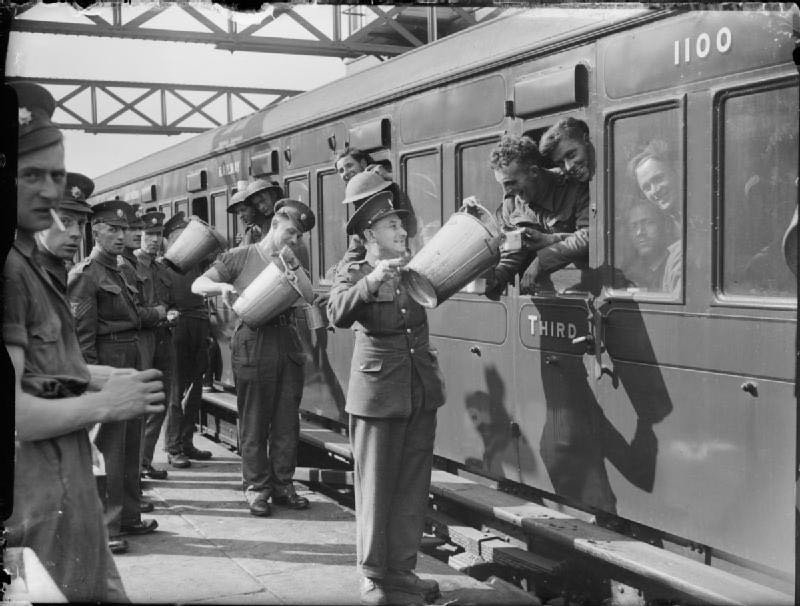
As France fell, British and French troops were trapped by the German army at Dunkirk, on the coast of northern France. Britain decided to bring them home in a huge operation by sea. As well as the Navy, many ordinary people offered to sail their own small boats, such as pleasure boats and fishing boats, across the Channel to help. Together they brought more than 300,000 men back from the beaches around Dunkirk.
Many lives were lost and a great deal of equipment was left behind, but the evacuation was still a success, because it meant Britain could carry on fighting Germany. It also gave English a new phrase, "the Dunkirk spirit", which means people sticking together and refusing to give up when times are hard.
Addison Road station, London, 31 May 1940. Soldiers just back from Dunkirk are handed hot tea on the train.
Photo: Mr Saidman, War Office official photographer, Imperial War Museums H 1630, public domain, via Wikimedia Commons
Quiz
Which of the following statements is correct?
Dunkirk was in 1940, when British troops were getting out of Europe; D-Day in 1944 was when the Allies went back in. One out, one in, four years apart.
The Battle of Britain and the Blitz
Hitler wanted to invade Britain, but before he could send soldiers across the sea, Germany had to control the skies. So the German air force attacked Britain from the air. Britain fought back hard with its fighter planes and, in the summer of 1940, won this vital battle in the air, known as the Battle of Britain. The two key planes for the RAF (the Royal Air Force) were the Spitfire and the Hurricane, both designed and built in Britain.
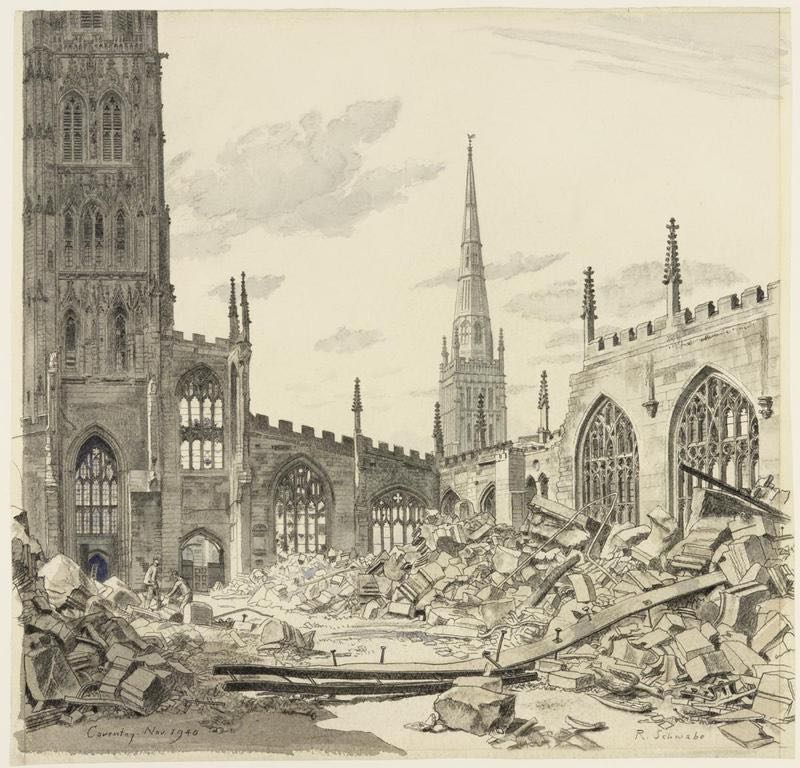
Even after losing the air battle, the German air force kept on bombing London and other cities at night. This was the Blitz. Coventry was almost completely destroyed, and other cities suffered badly too, especially the East End of London.
Even with their homes in ruins, people in Britain showed great courage and refused to be beaten. Today, when British people talk about "the Blitz spirit", they mean everyone helping each other through hard times.
After the air raid on the night of 14 November 1940, only the outer walls and the tower of Coventry's medieval cathedral were left. An official war artist painted this soon after the raid. After the war a new cathedral was built next to the ruins, which were kept as a symbol of peace and remembrance.
Painting: Randolph Schwabe, Imperial War Museums, public domain, via Wikimedia Commons
The Blitz lasted from September 1940 to May 1941, and more than 40,000 civilians were killed. Every night thousands of Londoners took blankets down into Underground stations to sleep. Buckingham Palace was hit too, and Queen Elizabeth (later known as the Queen Mother) is reported to have said that now she could look the people of the bombed East End in the face. George VI and his family stayed in Britain for the whole war instead of moving abroad.
The Battle of Britain pilots became known as "the Few", the "so few" of Churchill's famous line. Many of them came from other countries; No. 303 Squadron, made up of Polish pilots, had an especially strong record.
Quiz
In the Battle of Britain, which TWO aircraft did the most to help the RAF defend the country?
The Spitfire and the Hurricane. Concorde was a supersonic passenger plane that first flew in 1969, and the Harrier jump jet was also a post-war invention; you will meet both in the next chapter.
War around the world
While Britain was defending itself at home, its forces were also fighting the Axis in many other parts of the world. In Asia, Japan defeated the British at Singapore and then occupied Burma, which put India in danger.
In 1941, two events changed the course of the war:
In December, Japan bombed the US naval base at Pearl Harbor, and the United States joined the war.
In the same year, Hitler launched the biggest invasion in history by attacking the Soviet Union. Both sides lost huge numbers of people, and in the end the Soviets pushed the Germans back. This was a turning point in the war.
Little by little, the Allies got the upper hand, with important victories in North Africa and Italy. Germany's heavy losses in the Soviet Union, together with American support, finally made the Allies strong enough to take on Hitler's armies in western Europe.
D-Day: the Normandy landings
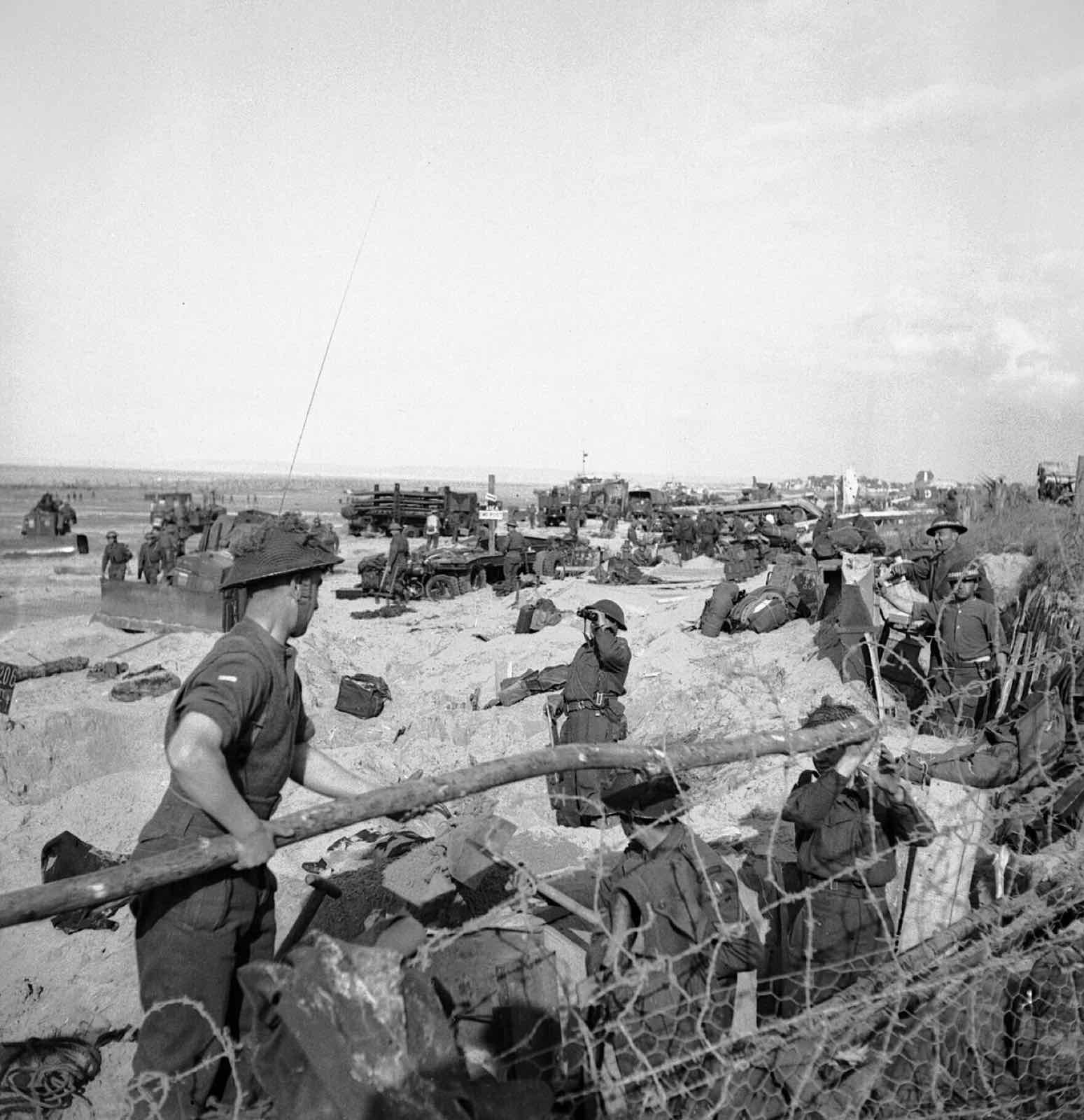
On 6 June 1944, Allied troops landed in Normandy in France, a day usually known as D-Day. After winning on the Normandy beaches, they fought their way across France and finally into Germany.
British troops and naval beach parties on Sword Beach, Normandy, 6 June 1944.
Photo: Capt. Knight, No 5 Army Film & Photographic Unit, Imperial War Museums B 5116, public domain, via Wikimedia Commons
The "D" does not stand for anything special: it simply means "day". The military used "D-Day" for the day an operation begins, with D-1 for the day before and D+1 for the day after, so a change of date did not mean rewriting the whole plan. That mattered here, because the landings were first planned for 5 June and bad weather put them back by a day. More than 150,000 Allied soldiers landed on five beaches: Utah and Omaha (American), Gold and Sword (British) and Juno (Canadian).
Quiz
On what date did allied forces land in Normandy, in what is often called D-Day?
6 June 1944. The other three dates are all in this chapter too: 11 November 1918 is the end of the First World War, 1 July 1916 is the first day of the Somme, and 8 May 1945 is VE Day (Victory in Europe Day).
Victory: first Germany, then Japan
In May 1945 the Allies completely defeated Germany. The war against Japan went on until August 1945, when the United States dropped its new atomic bombs on Hiroshima and Nagasaki in Japan. Japan then surrendered, and the war was over.
British scientists had a part in the story of the atomic bomb. A team led by the New Zealand-born physicist Ernest Rutherford, working first at the University of Manchester and later at the University of Cambridge, were the first to "split the atom". Later, a number of British scientists joined the Manhattan Project, the American programme that built the atomic bomb.
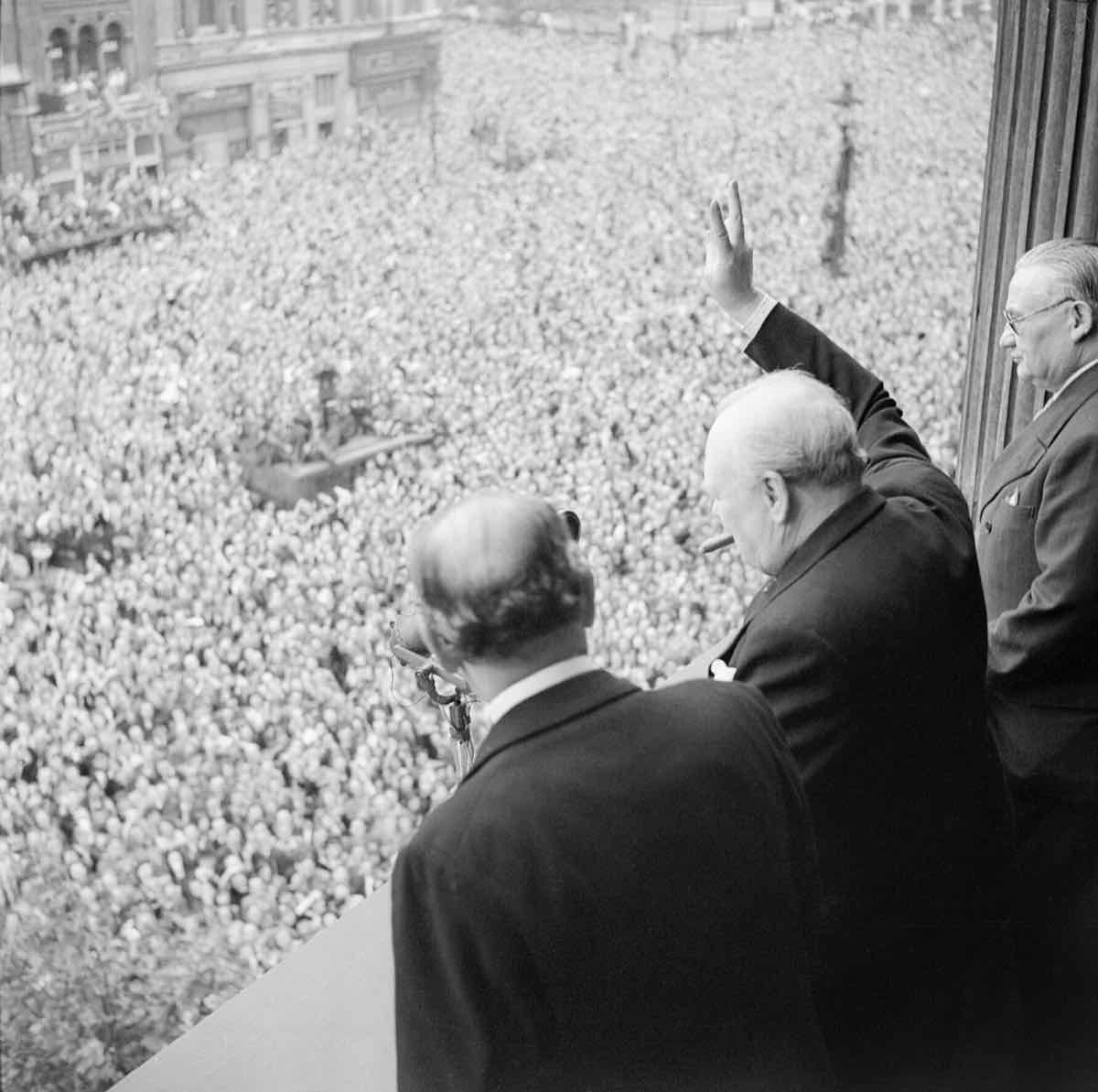
VE Day, 8 May 1945: from the balcony of the Ministry of Health in Whitehall, London, Churchill makes the V for victory sign to the crowds. That evening 19-year-old Princess Elizabeth (later Queen Elizabeth II) and her sister, Princess Margaret, were allowed by their father, George VI, to slip out of Buckingham Palace with a group of officers and join the crowds. Nobody recognised them, and many years later the Queen remembered it as one of the most memorable nights of her life.
Photo: Major W. G. Horton, War Office official photographer, Imperial War Museums H 41849, public domain, via Wikimedia Commons
Quiz
Which of the following statements is correct?
Scientists led by Rutherford were the first to split the atom. Germany was defeated in May 1945, but the war against Japan only ended in August 1945, after the atomic bombs were dropped.
Fleming and penicillin
We end this chapter with a Scot who changed medicine: Alexander Fleming (1881–1955). Born in Scotland, he moved to London in his teens and went on to train as a doctor. In 1928, while he was studying flu, he discovered penicillin.
But Fleming only made the discovery. Turning penicillin into a medicine that people could actually take was the work of two other scientists, Howard Florey and Ernst Chain, and by the 1940s it was being made in huge quantities. In 1945 Fleming received the Nobel Prize in Medicine, and doctors still use penicillin to treat infections caused by bacteria.
The discovery began with an untidy bench. In the summer of 1928 Fleming came back from holiday to his laboratory in London and found that a dish of bacteria he had left out had grown mould, and that all the bacteria around the mould had died. Instead of throwing the dish away, he set out to find out why, and that led him to penicillin. The 1945 Nobel Prize was in fact shared by three people: Fleming, Florey and Chain.
With the war in Europe won, Britain held its first general election for ten years in July 1945. What the voters chose would shape the country for decades to come.
Quiz
Who discovered penicillin in 1928?
Fleming discovered penicillin, and Florey and Chain turned it into a medicine. The other three are on the next chapter's list of 20th-century British inventions: Macleod is insulin, Watson-Watt is radar and Crick is the structure of DNA. Matching inventors to their inventions is a very common type of question.
Chapter summary
Early 1900s reforms
Old-age pensions, free school meals, help for the unemployed, safer workplaces, slum prevention; MPs paid for the first time
28 June 1914
Archduke Franz Ferdinand assassinated, leading to the First World War (1914–1918)
Allies vs Central Powers
First World War: the Allies (Britain, France, Russia, Japan, Belgium, Serbia) against the Central Powers (Germany, Austria-Hungary, the Ottoman Empire)
British Empire
More than a million Indians fought and about 40,000 died; Britain had over 2 million casualties
1916 Somme
About 60,000 British casualties on day one
11.00 am, 11 Nov 1918
End of the First World War; Remembrance Day, poppies, the Cenotaph in Whitehall
1918 / 1928 votes
1918: women over 30; 1928: women at 21, the same as men
Ireland 1916–1922
1916 Easter Rising; 1921 treaty; 1922 split into Northern Ireland (stays in the UK) and the Irish Free State; a republic from 1949
1929 Great Depression
Shipbuilding hit hard, cars and aviation grew; cars rose from 1 million to 2 million
BBC 1922 / 1936
Radio from 1922; the world's first regular TV service in 1936
1939
Hitler (in power from 1933) invades Poland, and Britain and France declare war; the Axis: Germany, Italy, Japan
Churchill
Prime Minister from May 1940; Conservative; lost in 1945, Prime Minister again in 1951; greatest Briton in 2002
1940 Dunkirk
Civilian small boats help the Navy rescue more than 300,000 men; the Dunkirk spirit
1940 Battle of Britain
The Spitfire and the Hurricane
The Blitz
Coventry almost destroyed, the East End badly hit; the Blitz spirit
1941
Pearl Harbor brings the USA into the war; Germany invades the Soviet Union
6 June 1944 D-Day
Allied landings in Normandy
May / Aug 1945
Germany defeated in May; Japan surrenders in August after Hiroshima and Nagasaki; Rutherford's team first split the atom, and British scientists later joined the Manhattan Project
1928 Fleming
A Scot who discovered penicillin; Florey and Chain made it into a medicine, mass-produced in the 1940s; Nobel Prize in Medicine 1945
 Poppies
 Two minutes' silence at 11:00
 The Cenotaph in Whitehall