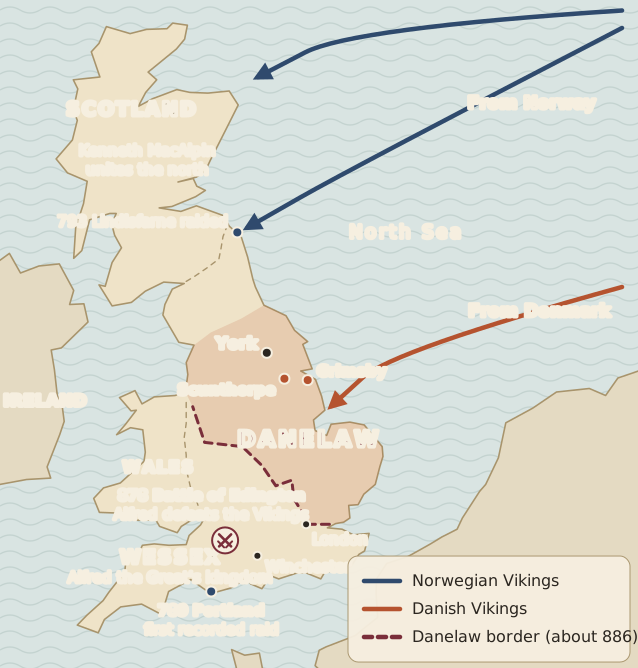
In 597 St Augustine brought Christianity from Rome to Kent. For almost two centuries after that, monasteries and churches spread across the Anglo-Saxon kingdoms. Then a new danger came from across the sea. In AD 789 the Vikings came to Britain for the first time. Their homelands were Denmark, Norway and Sweden. At first they came to raid towns on the coast, taking goods and carrying people off as slaves. Later some of them stayed and built communities of their own in eastern England and in Scotland.
The first visit went badly from the start. The Anglo-Saxon Chronicle records three ships landing at Portland in Dorset, in the south of England. The king's local official (the reeve) took them for traders and rode out to tell them to report to the king's town, and they killed him on the spot. It is the first recorded Viking attack on England. Oddly, the Chronicle calls them "the first ships of Danish men" while saying they came from Hordaland, in Norway: at the time the English often called all Vikings "Danes".
Quiz
Which of the following statements is correct?
The Vikings set out from Denmark, Norway and Sweden, and their first raid on Britain was in 789. Normandy was William's homeland in 1066, and 410 is the year the Romans left.
The Danelaw (pale red) was roughly the north-eastern half of England, beyond a line running north from London along the River Thames, the River Lea and the old Roman road called Watling Street. The border shown is approximate, and the real area changed over time.
Alfred the Great: the only native English king called "the Great"
Under threat from the Vikings, the Anglo-Saxon kingdoms of England came together under Alfred the Great, and he defeated the Vikings. England has only ever had one King Alfred, so he has no number after his name.
In 878 Alfred beat the Viking leader Guthrum at the Battle of Edington. Guthrum surrendered and was baptised as a Christian, with Alfred as his godfather.
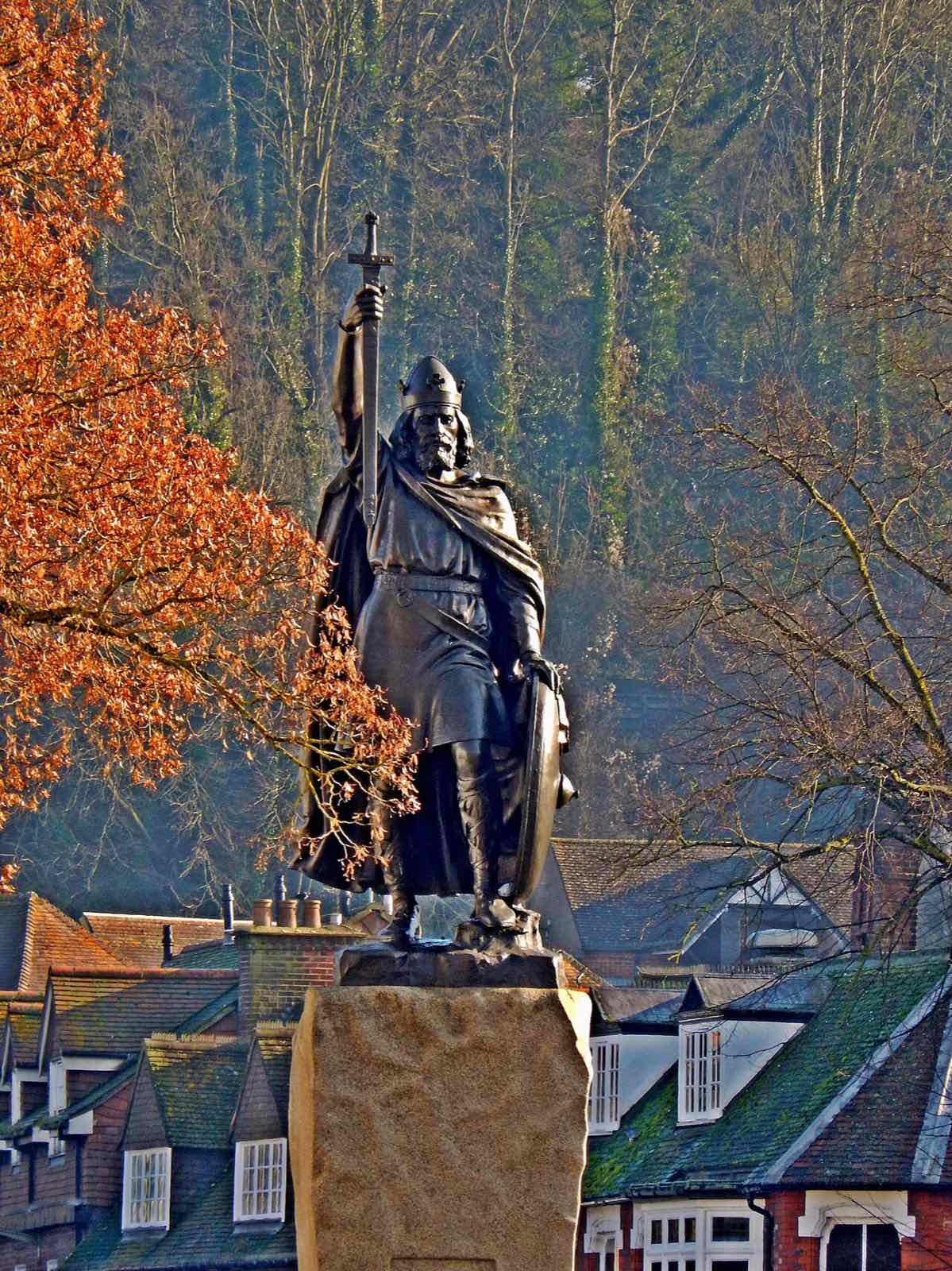
The statue of Alfred the Great in Winchester, an important city in his kingdom of Wessex.
Photo: NickDenbow, CC BY-SA 4.0, via Wikimedia Commons
Alfred came close to losing everything first. Early in 878 the Vikings caught him by surprise, and he had to hide in the marshes of south-west England. The story goes that he stayed with a peasant woman who asked him to watch some cakes (small loaves) baking by the fire. Alfred was so busy thinking about his kingdom that he let them burn, and the woman, who had no idea he was the king, told him off. It is a legend, not something written down at the time, but almost every British child has heard it.
Quiz
Which king united the Anglo-Saxon kingdoms in England and defeated the Vikings?
It was Alfred the Great. Cnut was a Danish king; Kenneth MacAlpin united the north, in what became Scotland; and Edward the Confessor was the king whose death in early 1066 opens the story of 1066.
The Danelaw: Vikings in place names
Many Vikings settled for good, above all in eastern and northern England. This area was called the Danelaw, which means the area where Danish law applied.
Even today, many place names there come from the Viking languages, such as Grimsby and Scunthorpe. Over time the Viking settlers blended in with the local people, and some became Christians.
-by
Old Norse for "village" or "farm" Grimsby, Derby
-thorpe
"a small outlying settlement" Scunthorpe
sky
from Old Norse
window vindauga = "wind eye"
Look closer and the Viking roots show up everywhere. In the Domesday Book, Scunthorpe is written Escumesthorpe, "Skuma's farm", and the -by in Grimsby is Old Norse for "village". Everyday words came too: sky, egg, knife and even they. Window was once vindauga, a "wind eye": a hole in the wall that let the wind in.
Quiz
Which TWO place names in England come from the Viking languages?
Look at the endings: -by and -thorpe come from the Vikings. The names Canterbury and Winchester come from older Anglo-Saxon and Latin.
Quiz
Is the statement below TRUE or FALSE?
The Danelaw was the area in the south-west of England where most Viking invaders settled.
False. The Danelaw was in the east and north of England. The south-west was Alfred the Great's kingdom of Wessex. Look at the map above: Grimsby and Scunthorpe are both in the east.