1853–1856
The Crimean War and Florence Nightingale
The Victorian age was mostly peaceful at home, but Britain still fought wars abroad. The Crimean War (1853–1856) saw Britain, Turkey and France fighting together against Russia. It was the first war that the media reported on in depth, with news reports and photographs. Conditions were very poor, and many soldiers died not from their wounds but from illnesses they caught in hospital.
During the war Queen Victoria introduced the Victoria Cross, a medal to honour acts of bravery by members of the armed forces.
The medal has a story of its own. Traditionally the Victoria Cross is said to be made from Russian cannons captured in the Crimean War, but one historian's research found that the metal for medals given out from the 20th century onwards actually came from two Chinese cannons. This is still debated.
Florence Nightingale (1820–1910) had English parents but was born in Italy. When she was 31 she went to Germany to train as a nurse. In 1854 she travelled to an army hospital in Turkey to look after soldiers wounded in the Crimean War. With other nurses, she improved conditions in the hospital and brought the death rate down. In 1860 she founded a school to train nurses, the Nightingale Training School, at St Thomas' Hospital in London. It was the first school of its kind, and it still exists. She is often seen as the founder of modern nursing.
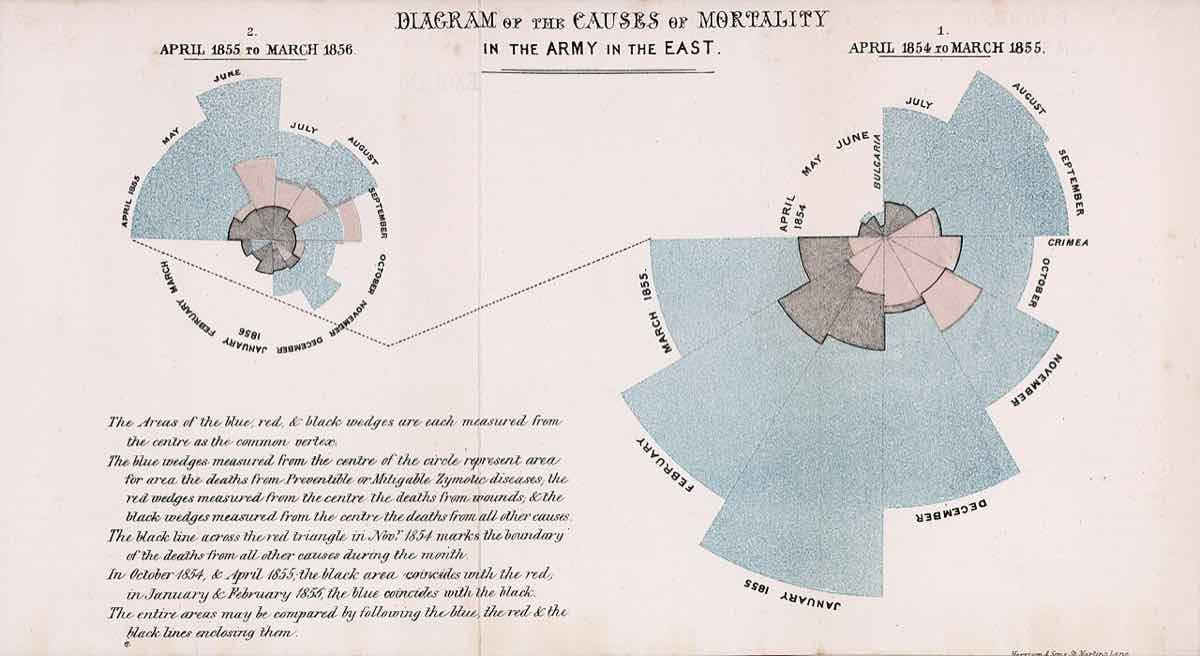
She was named after Florence, the Italian city where she was born. Because she checked on the wards at night carrying a lamp, the newspapers called her "The Lady with the Lamp". She was also very good at maths: she used charts like the one below to persuade the government to improve hygiene in the army, and in 1858 she became the first woman member of the Royal Statistical Society.
Quiz
Which of the following statements is correct?
The Victoria Cross was introduced during the Crimean War (1853–1856). The Boer War (1899–1902) only began near the end of Victoria's life, when the medal had already existed for almost half a century.