During the years when Britain and France were at war, from the French Revolution to Napoleon, the shape of the country itself changed. Ireland had shared a king with England and Wales since the time of Henry VIII, but it was still a separate country. In 1801, under the Act of Union of 1800, Ireland was formally joined with England, Scotland and Wales.
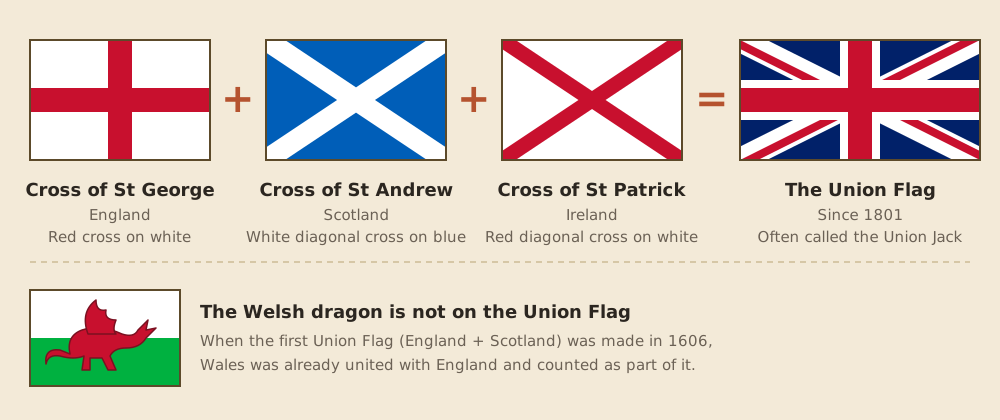
The flag changed too. The new Union Flag, often called the Union Jack, laid the crosses of the patron saints of England, Scotland and Ireland on top of each other. It is still the official flag of the UK today.
How the Union Flag is put together. Look closely and you'll see the red diagonal stripes are not in the middle of the white ones. This lets both the Scottish and the Irish crosses show, and it means the flag has a right way up: flying it upside down is seen as disrespectful.
The cross of St George: patron saint of England, a red cross on a white background.
The cross of St Andrew: patron saint of Scotland, a white diagonal cross on a blue background.
The cross of St Patrick: patron saint of Ireland, a red diagonal cross on a white background.
Wales has its own official flag too, showing a red dragon (the Welsh dragon). But the dragon is not on the Union Flag. This is because when the first Union Flag was made in 1606, from the flags of England and Scotland, the Principality of Wales was already united with England.
The flag also has two names. Some people insist it should only be called the Union Jack when it flies on a ship, and the Union Flag everywhere else, but the Flag Institute, a UK organisation that studies flags, says both names are fine. You may see either name in the test; they mean the same flag.
Quiz
Which TWO of the following appear on the Union Flag?
The Union Flag has the crosses of St George, St Andrew and St Patrick. Neither the Welsh dragon nor the cross of St David, the patron saint of Wales, is on it, because Wales was already joined to England when the first Union Flag was made.
Quiz
In which year did Ireland become unified with England, Scotland and Wales?
Under the Act of Union of 1800, Ireland was formally joined to the rest in 1801, and the flag changed to the Union Flag with the cross of St Patrick added. 1707 is when England and Scotland were united; 1606 is when the first Union Flag appeared (with only the English and Scottish crosses); and 1922 is when Ireland was divided and most of it became independent.
Quiz
Is the statement below TRUE or FALSE?
The cross of St Andrew, patron saint of Scotland, is a diagonal red cross on a white ground.
False. The cross of St Andrew is a white diagonal cross on a blue background. The red diagonal cross on white is St Patrick's cross, for Ireland, and England's cross of St George is an upright red cross on white.