In England, Wales and Northern Ireland, serious criminal cases are tried in the Crown Court, by a judge and a jury.
Serious cases in Scotland go to a Sheriff Court, either by a sheriff (a judge) alone or by a sheriff with a jury. The most serious cases, such as murder, go to the High Court of Justiciary (often just called the High Court), where they are heard by a judge and a jury.
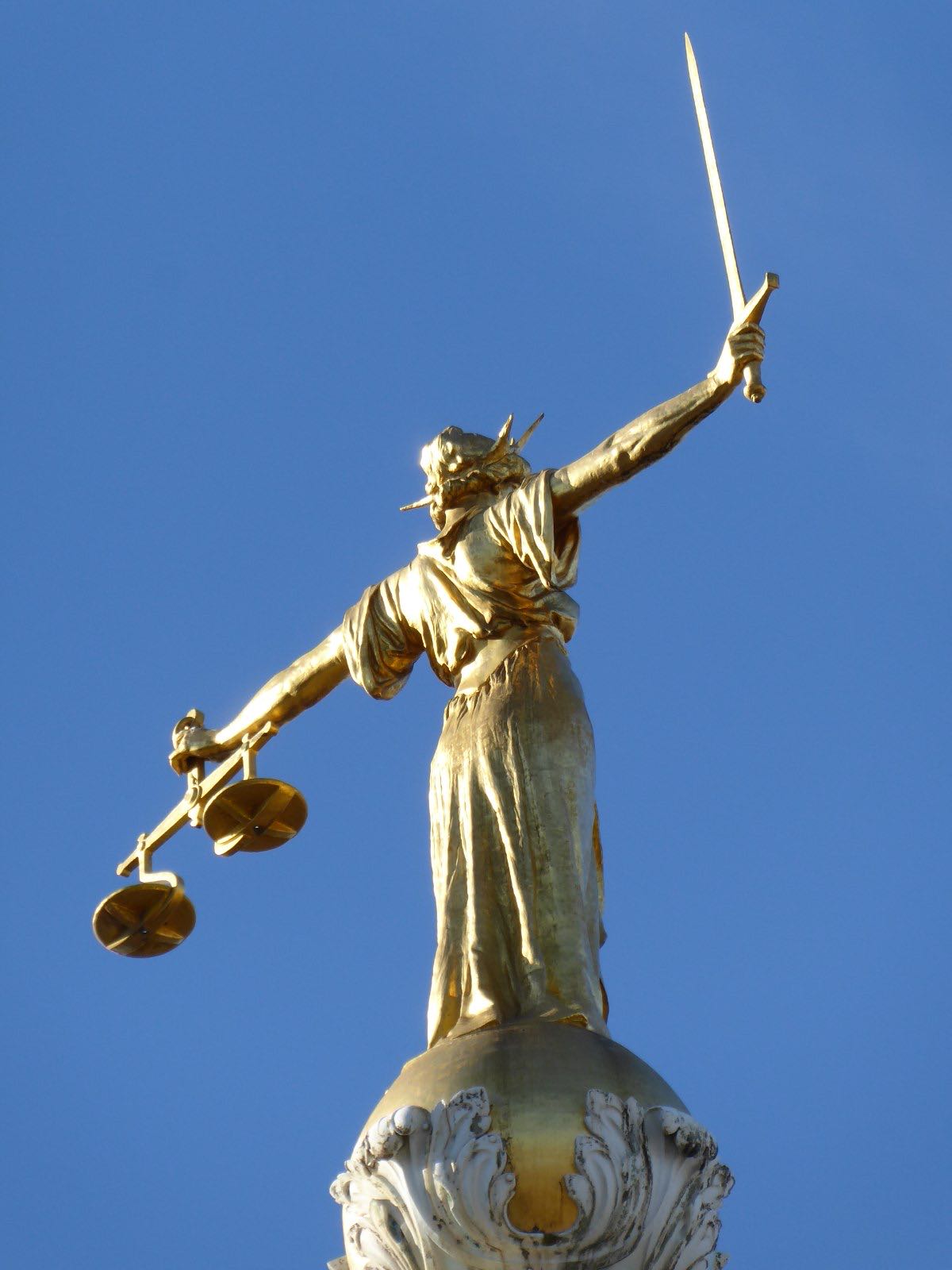
The Central Criminal Court in London, known as the Old Bailey. On top of the dome, Lady Justice holds a sword in her right hand and scales in her left. Unlike many statues of Lady Justice, this golden figure from the early 1900s wears no blindfold. Many famous trials have taken place in the court below.
Photo: Philip Halling / Geograph, CC BY-SA 2.0, via Wikimedia Commons
A jury is a group of ordinary people, picked at random from the local electoral register (the list of voters):
England, Wales and Northern Ireland: 12 people
Scotland: 15 people
If you receive a summons (an official letter calling you), you must serve on the jury, unless you are not eligible (for example, because you have a criminal record) or you have a good reason to be excused (for example, illness). Jurors listen to the evidence in court and then reach a verdict of "guilty" or "not guilty". In Scotland there is a third possible verdict: "not proven". If the jury finds someone guilty, the judge decides the punishment, not the jury.
The Justiciary Building beside the Royal Mile in Edinburgh, where Scotland's High Court of Justiciary sits. When it was finished in 1937 it was the Sheriff Court; in the early 1990s it was handed over to the High Court.
Photo: Enric, CC BY-SA 4.0, via Wikimedia Commons
Quiz
Which TWO statements about juries are correct?
Juries in England, Wales and Northern Ireland have 12 members; in Scotland they have 15. The jury only decides guilty or not guilty: the judge decides the punishment.
Quiz
In Scotland, where are the most serious criminal cases, such as murder, heard?
In Scotland, the most serious cases are heard in the High Court, by a judge and jury. Other serious cases go to the Sheriff Court. The Crown Court belongs to the system in England, Wales and Northern Ireland, and Justice of the Peace Courts and Magistrates' Courts deal only with minor cases.
Quiz
Is the statement below TRUE or FALSE?
In Scotland, a jury can reach a verdict of 'not proven' as well as 'guilty' or 'not guilty'.
True. Juries in England, Wales and Northern Ireland have just two verdicts, 'guilty' and 'not guilty'. Scotland has a third: 'not proven'.