The first principle of UK law is simple: everyone is equal before the law. Whoever you are and wherever you come from, the law treats you by the same rules as everyone else.
The law falls into two broad kinds:
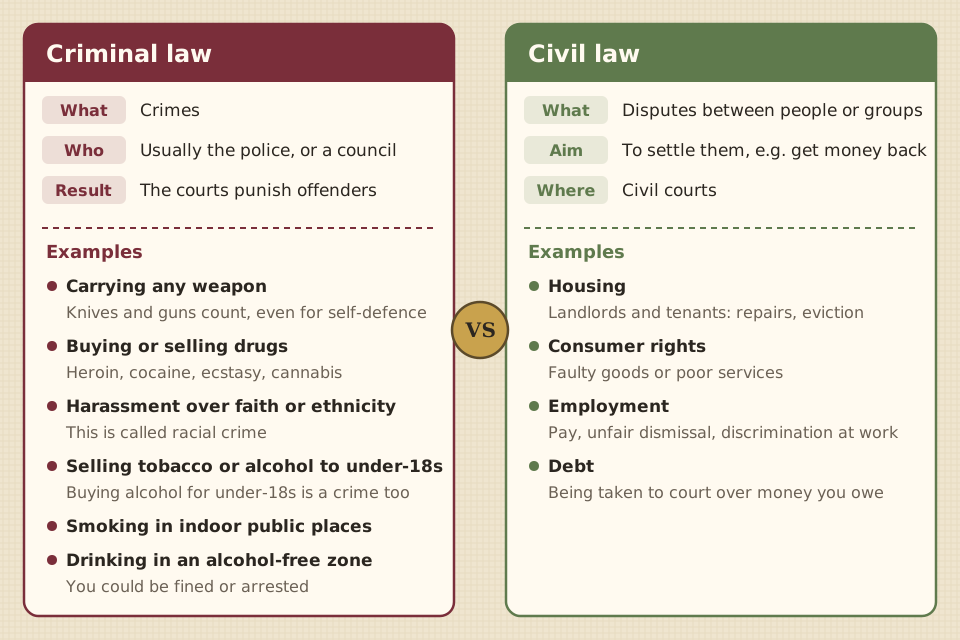
Criminal law deals with crimes. Cases are usually investigated by the police, or sometimes by another authority such as the local council, and the courts decide on the punishment.
Civil law is for settling disagreements between people or between groups.
Criminal law is about crimes; civil law is about disputes. All the examples are in this chart.
These are crimes in the UK
Here are some things that newcomers might not expect to be against the law:
Carrying a weapon: carrying any kind of weapon is a crime, even if you say it's for self-defence. That includes guns, knives, and anything made or adapted to hurt someone.
Drugs: it is illegal to buy or sell drugs, including heroin, cocaine, ecstasy and cannabis.
Racial crime: it is a criminal offence to harass someone, frighten them or cause them distress because of their religion or ethnic origin.
Selling tobacco: you must not sell tobacco products such as cigarettes, cigars or roll-your-own tobacco to anyone under 18.
Smoking in public places: smoking is banned in almost every enclosed public place, and signs show you where you can't smoke.
Buying alcohol: it is a crime to sell alcohol to anyone under 18, or to buy it for them. There is one exception: people aged 16 or over may drink alcohol with a meal in a restaurant or hotel.
Drinking in public: some places are marked as an alcohol-free zone, where you can't drink in the street. The police can also take alcohol away, or tell young people to leave a public place. If you break these rules you could be fined or arrested.
Of course, this list isn't complete. Murder, theft, assault and the other things that are crimes in most countries are crimes in the UK too.
Some of these rules are newer than you might think. The ban on smoking indoors only came in during 2006 and 2007, starting in Scotland in March 2006 and finishing in England in July 2007. Before that, a smoky pub was one of the most familiar sights in Britain.
These are civil disputes
Housing: disagreements between landlords and tenants, for example about repairs or eviction (being made to leave).
Consumer rights: for example, buying something that turns out to be faulty, or a service that goes wrong.
Employment: disputes about pay, being unfairly dismissed, or discrimination at work.
Debt: if you owe someone money, they may take you to court.
Quiz
Which TWO of the following are criminal offences in the UK?
Carrying a weapon (even if you say it's for self-defence) and selling cigarettes to someone under 18 are both criminal offences. B is a housing dispute between a landlord and a tenant, and C is about consumer rights; both come under civil law.
Quiz
Is the statement below TRUE or FALSE?
A 16-year-old is allowed to have an alcoholic drink alongside a meal when eating in a restaurant or hotel.
True. This is the one exception. Apart from this, selling alcohol to anyone under 18, or buying it for them, is a crime.