1920s–1930s
Between the wars: depression, cars and radio
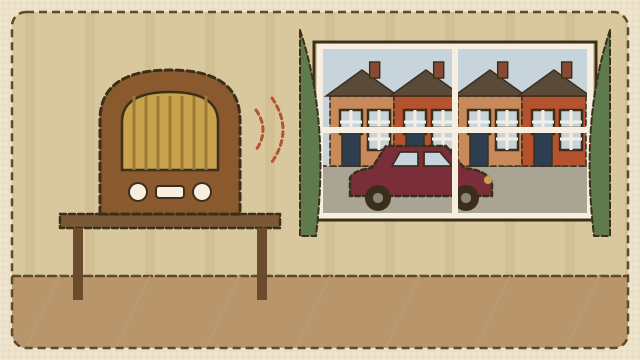
The twenty years after the First World War brought both good times and hard ones. In the 1920s life got better for many people. Public housing improved, and lots of new homes went up in towns and cities.
But in 1929 the whole world sank into the Great Depression, and some parts of Britain saw mass unemployment. The Depression of the 1930s hit different places in very different ways:
- Old heavy industries such as shipbuilding suffered badly.
- New industries such as cars and aviation (making aircraft) grew.
- Prices generally fell, so people who still had jobs had more money to spend. Between 1930 and 1939 the number of cars in Britain doubled, from 1 million to 2 million.
It was also a lively time for culture. The novelists Graham Greene and Evelyn Waugh became famous, and the economist John Maynard Keynes published new ideas about the economy that had a big influence. The BBC began radio broadcasting in 1922, and in 1936 it started the world's first regular television service.
The BBC did not begin as a public broadcaster. In 1922 it was the British Broadcasting Company, set up by several radio makers who wanted people to buy radios. In 1927 it became the British Broadcasting Corporation, the public body we know today; both names are shortened to BBC.
A side note: television (John Logie Baird), radar (Robert Watson-Watt), the jet engine (Frank Whittle), the Turing machine (Alan Turing) and insulin (John Macleod) all came from the 1920s and 1930s. They are covered with the other 20th-century British inventions in the story British inventions before the war. Alexander Fleming, who discovered penicillin, has his own story: Fleming and penicillin.
Quiz
In which year did the BBC start radio broadcasts?
Radio started in 1922; the TV service came in 1936. 1901 is the year Queen Victoria died, and 1948 is when the NHS began. To remember: first sound (1922), then pictures (1936).