1914
The First World War begins: one shot and two rival camps
One shot that set Europe on fire
Britain's confident mood of the early 20th century soon came to a sudden end. On 28 June 1914 Archduke Franz Ferdinand, the heir to the throne of Austria-Hungary, was shot dead in Sarajevo. Like the first domino falling, his murder led, step by step, to the First World War.
It very nearly did not happen. That morning the plotters had already failed once, when a bomb thrown at the Archduke's car missed it. In the afternoon he changed his plans to visit the people hurt by the bomb, but nobody told his driver, who took a wrong turn and stopped to reverse right in front of Gavrilo Princip, a 19-year-old member of the group. You will often read online that Princip was eating a sandwich in a shop nearby, but no record from 1914 supports this; it looks like a legend added later.
But the killing was only the spark. Several other forces had been building up for years and made war likely:
putting your own nation first
building up big armies and navies
competing for empires and colonies
Europe's great powers split into two alliances
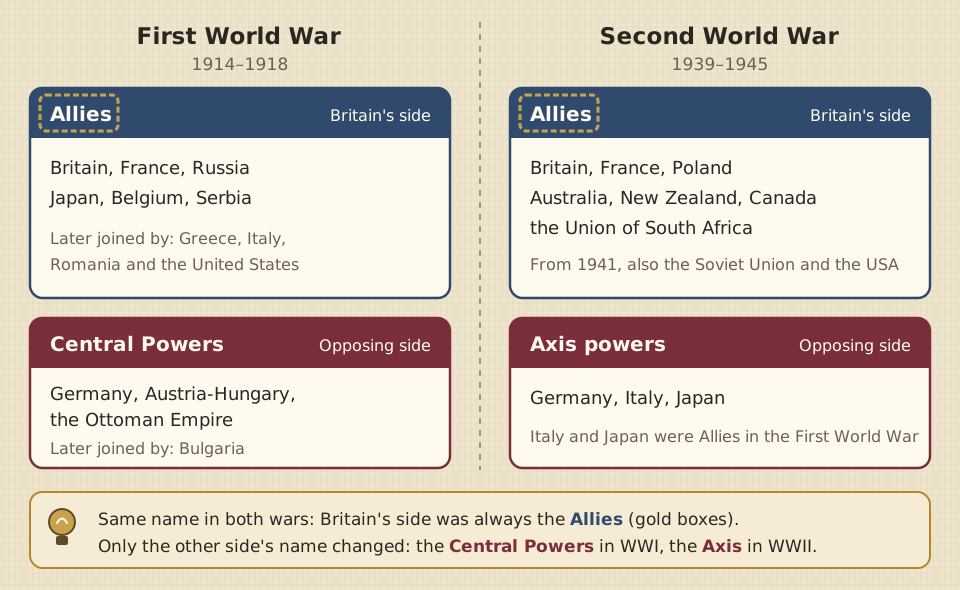
The two sides
Most of the fighting was in Europe, but the war pulled in countries from all over the world. Britain's side was known as the Allies, and the other side as the Central Powers.