Pop music, venues and festivals
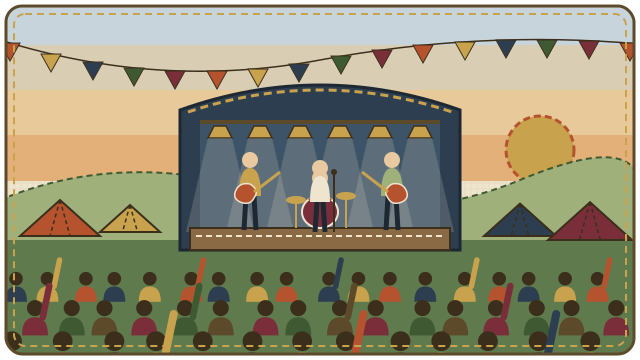
Since the 20th century, folk, jazz, pop and rock have all flourished in Britain. There are three reasons why British pop has had such a big effect on the rest of the world: English is spoken around the globe, Britain has cultural links with many countries, and British people are creative and inventive.
From the 1960s onwards, pop music has been one of Britain's most important gifts to world culture. The Beatles and the Rolling Stones still shape music at home and abroad (see Britain Since 1945). Later came the punk movement of the late 1970s, and the boy bands and girl bands of the 1990s.
- Big venues: in London, Wembley Stadium and The O2 (in Greenwich, in the south-east of the city); in Glasgow, the SEC Centre.
- Summer festivals take place all over the UK every year. Glastonbury is the most famous; others are the Isle of Wight Festival and Creamfields, a dance-music festival. Big-name bands share the stage with new acts.
- The National Eisteddfod of Wales: a yearly cultural festival of music, dance, art and new performances, mostly in Welsh. It includes several important competitions for poetry in Welsh.
- The Mercury Prize: given every September to the best album from the UK and Ireland.
- The Brit Awards: a yearly awards show with many categories, for example best British solo singer and best British group.
Quiz
What is the Mercury Prize awarded for?
The Mercury Prize is given every September to the best album from the UK and Ireland. Best British solo artist is one of the categories of the Brit Awards; West End musicals and classical composition are not what the Mercury Prize is for.
Quiz
Is the statement below TRUE or FALSE? The National Eisteddfod of Wales is held once every four years, and its performances are mostly in English.
False. The National Eisteddfod of Wales is held every year. It has music, dance, art and original performances, mostly in Welsh, and several important competitions for poetry in Welsh.