On one Saturday night every September, the Royal Albert Hall in London is packed with people waving flags and singing "Land of Hope and Glory" along with the orchestra. The tune of this "second national anthem" began life more than a hundred years ago as a march by a composer from Worcester. Who was he?
This chapter follows the "Arts and culture" part of the handbook's Chapter 4 (Arts and culture). No other part packs in so many names and works: composers, plays, painters, buildings, designers, writers and poets. Test questions often ask who wrote or made what, so most sections below include a quick-reference table of names, fields and best-known works. Film and British comedy come under "Leisure", so you'll find them in Leisure and Places of Interest.
Music: from the Proms to the Beatles
Music in Britain covers a huge range, from classical to modern pop, and there are concert venues and music events all over the country.
The best-known classical event is the Proms (The Proms): every summer, eight weeks of orchestral concerts in several venues, one of them the Royal Albert Hall (Royal Albert Hall) in London. Since 1927 the season has been organised by the BBC. The final concert, the Last Night of the Proms, is the most famous, and like the other concerts it is shown on television.
The name is short for "promenade concerts", and to promenade means to stroll about. When the concerts began in 1895, the seats in the middle of the hall were taken out, so people could buy a cheap ticket and stand or walk around while they listened. Today the centre of the Royal Albert Hall is still kept for "Prommers" with standing tickets.
Classical composers at a glance
The answer to our opening question is Elgar. There are seven composers to know, and the most common question is which piece belongs to whom:
Henry Purcell 1659–95
Organist at Westminster Abbey (Westminster Abbey). His work included church music and operas, and he created a sound that was clearly British and different from music elsewhere in Europe. His influence on British composers can still be heard today.
George Frederick Handel 1685–1759
Born in Germany, he made his home in Britain and became a British citizen in 1727. For George I he wrote Water Music, and for George I's son, George II, he wrote Music for the Royal Fireworks. Choirs often perform his oratorio (a long piece for choir and orchestra) Messiah, especially around Easter.
Gustav Holst 1874–1934
Wrote The Planets, in which each movement is about a planet of the solar system. He turned one movement, Jupiter, into the tune of I vow to thee my country, a hymn often sung in British churches.
Sir Edward Elgar 1857–1934
Born in Worcester (Worcester), England. He is best known for the Pomp and Circumstance Marches. March No. 1, known as Land of Hope and Glory, is normally played on the Last Night of the Proms.
Ralph Vaughan Williams 1872–1958
Composed for orchestras and choirs. His music owes a lot to traditional English folk songs.
Sir William Walton 1902–83
His work ranges from film scores to opera, and he wrote marches for the coronations of George VI and Elizabeth II. His best-known pieces are Façade, which later became a ballet, and Belshazzar's Feast, a work for a large choir.
Benjamin Britten 1913–76
Famous above all for his operas, such as Peter Grimes and Billy Budd. His A Young Person's Guide to the Orchestra takes a tune by Purcell and uses it to show off each section of the orchestra in turn. He also started the Aldeburgh festival (Aldeburgh festival) in Suffolk, which is still a major international event.
Handel's royal music drew big crowds from the start. One summer evening in 1717, George I sailed along the Thames on the royal barge while about 50 musicians on another boat played Water Music; the story goes that the king liked it so much he had it played at least three times. When the Royal Fireworks music had its public rehearsal in 1749, more than ten thousand people are said to have turned up, and carriages were stuck on London Bridge for three hours.
Quiz
Since 1927, which organisation has run the Proms, the summer season of orchestral concerts?
The BBC has organised the Proms since 1927, which is why the concerts are on TV. The National Trust looks after historic buildings and countryside; you'll meet it in the next chapter.
Quiz
Which TWO pieces of music were written by George Frederick Handel?
Handel wrote Water Music for George I and Music for the Royal Fireworks for George II. The Planets is by Holst, and the Pomp and Circumstance Marches are by Elgar. A memory aid: both of Handel's pieces were made for a king, one on the water and one with fireworks.
Quiz
Which composer wrote the opera Peter Grimes and started the Aldeburgh festival in Suffolk?
Britten is known for his operas, especially Peter Grimes and Billy Budd, and he founded the Aldeburgh festival. His Young Person's Guide to the Orchestra is built on music by Purcell, so the two names often turn up in the same question.
Pop music, venues and festivals
Since the 20th century, folk, jazz, pop and rock have all flourished in Britain. There are three reasons why British pop has had such a big effect on the rest of the world: English is spoken around the globe, Britain has cultural links with many countries, and British people are creative and inventive.
From the 1960s onwards, pop music has been one of Britain's most important gifts to world culture. The Beatles (The Beatles) and the Rolling Stones (The Rolling Stones) still shape music at home and abroad (see Britain Since 1945). Later came the punk (Punk) movement of the late 1970s, and the boy bands and girl bands of the 1990s.
Big venues: in London, Wembley Stadium and The O2 (in Greenwich, in the south-east of the city); in Glasgow, the SEC Centre.
Summer festivals take place all over the UK every year. Glastonbury is the most famous; others are the Isle of Wight Festival and Creamfields, a dance-music festival. Big-name bands share the stage with new acts.
The National Eisteddfod of Wales (National Eisteddfod of Wales): a yearly cultural festival of music, dance, art and new performances, mostly in Welsh. It includes several important competitions for poetry in Welsh.
The Mercury Prize (Mercury Prize): given every September to the best album from the UK and Ireland.
The Brit Awards (Brit Awards): a yearly awards show with many categories, for example best British solo singer and best British group.
Theatre: the West End, The Mousetrap and pantomime
Most towns and cities in Britain have a theatre, from big playhouses to tiny studios. Theatres are an important part of local life, with shows by both professional and amateur companies. London's West End (West End), also called "Theatreland" (Theatreland), is especially famous. Dame Agatha Christie's murder mystery The Mousetrap has been on stage in the West End since 1952. No other show in history has had such a long first run.
At the end of every performance, the actors ask the audience to keep the murderer's identity a secret. In 1974 the play moved from the Ambassadors Theatre to St Martin's Theatre next door; because there was no break, it still counted as the same run.
Musicals: from Gilbert and Sullivan to Lloyd Webber
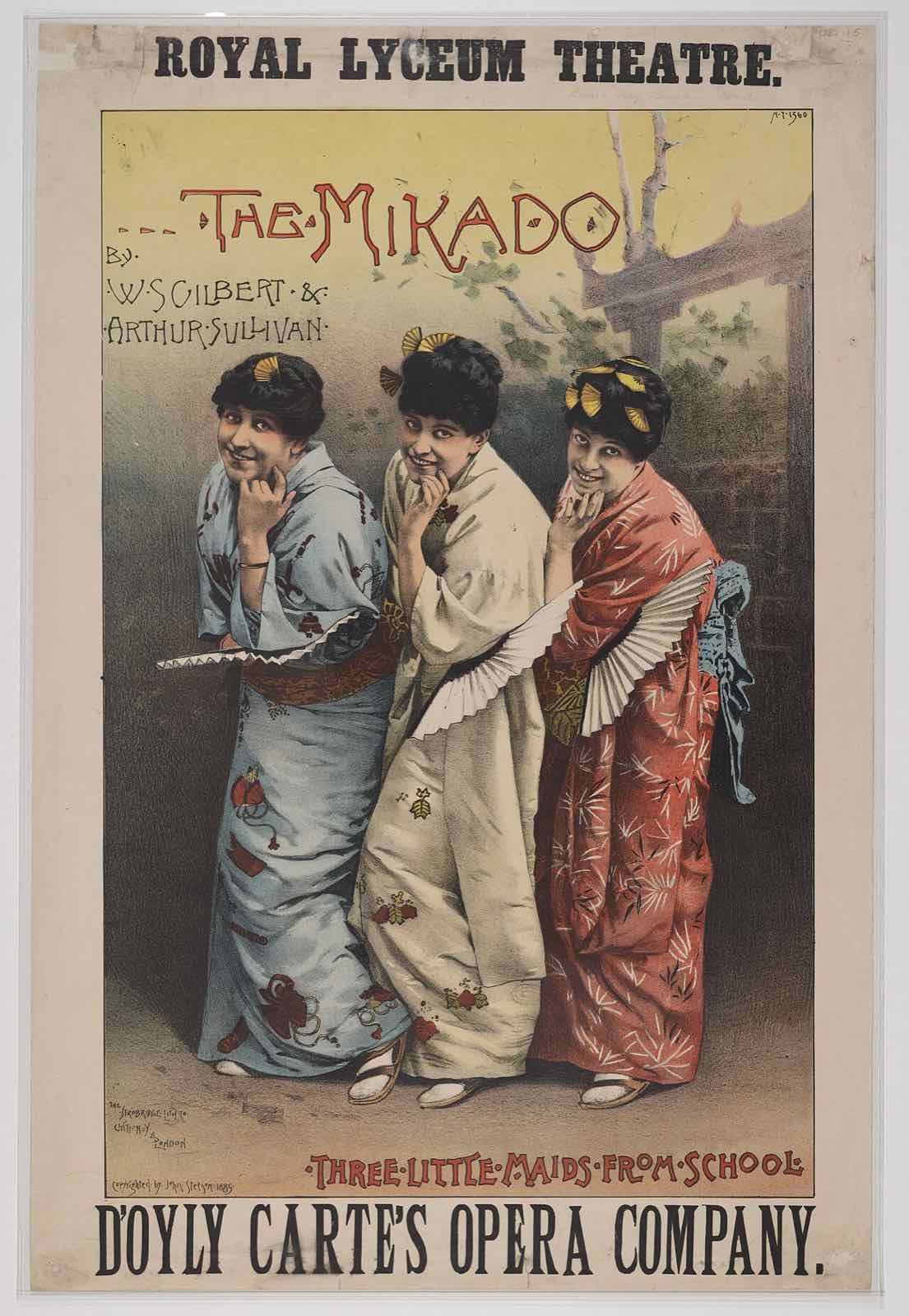
Britain has a strong tradition of musical theatre. In the 19th century, Gilbert and Sullivan (Gilbert and Sullivan) wrote many comic operas that poked fun at the popular culture and politics of their day. Examples are HMS Pinafore, The Pirates of Penzance and The Mikado. Professional and amateur groups still put them on today. Most of them opened at the Savoy Theatre in London, which in 1881 became the first public building in the world to be lit entirely by electric light.
A more recent name is the composer Andrew Lloyd Webber (Andrew Lloyd Webber), whose musicals have been hits around the world. With the lyricist (song-word writer) Tim Rice (Tim Rice) he wrote Jesus Christ Superstar and Evita, and his other shows include Cats and The Phantom of the Opera.
An 1885 poster for Gilbert and Sullivan's The Mikado, showing the three sisters from the story.
National Library of Scotland, Weir Collection, public domain, via Wikimedia Commons
Pantomime and the Edinburgh Fringe
One very British tradition is pantomime (pantomime). At Christmas many theatres put on a "panto": a light-hearted comedy with songs, based on a fairy tale and meant for the whole family. One traditional character is the Dame (the Dame), an old woman played by a man. There is often a pantomime horse or cow too, played by two actors sharing one costume. The audience is expected to join in loudly: when the villain creeps up behind the hero, everyone shouts "He's behind you!"
Every summer the Scottish capital hosts the Edinburgh Festival (Edinburgh Festival), which is really a group of arts and culture festivals. The largest and best known is the Edinburgh Festival Fringe (Edinburgh Festival Fringe), or simply "the Fringe". It is mostly theatre and comedy, and many of the shows are experimental. For the history of British comedy and TV comedy, see Leisure and Places of Interest.
The Fringe began without an invitation. When the Edinburgh International Festival was first held in 1947, eight theatre groups who hadn't been invited came anyway and performed on the "fringe", or edge, of the festival. That is also where the term "fringe theatre" (small, experimental theatre) comes from.
The top theatre prizes are the Laurence Olivier Awards (Laurence Olivier Awards), given every year in London, with categories such as best director, best actor and best actress. The awards take their name from Sir Laurence Olivier (later Lord Olivier), a British actor remembered above all for his many Shakespeare roles.
Quiz
Is the statement below TRUE or FALSE?
Agatha Christie's play The Mousetrap opened in the West End in 1952, and no show in history has had a longer first run.
True. The Mousetrap has been running since 1952, the longest first run of any show. Remember three things: Christie, the West End, 1952.
Quiz
Which TWO of these were written by Gilbert and Sullivan?
HMS Pinafore and The Mikado are 19th-century comic operas by Gilbert and Sullivan. Cats and Evita are 20th-century musicals by Andrew Lloyd Webber. An easy way to sort them: the old ones are Gilbert and Sullivan, the newer ones are Lloyd Webber.
Quiz
Is the statement below TRUE or FALSE?
The Edinburgh Festival Fringe takes place every summer, and most of its shows are theatre and comedy.
True. The Fringe is the largest and best-known part of the Edinburgh Festival, held every summer in Scotland's capital. Its shows are mostly theatre and comedy, and many of them are experimental.
Art: from royal portraits to the Turner Prize
In the Middle Ages most art had a religious subject: pictures painted on church walls, and illustrations in religious books. Much of it was destroyed after the Reformation, but rich families then started to collect other kinds of paintings and sculpture.
In the 16th and 17th centuries, many of the painters at work in Britain came from other countries. Examples are Hans Holbein (Hans Holbein), who painted Henry VIII (see The Tudors), and Sir Anthony Van Dyck (Sir Anthony Van Dyck), who painted Charles I (see The Stuarts). It was only from the 18th century that home-grown British artists, especially painters of portraits and landscapes, became well known.
You can see work by British and international artists in galleries across the country. London has The National Gallery, Tate Modern and Tate Britain; Cardiff has the National Museum; and Edinburgh has the Scottish National Gallery.
The Turner Prize (Turner Prize) began in 1984 to celebrate contemporary art (art being made today). It takes its name from the painter Joseph Turner. Each year four works make the shortlist and go on show at Tate Britain, and then the winner is announced. It is seen as one of the most respected prizes for visual art. Past winners include Damien Hirst and Richard Wright. Turner himself appears on the Bank of England's plastic £20 note, issued from 2020, together with one of his paintings.
Painters and sculptors at a glance
Thomas Gainsborough 1727–88
A portrait painter who often placed his sitters in country or garden scenery.
David Allan 1744–96
A Scottish painter, best known for portraits. One famous work is The Origin of Painting.
Joseph Turner 1775–1851
A very influential landscape painter with a modern style. He is credited with making landscape painting more respected.
John Constable 1776–1837
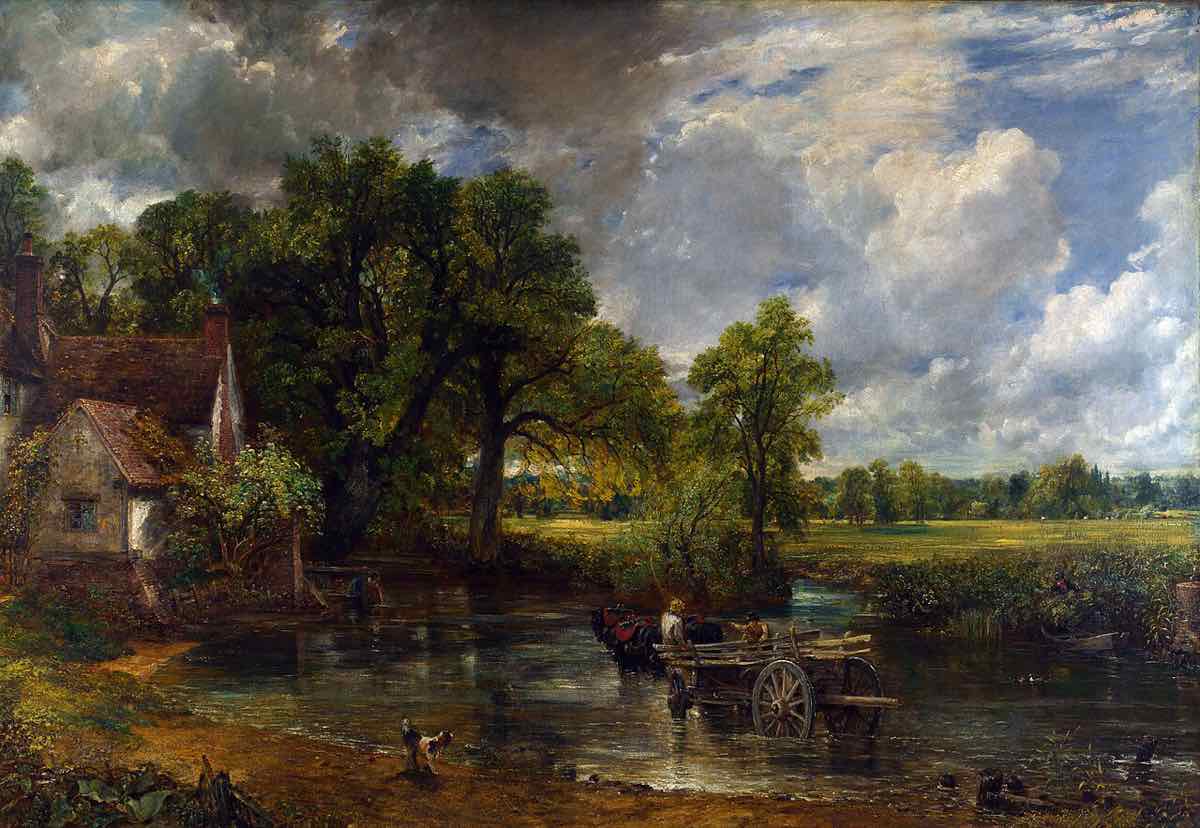
A landscape painter, famous for scenes of Dedham Vale (Dedham Vale) on the border of Suffolk and Essex, in the east of England.
The Pre-Raphaelites
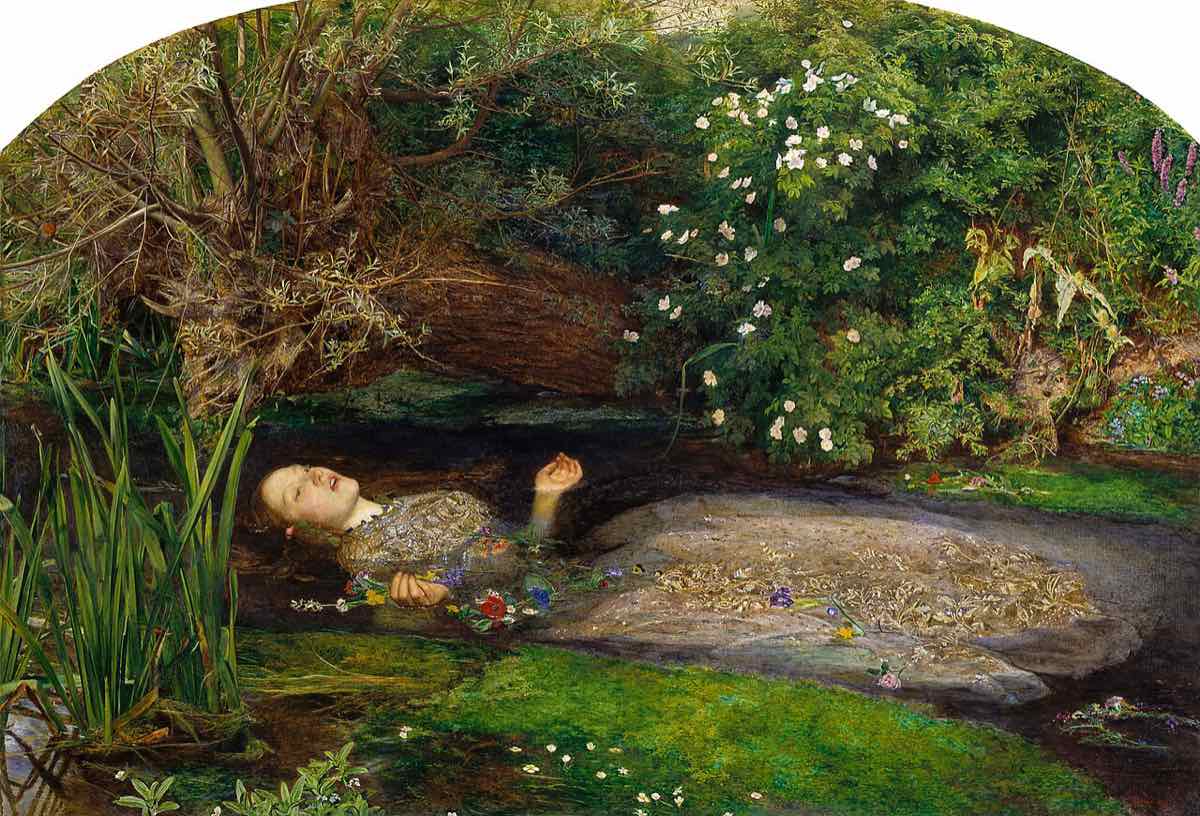
A major art movement from the second half of the 19th century. Its painters chose religious or literary subjects and painted them in fine detail and bright colours. Leading members were Dante Gabriel Rossetti, Holman Hunt and Sir John Millais.
Sir John Lavery 1856–1941
A very successful portrait painter from Northern Ireland. His sitters included the Royal Family.
Henry Moore 1898–1986
An English sculptor, famous for large abstract bronze sculptures.
John Petts 1914–91
A Welsh artist, known for engravings and stained glass. After a church in Birmingham, Alabama, in the USA was bombed in 1963, he designed a stained-glass window for it, paid for by donations from thousands of people in Wales.
Lucian Freud 1922–2011
A British painter born in Germany, known mainly for portraits.
David Hockney 1937–
A key figure in the pop art (pop art) movement of the 1960s, and still influential today.
Constable's The Hay Wain (1821) shows the area around Flatford Mill on the River Stour in Suffolk, near Dedham Vale. It hangs in the National Gallery in London.
John Constable, public domain, via Wikimedia CommonsOphelia (1851–52) by the Pre-Raphaelite painter Millais. The subject comes from Shakespeare's Hamlet, and the painting is in Tate Britain. Look at how carefully every leaf is painted, and how bright the colours are. To paint it, Millais had his model, Elizabeth Siddal, lie fully dressed in a bath of water for days. She caught a very bad cold, and her father wrote to Millais asking for £50 to pay the doctor.
John Everett Millais, public domain, via Wikimedia Commons
Quiz
Which painter is best known for his landscapes of Dedham Vale, on the border of Suffolk and Essex?
Dedham Vale means Constable. Turner also painted landscapes, but he is remembered for his modern style and the way he raised the status of landscape painting. Gainsborough is known for portraits, and Hockney for pop art.
Quiz
Is the statement below TRUE or FALSE?
Lucian Freud was a Scottish painter who is best known for his landscapes.
False. Freud was a British painter born in Germany, and he is famous for portraits. The Scottish portrait painter to remember is David Allan.
Quiz
What kind of work does the Turner Prize celebrate?
The Turner Prize, set up in 1984 and named after Joseph Turner, is for contemporary art. The prize for novels is the Man Booker Prize for Fiction, and London's theatre awards are the Laurence Olivier Awards.
Architecture: from Norman castles to the gothic revival
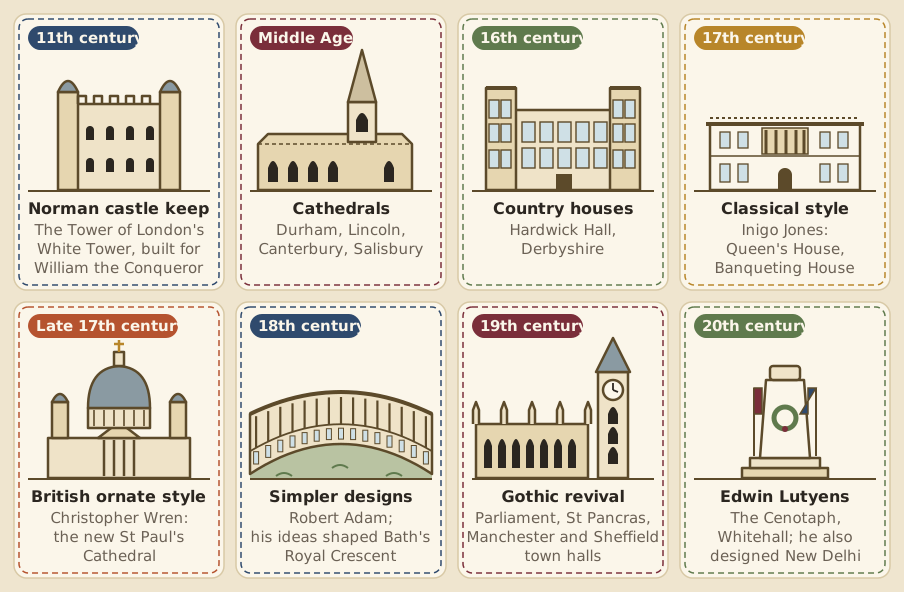
Britain's buildings are rich and varied. This picture shows the main style of each period:
British building styles, in date order. Under each picture are the architects and buildings that can come up in the test.
The Middle Ages: many cathedrals and churches were built, and a lot of them are still standing, for example the cathedrals at Durham, Lincoln, Canterbury and Salisbury. The White Tower (White Tower) at the Tower of London is a good example of a Norman castle keep (a strong central tower); William the Conqueror (William I) had it built.
Country houses: as the countryside became more peaceful and landowners grew richer, their homes became grander. Great country houses such as Hardwick Hall (Hardwick Hall) in Derbyshire appeared, and a British style of building began to develop. It was built in the 1590s, when glass was a luxury, yet it has an enormous number of windows; local people made up a rhyme about it: "Hardwick Hall, more glass than wall."
The 17th century: Inigo Jones (Inigo Jones) looked to classical architecture (the buildings of ancient Greece and Rome) when he designed the Queen's House (Queen's House) at Greenwich and the Banqueting House (Banqueting House) in Whitehall, London. Later that century Sir Christopher Wren (Sir Christopher Wren) created a British form of the richly decorated styles fashionable in Europe; his best-known example is the new St Paul's Cathedral (see The Stuarts). The Banqueting House wasn't only for feasts: in 1649 Charles I was executed just outside it.
The 18th century: simpler designs came into fashion. The Scottish architect Robert Adam (Robert Adam) shaped building styles in the UK, Europe and America. He designed the insides of buildings as well as the outsides, as at Dumfries House (Dumfries House) in Scotland. His ideas inspired architects in Bath, among other places; the Royal Crescent (Royal Crescent) there is a good example. It was actually designed by John Wood the Younger, though. Adam's ideas only influenced the architects in Bath, so don't assume he built it.
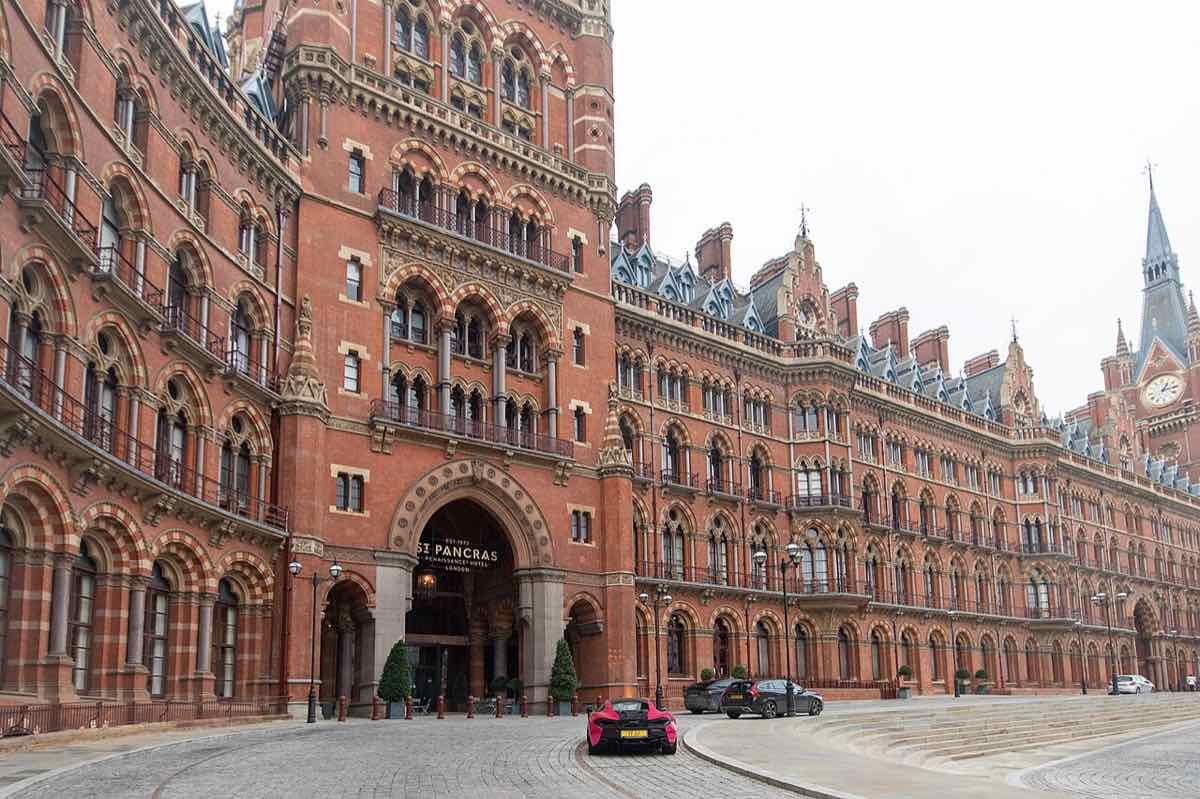
The 19th century: the medieval gothic (gothic) style came back into fashion. As cities grew, many large public buildings were put up in this style, such as the Houses of Parliament (Houses of Parliament), St Pancras Station (St Pancras Station) and the town halls of cities like Manchester and Sheffield.
The 20th century: Sir Edwin Lutyens (Sir Edwin Lutyens) was influential across the British Empire. He designed New Delhi (New Delhi) as the seat of government for India. When the First World War ended, he designed war memorials in many parts of the world, including the Cenotaph (Cenotaph) in Whitehall. The national Remembrance Day service is held there every year, attended by the Queen, politicians and foreign ambassadors (see Customs and Traditions).
Today: the firms set up by modern British architects take on major projects in the UK and around the world. Three names to know: Sir Norman Foster (Sir Norman Foster, born 1935), Lord Richard Rogers (Lord Richard Rogers, born 1933) and Dame Zaha Hadid (Dame Zaha Hadid, 1950–2016). Hadid's firm has carried on with her work since her death. You may have seen their work: Foster helped design the new Wembley Stadium (see Sport), Rogers designed the Millennium Dome, now known as The O2, and Hadid designed the Aquatics Centre for the London 2012 Olympics.
The red-brick gothic front of St Pancras Station and the former Midland Grand Hotel: a classic example of the 19th-century gothic revival. The station was nearly knocked down in the 1960s, but a campaign led by people including the poet John Betjeman saved it. There is now a bronze statue of him inside the station, and he is also one of the poets at the end of this chapter.
Photo: mgaylard (www.mgaylard.co.uk), CC BY 2.0, via Wikimedia Commons
Gardens and landscape design
Britain is just as proud of its gardens and landscapes as of its buildings. The great name of the 18th century is Lancelot "Capability" Brown (Lancelot 'Capability' Brown). He reshaped the parkland of country estates with sweeping lawns, clumps of trees and lakes, so that it looked natural, as if nobody had planned it. He was known for telling owners that their land had great "capabilities" (possibilities), which is how he got his nickname. Later, Gertrude Jekyll (Gertrude Jekyll) often teamed up with Lutyens, creating colourful gardens around the houses he designed.
Gardens are still an important part of British homes. Every year the Chelsea Flower Show (Chelsea Flower Show) shows off garden designs from Britain and the rest of the world.
Quiz
Which of the following statements is correct?
The Cenotaph was designed in the 20th century by Lutyens, who also designed New Delhi. Wren was a 17th-century architect, working more than 200 years before the First World War; his most famous building is St Paul's Cathedral.
Quiz
Which TWO of these buildings were built in the 19th-century revival of the gothic style?
The Houses of Parliament and St Pancras Station are both 19th-century gothic buildings. The Queen's House is in Inigo Jones's 17th-century classical style, and the Royal Crescent in Bath belongs to the simpler designs of the 18th century.
Design and fashion: from furniture to the miniskirt
Britain has produced many great designers. Three stand out in different fields, alongside three recent fashion designers:
Thomas Chippendale
An 18th-century designer of furniture.
Clarice Cliff
Designed pottery (ceramics) in the Art Deco (Art Deco) style.
Sir Terence Conran
A 20th-century interior designer.
Fashion
Well-known recent fashion designers: Mary Quant, Alexander McQueen and Vivienne Westwood.
Each of these names has a story. Mary Quant is often called the "mother of the miniskirt" because she made it fashionable in 1960s London, although who actually invented it is disputed. Westwood brought punk into fashion in the 1970s, which links to the punk movement in the music section above. And Conran opened the shop Habitat in 1964, bringing modern design into ordinary homes.
Quiz
Clarice Cliff is remembered as a designer of what?
Clarice Cliff designed ceramics in the Art Deco style. Thomas Chippendale designed 18th-century furniture, Sir Terence Conran was a 20th-century interior designer, and John Petts was a Welsh artist known for stained glass.
Literature: Nobel prizes, Sherlock Holmes and Harry Potter
Britain's literature has a long and highly respected history. Several British writers have won the Nobel Prize in Literature, among them the novelist Sir William Golding (Sir William Golding), the poet Seamus Heaney (Seamus Heaney) and the playwright Harold Pinter (Harold Pinter).
Other writers are loved for popular fiction. People all over the world read Agatha Christie's detective stories, and Ian Fleming (Ian Fleming) created James Bond (James Bond) in his novels. In 2003, JRR Tolkien's (JRR Tolkien) The Lord of the Rings was voted the country's favourite novel.
The Man Booker Prize for Fiction (Man Booker Prize for Fiction) has been given every year since 1968 to the best novel by a writer from the Commonwealth, Ireland or Zimbabwe. Winners include Ian McEwan, Hilary Mantel and Julian Barnes.
Writers at a glance
Jane Austen 1775–1817
English novelist: Pride and Prejudice, Sense and Sensibility. She wrote about marriage and family life, and many of her books have been made into TV series or films.
Charles Dickens 1812–70
Oliver Twist, Great Expectations. People still use the names of his characters in everyday speech: a Scrooge (Scrooge) is a mean person, and a Mr Micawber (Mr Micawber) is someone who is always hopeful.
Robert Louis Stevenson 1850–94
Adults and children still read his books: Treasure Island, Kidnapped, Dr Jekyll and Mr Hyde.
Thomas Hardy 1840–1928
A novelist and poet. His best-known novels are about country life: Far from the Madding Crowd, Jude the Obscure.
Sir Arthur Conan Doyle 1859–1930
A Scottish doctor and writer, famous for the stories about Sherlock Holmes (Sherlock Holmes), one of the earliest detectives in fiction.
Evelyn Waugh 1903–66
Wrote satirical novels (novels that make fun of society), such as Decline and Fall and Scoop. His most famous book is probably Brideshead Revisited.
Sir Kingsley Amis 1922–95
English novelist and poet who wrote more than 20 novels. The best known is Lucky Jim.
Graham Greene 1904–91
His novels were often shaped by his religious faith: Brighton Rock, The Heart of the Matter, Our Man in Havana and The Honorary Consul.
J K Rowling 1965–
Her Harry Potter books for children have been hugely popular around the world. She now writes novels for adults as well.
A few of these writers come with a story. Scrooge is the main character in Dickens's A Christmas Carol, and Mr Micawber comes from David Copperfield, where he keeps saying that something will "turn up". Conan Doyle studied medicine in Edinburgh, and Sherlock Holmes's sharp powers of observation are said to be based on one of his teachers, Dr Joseph Bell. And Evelyn Waugh was a man; to make things more confusing, his first wife was also called Evelyn, and their friends called them "He-Evelyn" and "She-Evelyn".
Quiz
Which author created the characters Scrooge and Mr Micawber?
Both are Dickens characters. Calling someone a Scrooge means they are mean with money, and a Micawber is someone who never stops hoping things will get better.
Quiz
Which of the following statements is correct?
Tolkien's The Lord of the Rings came top in the 2003 vote for the nation's favourite novel. Rowling's Harry Potter books are children's books that became popular all over the world.
Quiz
What kind of work wins the Man Booker Prize for Fiction?
Each year the Man Booker Prize for Fiction picks one novel; the author can be British, Irish, Zimbabwean or from another Commonwealth country. Hilary Mantel, Julian Barnes and Ian McEwan have all won it. Contemporary art has the Turner Prize, theatre has the Laurence Olivier Awards, and film has the BAFTA awards.
Quiz
Which writer created the detective Sherlock Holmes?
Sherlock Holmes, one of the first detectives in fiction, was created by Sir Arthur Conan Doyle, a Scottish doctor and writer. Agatha Christie is also famous for detective stories, which can be confusing, but Holmes is Conan Doyle's. Ian Fleming created James Bond, and Thomas Hardy wrote about country life.
British poets: from Beowulf to Poets' Corner
British poetry is among the richest in the world. Here it is period by period:
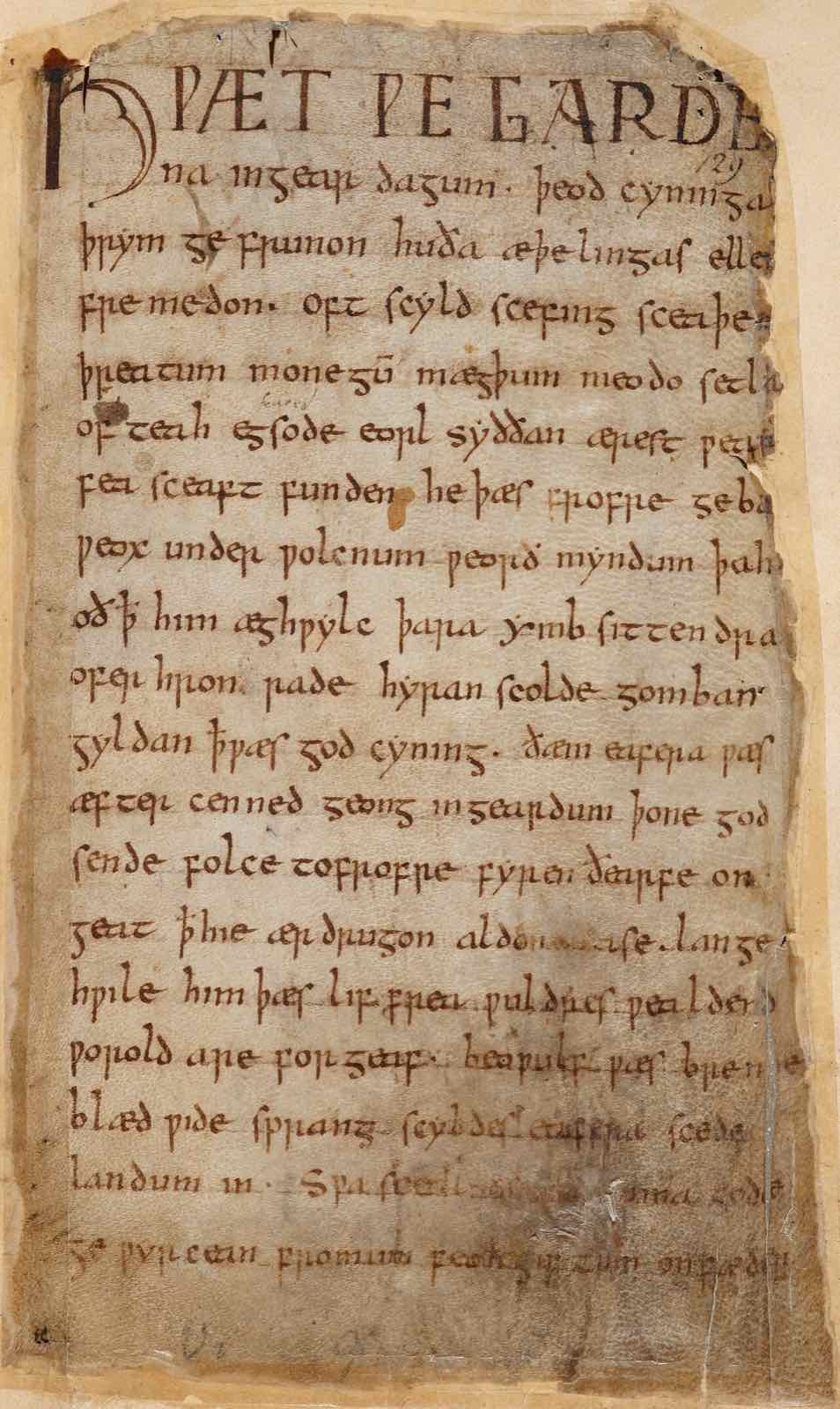
Anglo-Saxon times: the long poem Beowulf tells of a hero who fights monsters. People are still translating it into modern English today.
The Middle Ages: poems that survive from this time include Chaucer's Canterbury Tales (see The Middle Ages) and Sir Gawain and the Green Knight, about a knight at the court of King Arthur.
Shakespeare: as well as plays, he wrote many sonnets (sonnet), poems that must have exactly 14 lines, and a few longer poems (see The Tudors).
After Protestant ideas spread: some poets took their inspiration from religion, such as John Milton (John Milton), who wrote Paradise Lost. By the time he wrote it he was blind, so he spoke the whole poem aloud and other people wrote it down.
Inspired by nature: poets such as William Wordsworth (William Wordsworth). Sir Walter Scott (Sir Walter Scott) based his poems on Scotland and on the old stories and songs of the lands along the Scottish–English border. He also wrote novels, many of them set in Scotland.
The 19th century, when poetry was hugely popular: William Blake and John Keats; Lord Byron and Percy Shelley; Alfred Lord Tennyson; and the married couple Robert and Elizabeth Browning.
The First World War: many poets wrote about what they saw and felt in the war, for example Wilfred Owen (Wilfred Owen) and Siegfried Sassoon (Siegfried Sassoon).
More recently: popular poets include Ted Hughes, John Masefield, Sir John Betjeman and Sir Walter de la Mare.
Many of the most famous poets are buried in, or have a memorial in, Poets' Corner (Poets' Corner) in Westminster Abbey.
The first page of the only surviving copy of Beowulf, written down around the year 1000. The scorch marks at the edges come from a fire in a London library in 1731. It is now kept at the British Library. One of the people who later translated the poem into modern English was Seamus Heaney, the Nobel prize winner mentioned above; his version came out in 1999 and became a bestseller.
British Library, Cotton MS Vitellius A XV, public domain, via Wikimedia Commons
Five poems to recognise
Five poems are worth knowing, and a question might give you a line and ask who wrote it. You only need to recognise how each one begins and who the poet is:
"Oh, to be in England"
Robert Browning (1812–89), Home Thoughts from Abroad: far from home, the poet longs for England in April, when new leaves are opening on the elms and a chaffinch is singing in the orchard.
"She walks in beauty, like the night"
Lord Byron (1788–1824), She Walks in Beauty: praise for a woman who is like a cloudless, starry night, with the loveliest parts of darkness and light together in her face and eyes.
"I wandered lonely as a cloud"
William Wordsworth (1770–1850), The Daffodils: drifting alone like a cloud, the poet suddenly comes across a great mass of golden daffodils.
"Tyger! Tyger! burning bright"
William Blake (1757–1827), The Tyger: the poet speaks to a tiger glowing in a dark forest and asks what kind of hand could have made something so frightening and so perfectly shaped.
"What passing-bells for these…"
Wilfred Owen (1893–1918), Anthem for Doomed Youth: soldiers killed like animals on the battlefield get no church bells at their funerals, only the furious noise of the guns.
Two of these poems are tied to real moments. Wordsworth's daffodils were real: in 1802 he and his sister Dorothy saw a huge stretch of them beside Ullswater in the Lake District. Owen was killed on 4 November 1918, one week before the First World War ended, and his mother received the telegram about his death on Armistice Day, while church bells were ringing to celebrate the peace.
Quiz
Which poet wrote the line 'I wandered lonely as a cloud'?
It's Wordsworth's The Daffodils. He was a poet of nature, and both the cloud and the daffodils are part of nature. Byron wrote She Walks in Beauty, Blake wrote The Tyger, and Owen wrote about the First World War.
Review: who lived at the same time?
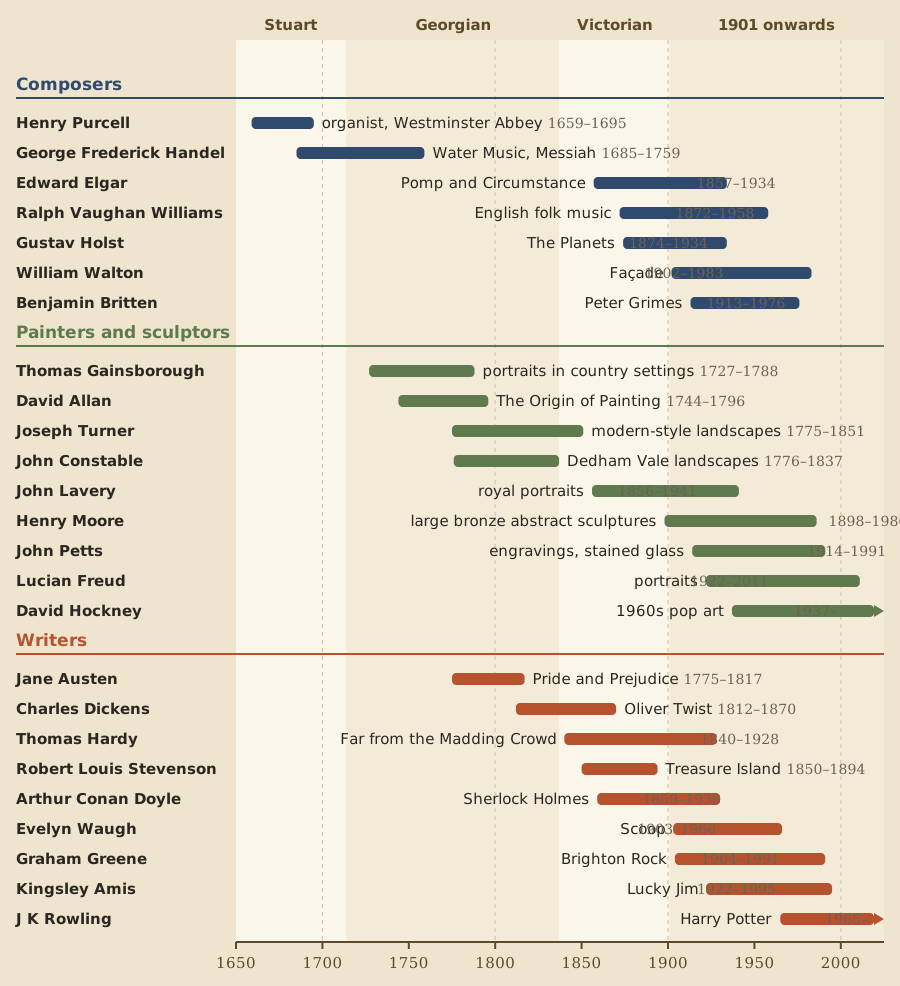
Putting this chapter's composers, painters and writers on one timeline makes them easier to remember. For example, Jane Austen, Turner and Constable were born within a year or so of each other, and Elgar, Holst and Conan Doyle all lived into the 1930s.
Each bar shows one person's life, with a famous work beside it. The background is split into the Stuart, Georgian and Victorian periods and the years from 1901 onwards. Handel's bar starts in 1685, the year he was born. An arrow means the person was still alive when the handbook came out.
Chapter summary
The Proms
Eight-week summer season of orchestral music; run by the BBC since 1927; the Last Night is at the Royal Albert Hall and shown on TV
Purcell
Organist at Westminster Abbey; a distinctly British style
Handel
Born in Germany, British citizen in 1727; Water Music (George I), Music for the Royal Fireworks (George II), Messiah
Holst / Elgar
Holst: The Planets and Jupiter; Elgar: born in Worcester, Pomp and Circumstance, Land of Hope and Glory
Vaughan Williams / Walton
Vaughan Williams: English folk music; Walton: coronation marches, Façade, Belshazzar's Feast
Britten
The operas Peter Grimes and Billy Budd; A Young Person's Guide to the Orchestra; Aldeburgh festival (Suffolk)
Pop since the 1960s
The Beatles, the Rolling Stones; punk in the late 1970s; boy and girl bands in the 1990s
Venues / festivals
Wembley, The O2 (Greenwich), the SEC Centre (Glasgow); Glastonbury, Isle of Wight, Creamfields
Eisteddfod / Mercury / Brits
National Eisteddfod (in Welsh, with poetry competitions); Mercury Prize: September, best album from the UK and Ireland; Brit Awards
The Mousetrap
By Christie; in the West End since 1952; the longest first run
Gilbert and Sullivan
19th-century comic operas: HMS Pinafore, The Pirates of Penzance, The Mikado
Lloyd Webber
With Tim Rice: Jesus Christ Superstar, Evita; also Cats, The Phantom of the Opera
Pantomime
Christmas family show; the Dame is played by a man; a horse or cow played by two actors
Edinburgh Fringe
Every summer; mainly theatre and comedy, often experimental
Olivier Awards
Every year in London; named after Olivier, famous for his Shakespeare roles
Holbein / Van Dyck
Painters from abroad in the 16th and 17th centuries; British portrait and landscape painters became famous from the 18th century
Turner Prize
Started in 1984, for contemporary art; four works shortlisted and shown at Tate Britain; Hirst, Wright
Painters
Gainsborough (portraits in the countryside), Allan (Scotland), Turner (landscapes), Constable (Dedham Vale), the Pre-Raphaelites, Lavery (Northern Ireland), Freud (portraits), Hockney (pop art)
Moore / Petts
Moore: large abstract bronze sculptures; Petts: Welsh, engravings and stained glass
Architecture
White Tower (Norman) → cathedrals → Hardwick Hall → Jones (Queen's House, Banqueting House) → Wren (St Paul's) → Adam (Dumfries House, Bath) → gothic revival (Parliament, St Pancras) → Lutyens (New Delhi, the Cenotaph)
Foster / Rogers / Hadid
Modern architects whose firms work worldwide; Foster (1935–), Rogers (1933–), Hadid (1950–2016)
Capability Brown / Jekyll
Brown: natural-looking landscapes; Jekyll: colourful gardens, working with Lutyens; Chelsea Flower Show
Beowulf, Sir Gawain, Shakespeare (sonnets have 14 lines), Milton (Paradise Lost), Wordsworth, Scott, Owen and Sassoon (First World War); Poets' Corner is in Westminster Abbey