Five poems to recognise
Five poems are worth knowing, and a question might give you a line and ask who wrote it. You only need to recognise how each one begins and who the poet is:
| "Oh, to be in England" | Robert Browning (1812–89), Home Thoughts from Abroad: far from home, the poet longs for England in April, when new leaves are opening on the elms and a chaffinch is singing in the orchard. |
|---|---|
| "She walks in beauty, like the night" | Lord Byron (1788–1824), She Walks in Beauty: praise for a woman who is like a cloudless, starry night, with the loveliest parts of darkness and light together in her face and eyes. |
| "I wandered lonely as a cloud" | William Wordsworth (1770–1850), The Daffodils: drifting alone like a cloud, the poet suddenly comes across a great mass of golden daffodils. |
| "Tyger! Tyger! burning bright" | William Blake (1757–1827), The Tyger: the poet speaks to a tiger glowing in a dark forest and asks what kind of hand could have made something so frightening and so perfectly shaped. |
| "What passing-bells for these…" | Wilfred Owen (1893–1918), Anthem for Doomed Youth: soldiers killed like animals on the battlefield get no church bells at their funerals, only the furious noise of the guns. |
Two of these poems are tied to real moments. Wordsworth's daffodils were real: in 1802 he and his sister Dorothy saw a huge stretch of them beside Ullswater in the Lake District. Owen was killed on 4 November 1918, one week before the First World War ended, and his mother received the telegram about his death on Armistice Day, while church bells were ringing to celebrate the peace.
Quiz
Which poet wrote the line 'I wandered lonely as a cloud'?
It's Wordsworth's The Daffodils. He was a poet of nature, and both the cloud and the daffodils are part of nature. Byron wrote She Walks in Beauty, Blake wrote The Tyger, and Owen wrote about the First World War.
Review: who lived at the same time?
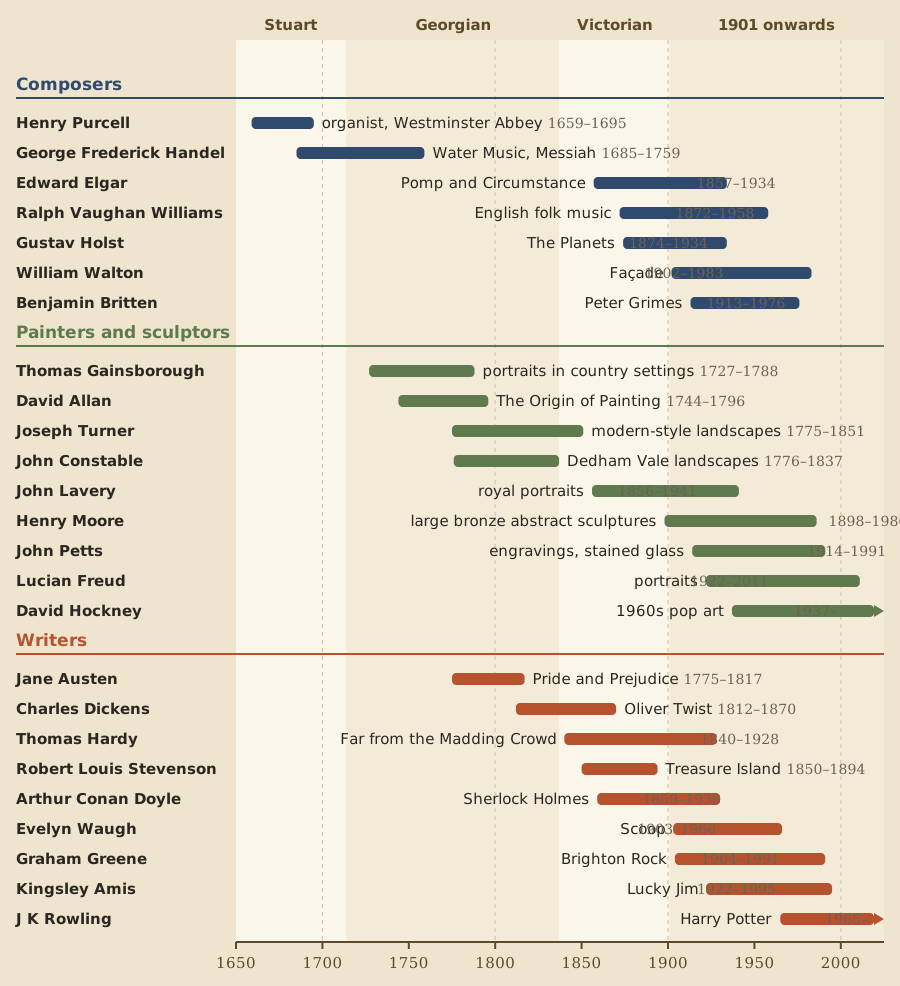
Putting Britain's composers, painters and writers on one timeline makes them easier to remember. For example, Jane Austen, Turner and Constable were born within a year or so of each other, and Elgar, Holst and Conan Doyle all lived into the 1930s.