Your Role in the Community: Neighbours, Jurors and Volunteers
One morning an envelope with a royal crest drops through your letterbox. On the front it says "Jury Summons". You never signed up for anything, and you don't know a single judge. So why you? Because your name is on the electoral register, and you happened to be picked at random.
If you become a British citizen or make the UK your permanent home, you gain responsibilities and opportunities as well as rights. This chapter covers the shared values and responsibilities we all have, and the many ways you can join in: being a good neighbour, helping at a school, joining a political party, giving blood, volunteering and caring for the environment. At the end, it adds two things that everyone living in the UK has to deal with: paying tax and driving.
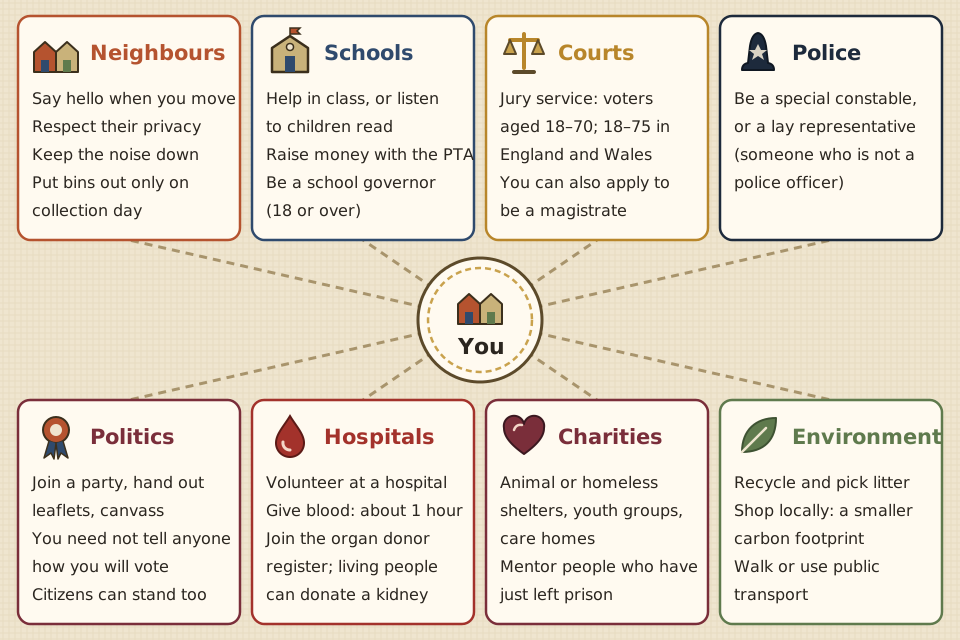
The ways of taking part in this chapter, all in one picture. Each one is explained below.
Values and responsibilities we can all agree on
The UK is one of the most diverse societies in the world. Even so, there is a set of values and responsibilities that everyone can sign up to:
Keep to the law and respect it
Know about other people's rights, and respect them
Be fair to others
Behave responsibly
Help and protect your family
Respect and look after the environment
Treat everyone equally, whatever their race, religion, sex, age, class, disability or sexual orientation
Work to support yourself and your family
Help other people
Vote in local and national elections
Accepting these values and responsibilities makes it easier to become a full and active citizen.
Quiz
Which TWO of the following are among the shared values and responsibilities that the handbook says everyone can agree with?
Looking after the environment and voting are both on the list of ten. Joining a political party is one way to take part in democracy, but it isn't a responsibility for everyone, and nobody is asked to attend religious services.
Being a good neighbour
When you move into a new house or flat, go and say hello to the people living nearby. Getting to know your neighbours helps you settle into the community and make friends. Neighbours can be a real help too: they might feed your pet while you're away, or tell you which local shops and services are good.
To avoid falling out with your neighbours, here is some practical advice:
Respect their privacy.
Keep down the noise you make.
Keep your garden tidy.
Only put your rubbish bags and bins out in the street or shared areas on the day the rubbish is collected.
Taking part in local life
Giving your time as a volunteer and helping out locally are a big part of good citizenship. You fit in and get to know people, and when neighbours support each other, the whole community gets better. It is also a way of living up to your duties as a citizen, like acting responsibly and helping other people.
One well-known way of looking out for each other started in a single village. The UK's first neighbourhood watch scheme began in 1982 in Mollington, in Cheshire, where the police borrowed the idea from the United States and called it Home Watch. Today Neighbourhood Watch groups can be found all over the UK.
Quiz
Which of the following statements is correct?
The advice is to respect your neighbours' privacy, keep the noise down, keep your garden tidy, and only put your bins out on the day the rubbish is collected.
Jury service: a duty you can be picked for
If you have the right to vote, you may also be chosen to sit on a jury. People are picked at random from the electoral register to serve as jurors. Anyone on the register aged 18 to 70 may be called for jury service, and in England and Wales the upper age is 75, so the range there is 18 to 75.
How many people sit on a jury, what they do and when you can be excused were covered in the previous chapter, Respecting the Law: 12 people in England, Wales and Northern Ireland, and 15 in Scotland. If you are summoned you must go, unless you are not eligible or have a good reason such as illness.
According to the UK government website, jury service in England and Wales usually lasts up to 10 working days, and you must reply within 7 days of getting your summons. If a trial is likely to take longer, the court will tell you in advance.
Quiz
According to the handbook, who can be called to serve on a jury in England and Wales?
The age range is 18 to 70 for people on the electoral register, but 18 to 75 in England and Wales. Jurors are ordinary members of the public; they don't need to know about the law.
Helping at school: from reading to governing
If you have children, there are lots of ways to help their school: helping in the classroom, supporting activities, or listening to children read.
Many schools hold fundraising events, such as second-hand book sales, toy sales or sales of food that people bring in, to pay for extra equipment or activities outside lessons, and you can suggest your own fundraising ideas too. Sometimes a parent-teacher association (PTA) organises these events. Volunteering to help, or joining the PTA, is good for the school and a way to make new friends in the community. Notices at the school, or letters your child brings home, will tell you what is going on.
School governors and school boards
A school governor, or in Scotland a member of a school board, is someone from the community who wants to help improve children's education.
You must be 18 or older when you are elected or appointed, and there is no upper age limit.
They play an important part in raising school standards and have three main jobs: deciding the school's strategic direction (its long-term plan), making sure it is held to account (accountability), and keeping track of how well the school is doing and judging it.
If you are interested, you can simply ask your local school whether it needs new governors or board members. In England you can also apply online through the Governors for Schools website.
Parents and other community groups in England can apply to open a free school in their area. The UK government website (GOV.UK) explains how.
Quiz
Which of the following statements is correct?
School governors are members of the community who want to help children's education; they don't have to be parents. You need to be 18 or over, and there is no upper age limit.
Supporting a political party: canvassing and standing
Political parties are happy to welcome new members. Joining one is a way to show which ideas you support and to take part in the democratic process.
Parties are especially busy around elections. Party members try hard to win votes for their candidates, for example by handing out leaflets in the street or knocking on doors to ask for support. This is called canvassing. If you'd rather not say, you don't have to tell a canvasser who you plan to vote for.
You can keep your vote to yourself because the UK has had secret voting since the Ballot Act of 1872. Before that, voters had to say out loud who they were voting for, which made it easy for landlords and employers to put pressure on them.
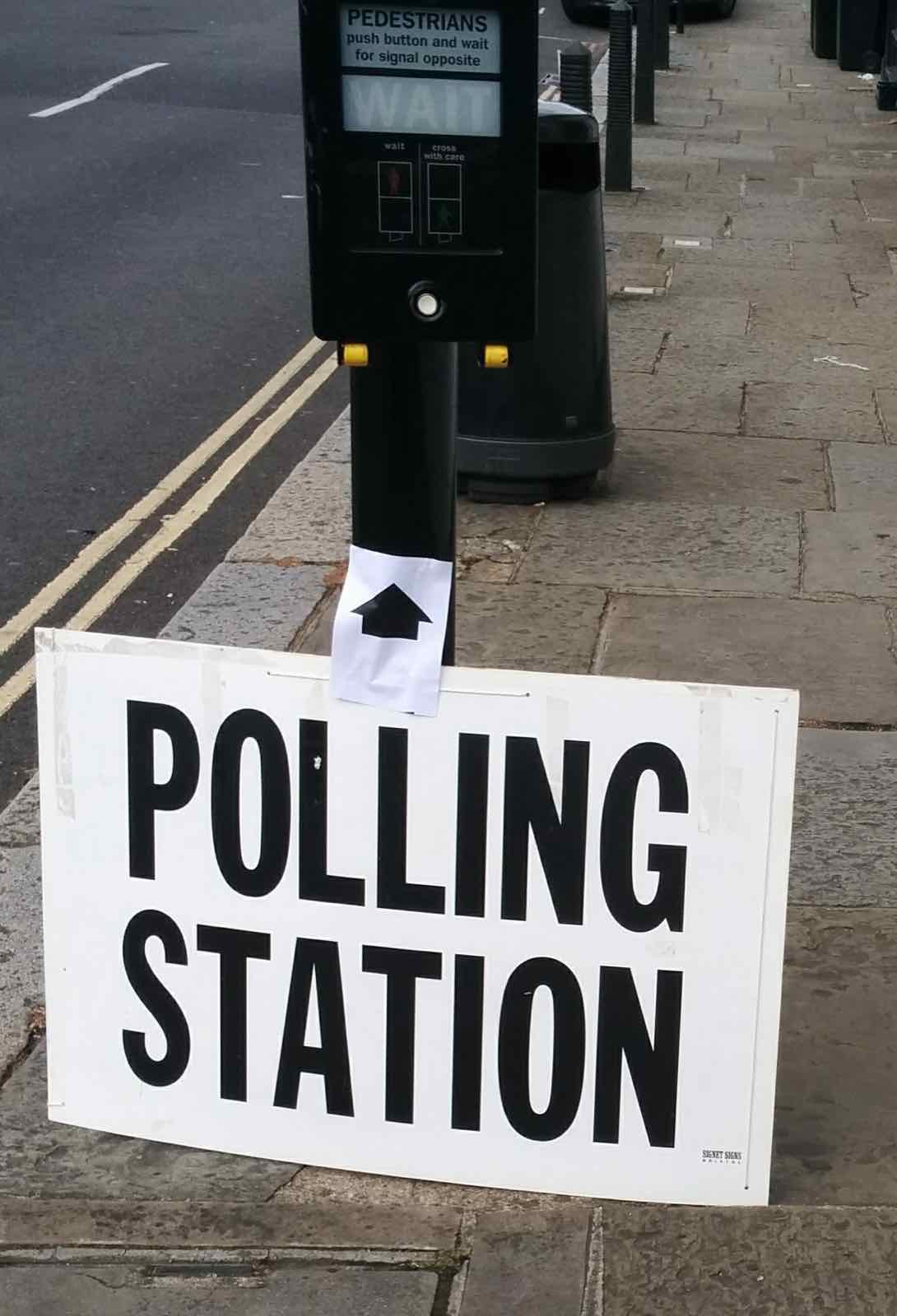
A sign in a London street pointing voters to a polling station during the 2017 general election.
Photo: Bondegezou, CC BY-SA 4.0, via Wikimedia Commons
Standing for office yourself
To get more deeply involved in UK politics, British citizens can stand for election as a local councillor, or as an MP (or a member of one of the devolved parliaments or assemblies). Irish citizens and eligible Commonwealth citizens may also be able to stand. If you'd like to join a party, look at the parties' websites.
Quiz
Is the statement below TRUE or FALSE?
When a party worker knocks on your door before an election, you are required to tell them which candidate you will vote for.
False. Canvassers often knock on doors, but if you don't want to say, you don't have to tell them how you plan to vote.
Helping local public services
Many local services need volunteers, for example local hospitals and youth projects. These services often want local people to have a say in how they are run. Universities, housing associations, museums and arts councils may also advertise for volunteers to sit on their governing boards.
You can also volunteer with the police as a special constable, or as a lay representative (someone who is not a police officer). You can even apply to be a magistrate, one of the people from the previous chapter who hear minor criminal cases in the Magistrates' Court. These vacancies are often advertised in local newspapers or on local radio, and you can also look them up on the UK government website.
In England and Wales, special constables are unpaid volunteers, but they wear a uniform, are trained, and on duty have the same powers as regular police officers. Many have a full-time job in the day and do police work in the evenings and at weekends.
Quiz
Which of these is a way for a member of the public to volunteer with the police?
A special constable is a police volunteer. A Chief Constable is the professional officer in charge of a police force; a Police and Crime Commissioner (PCC) is an elected post; and a sheriff is a judge in Scotland.
Giving blood and organs
Hospitals use donated blood to treat people with many kinds of injury and illness. Donating takes only about an hour. Where you sign up depends on where you live: there is one service for England and North Wales (blood.co.uk), one for the rest of Wales, one for Scotland and one for Northern Ireland.
Many people in the UK are waiting for an organ transplant. If you join the register as an organ donor, your family will find it easier to make a decision about donating your organs after your death. You can sign up on the NHS organ donation website. And living people can donate a kidney too.
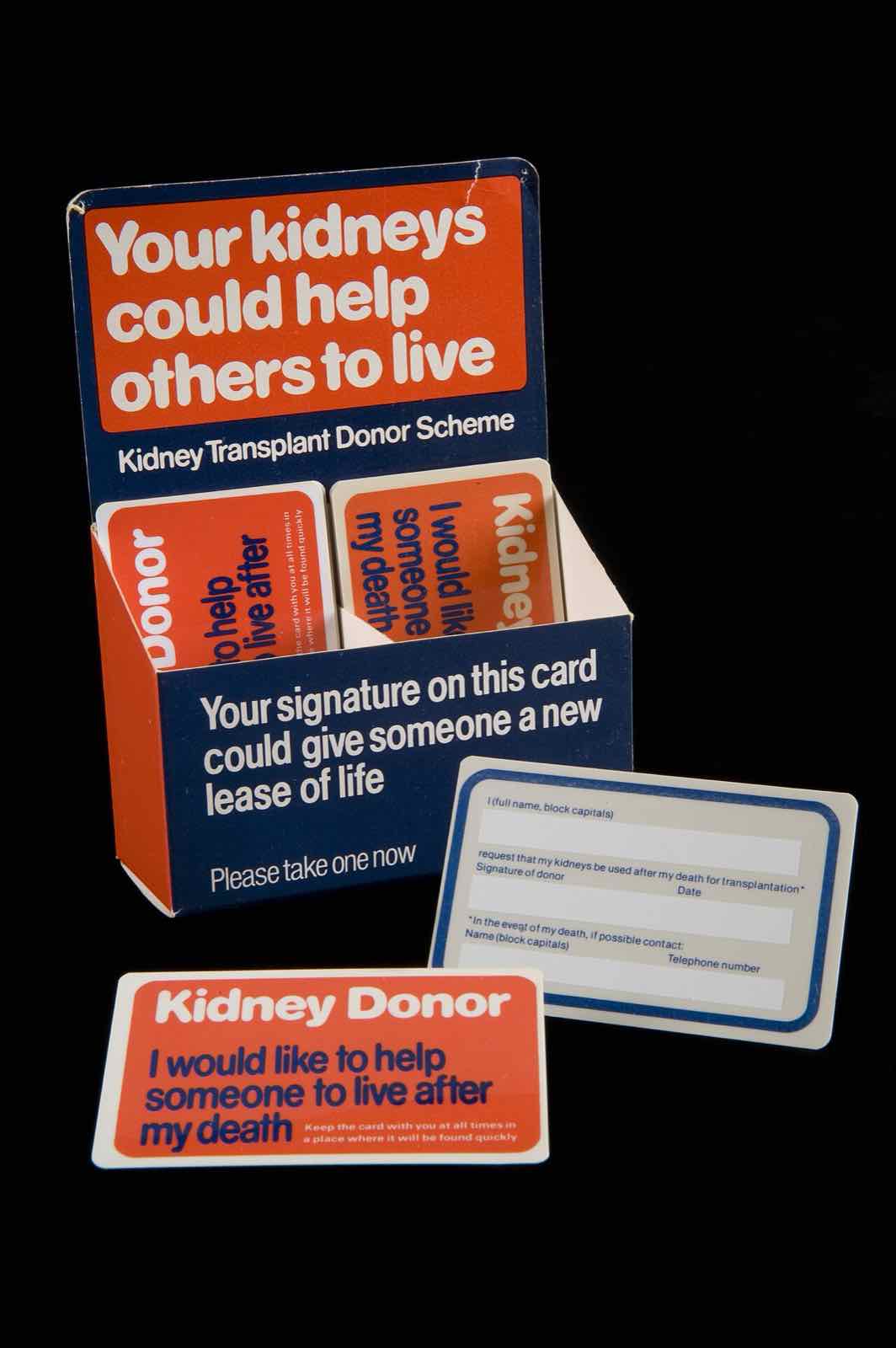
Kidney donor cards used in England from 1971 to 1981. From 1981 the cards were extended to other organs, such as the heart, liver and corneas, and in 1994 the NHS set up its Organ Donor Register.
Wellcome Collection, CC BY 4.0, via Wikimedia Commons
Quiz
Is the statement below TRUE or FALSE?
Signing up to the organ donor register helps your relatives when they must decide about donating your organs after your death.
True. Registering as an organ donor makes the decision easier for your family. And don't forget: living people can donate a kidney too.
Volunteering: doing good, and practising your English
Volunteering means working for good causes without being paid. It has lots of benefits: you meet new people and help make your community a better place. Some volunteering also lets you practise your English and build work skills, which can help you find a job or improve your CV (the document that lists your work history and skills). Many people volunteer simply because they want to help others.
Some examples of volunteering:
Animals: helping at a local animal shelter
Youth work: volunteering with a youth group
The environment: joining a community litter pick
Homeless people: helping at a homeless shelter
Mentoring: for example, supporting someone just released from prison
Health and hospitals: for example, helping on a hospital information desk
Older people: for example, helping in a care home
Some well-known charities
The UK has thousands of active charities and voluntary groups, from the British branches of international organisations to small groups that work only in one area. They improve life for people, animals and the environment in all sorts of ways. Here are some examples:
British branch of an international organisation: the British Red Cross
Older people: Age UK
Children: the NSPCC (National Society for the Prevention of Cruelty to Children)
Homeless people: two charities, Crisis and Shelter
Medical research: Cancer Research UK
The environment: the National Trust and Friends of the Earth
Animals: the PDSA (People's Dispensary for Sick Animals)
These organisations need volunteers to help with their activities and to raise money. They often advertise in local newspapers, and most have websites describing their volunteering opportunities. There are also websites that collect volunteering opportunities from many organisations.
Some of these charities have long histories. The PDSA was founded by Maria Dickin in 1917 to treat, free of charge, the pets of families who couldn't afford a vet. Since 1943 it has awarded the Dickin Medal to animals that showed great courage in war, such as messenger pigeons and search dogs, and the medal is often called "the animals' Victoria Cross".
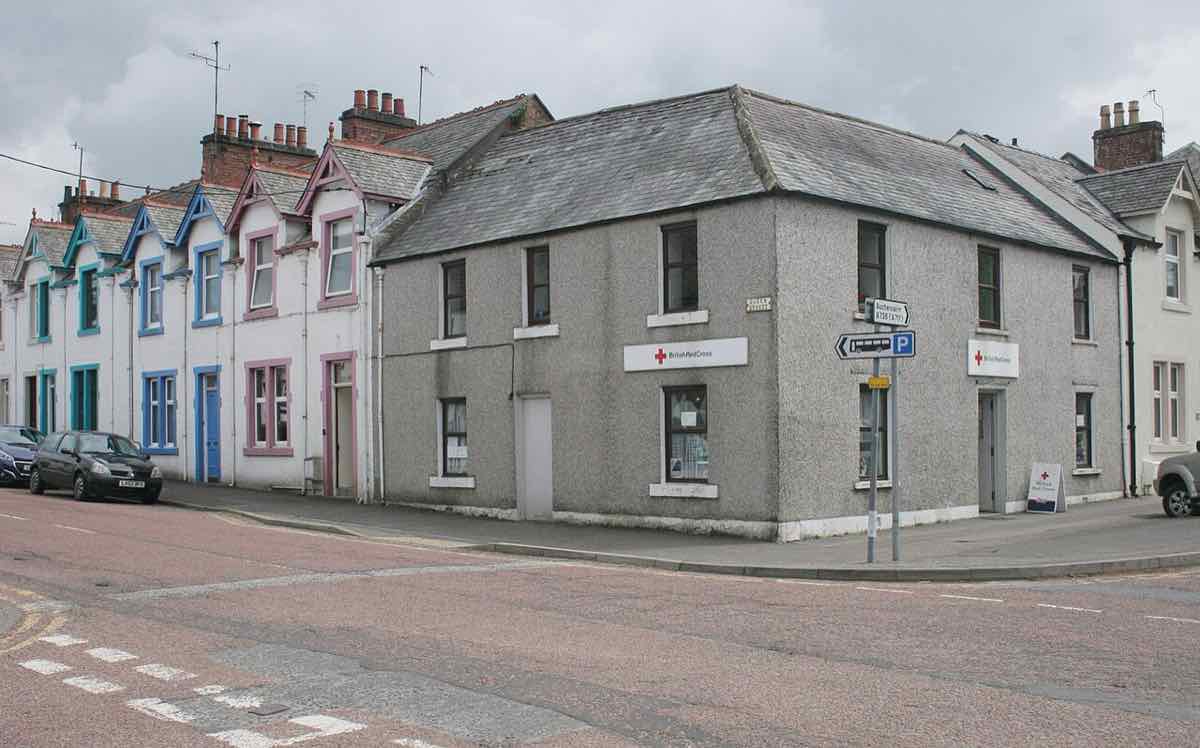
A British Red Cross charity shop in Castle Douglas, Scotland. Shops like this are found on high streets all over the UK. They sell clothes and books given by the public, and most of the staff are volunteers.
Photo: Richard Sutcliffe / Geograph, CC BY-SA 2.0, via Wikimedia Commons
Volunteering for young people
Young people also have plenty of chances to volunteer, gain qualifications and build skills. One example is the National Citizen Service, which gives 16- and 17-year-olds outdoor activities, skills training and the chance to take part in a community project. England, Wales, Scotland and Northern Ireland each have their own websites for finding volunteering opportunities.
Quiz
Which of the following statements is correct?
The National Citizen Service is one of the volunteering opportunities for young people: 16- and 17-year-olds can choose to take part in outdoor activities, build their skills and join a community project. Nobody has to do it.
Quiz
Which of these charities works to protect children?
The NSPCC (National Society for the Prevention of Cruelty to Children) looks after children. Age UK works with older people, the PDSA helps animals, and Friends of the Earth campaigns on the environment.
Looking after the environment
Recycle as much of your waste as you can. There are three good reasons:
Making new products from recycled materials uses less energy.
We don't need to dig as many raw materials out of the ground.
There is less rubbish, so less goes to landfill (big holes in the ground where waste is buried).
If you live in England, you can use a recycling website (recyclenow.com) to see what can be recycled at home and nearby. Wales and Scotland have their own websites, and in Northern Ireland you can ask your local council.
Collection day on a housing estate in Cwmbran, Wales, with wheelie bins and recycling boxes lined up by the road. Each local council runs its own rubbish and recycling, so bin colours, sorting rules and collection days change from one area to the next. After moving house, check the rules where you now live.
Photo: Jaggery / Geograph, CC BY-SA 2.0, via Wikimedia Commons
Another good way to support your community is to shop locally when you can. This helps businesses and farmers in your area and across the UK, and it also reduces your carbon footprint (the amount of greenhouse gas your life produces), because what you buy doesn't have to travel so far.
When you can, walk or use public transport. Both cause less pollution than driving.
Quiz
Which of the following statements is correct?
When you shop locally, the goods don't have to travel as far, so your carbon footprint is smaller, and local businesses and farmers benefit too. B gets recycling the wrong way round: making new products from recycled materials uses less energy.
Two things everyone deals with: tax and driving
Tax and driving are both part of everyday life, so this chapter covers them too.
Income tax
In the UK, you pay income tax on what you earn. Income that is taxed includes:
wages from a job
profits if you are self-employed
benefits that are taxable
pensions
income from property, savings and dividends (payments from shares)
Income tax pays for government services, such as:
Roads
Education
Police
The armed forces
For most people, income tax is taken straight from their pay by their employer and sent to HM Revenue & Customs (HMRC), which is the government department responsible for collecting tax. The name for this system is Pay As You Earn (PAYE).
If you are self-employed, you pay your own tax through a system called self-assessment, which means filling in a tax return. Other people may need to fill one in too. If HMRC sends you a tax return, complete it and send it back as soon as you have all the information you need. For help, there is HMRC's self-assessment helpline, 0300 200 3310, and HMRC's pages on the UK government website (GOV.UK).
National Insurance
Almost everyone in the UK who is in paid work, including people who are self-employed, must pay National Insurance Contributions. The money is used for benefits and services provided by the state, for example the National Health Service (NHS) and the state retirement pension.
Employees have their National Insurance taken from their pay by their employer; self-employed people pay it themselves. People who haven't paid enough cannot get certain benefits that depend on contributions, such as Jobseeker's Allowance or a full state pension. Some people, such as part-time workers, may not get statutory payments such as maternity pay if they earn too little.
Your National Insurance number
Your National Insurance number is your own personal account number, and nobody else has the same one. It makes sure the tax and National Insurance you pay are recorded correctly against your name.
Young people in the UK get their number just before their 16th birthday.
People who are not UK nationals need a number to look for work, start work or become self-employed in the UK, but you can start work before you have one.
To get one, phone the National Insurance number application line. You need permission to work in the UK first.
Once you have applied, the Department for Work and Pensions (DWP) writes to you and invites you to an interview at Jobcentre Plus. The same letter says which papers you need to bring to show who you are.
Quiz
What is the name of the system in which employers deduct income tax from wages and send it straight to HM Revenue & Customs?
Under Pay As You Earn (PAYE), your employer takes off the tax for you. Self-assessment is how self-employed people pay their own tax; National Insurance is a separate payment that funds pensions and the NHS; and Jobseeker's Allowance is a benefit.
Quiz
Which TWO are funded by National Insurance Contributions, according to the handbook?
The split is: National Insurance pays for state benefits and services, for example the NHS and the state retirement pension, while income tax pays for roads, education, the police and the armed forces.
Driving
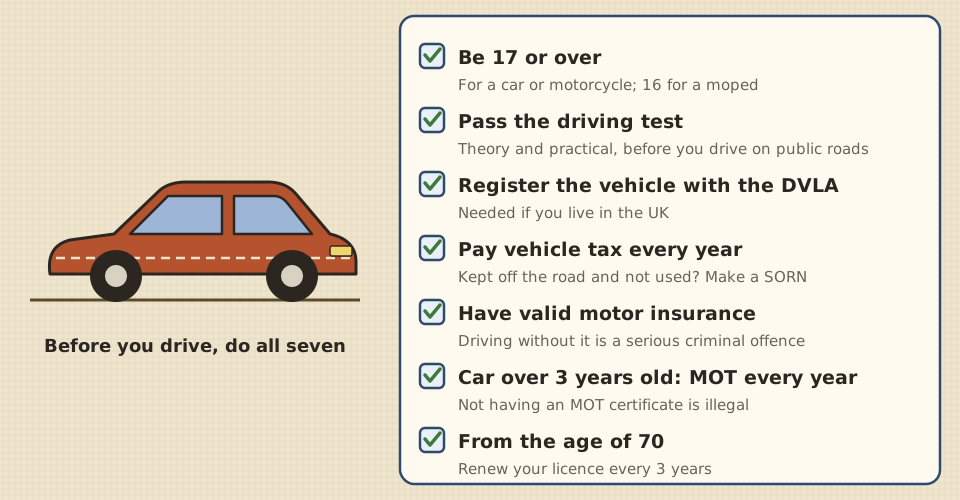
In the UK, you must be at least 17 to drive a car or ride a motorcycle, and you need a driving licence to use public roads. To get a UK licence you must pass a driving test, which checks your knowledge and your practical driving skills. You must be at least 16 to ride a moped (a small, low-powered motorbike), and there are other age rules and special tests for driving large vehicles.
Your licence is valid until you are 70. After that, you renew it every 3 years.
In Northern Ireland, new drivers must display an "R" plate (for "restricted driver") on their car for 1 year after passing their test.
A licence issued abroad can be used for up to 12 months in the UK; after that, if you want to keep driving, you must get a full UK licence. Check the GOV.UK page about driving on a non-GB licence to make sure yours is accepted.
Seven things to do before you drive.
Rules for the vehicle
If you live in the UK, your car or motorcycle must be registered with the Driver and Vehicle Licensing Agency (DVLA). Every year you have to pay vehicle tax, and when the vehicle changes owner, the tax can't be handed on to the new keeper. If you keep the vehicle off the road and don't use it, you must make a Statutory Off Road Notification (SORN) to the DVLA; a SORN can't be passed to a new owner either. You must also have valid motor insurance: driving without insurance is a serious criminal offence. If your vehicle is more than three years old, it needs an MOT test every year, and it is against the law not to have an MOT certificate.
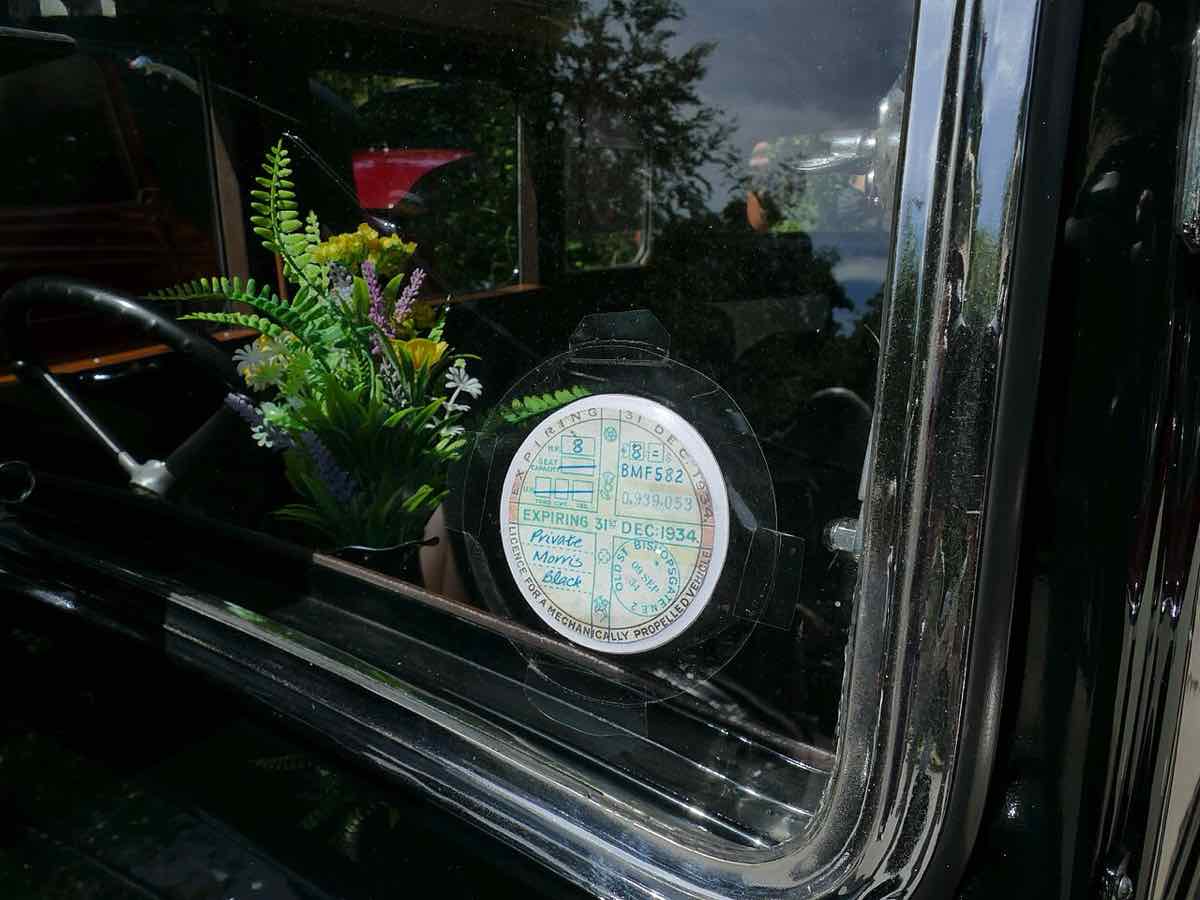
An old-style paper tax disc, seen at a classic car show. Until October 2014, every car in the UK had to display one on its windscreen.
Photo: Stephen Craven / Geograph, CC BY-SA 2.0, via Wikimedia Commons
MOT stands for Ministry of Transport, a ministry that was renamed long ago, though the test kept its name. When the test began in 1960 it only applied to cars more than 10 years old; in 1967 that was cut to 3 years. Learning to drive works like this: you apply for a provisional licence, take lessons with an instructor, and then pass a theory test (multiple-choice questions plus a hazard perception test) and a practical driving test.
Quiz
Which TWO of the following statements about minimum ages are correct?
The minimum age is 16 for a moped, and 17 for a car or a motorcycle. A motorcycle is bigger and more powerful than a moped, so its minimum age is higher.
Quiz
Which TWO of the following are legal requirements for driving your own car in the UK?
Motor insurance is a must: driving without it is a serious criminal offence. And once a car is over three years old, it needs an MOT every year. You don't have to carry your passport in the car, and you don't retake the test every five years: your licence lasts until you are 70.
Quiz
What must you do if your car is kept off the road and you are not using it?
A vehicle that is parked off the road and not used needs a SORN (Statutory Off Road Notification) sent to the DVLA. Like vehicle tax, a SORN does not pass to the next owner if you sell the vehicle or give it away. The MOT is a yearly test for vehicles over three years old, not a six-monthly one.
Chapter summary
Shared values
Keep the law, respect others' rights, be fair, behave responsibly, look after your family, protect the environment, treat everyone equally, work to support your family, help others, vote
Good neighbour
Introduce yourself; respect privacy, keep noise down, keep your garden tidy; bins out only on collection day
Jury service
Picked at random from the electoral register, aged 18 to 70 (18 to 75 in England and Wales)
Schools & PTAs
Help in class, listen to children read, raise money; PTAs run events
School governors
18 or over, no upper age limit; strategic direction, accountability, monitoring and evaluating (Scotland: school boards)
Canvassing
Handing out leaflets and knocking on doors; you don't have to say how you'll vote
Standing for office
British citizens can stand as a councillor or MP (or for a devolved parliament or assembly); Irish and eligible Commonwealth citizens may also be able to
Local services
Hospitals and youth projects; special constables, lay representatives, magistrates
Blood & organs
Giving blood takes about an hour; registering as an organ donor helps your family decide; living people can donate a kidney
Charities
Age UK: older people; NSPCC: children; PDSA: animals; National Trust and Friends of the Earth: environment
NCS
National Citizen Service: for 16- and 17-year-olds
Environment
Recycle (less energy, fewer raw materials, less landfill), shop locally, walk or use public transport
PAYE / self-assessment
Employers take income tax from pay and send it to HMRC; self-employed people do self-assessment
National Insurance
Pays for the state pension and the NHS; you get your number just before 16; others apply by phone, then go to an interview at Jobcentre Plus
Driving
Cars from 17, mopeds from 16; licence valid to 70, then renewed every 3 years; a licence from another country for up to 12 months
Car rules
Register with the DVLA, pay vehicle tax every year (SORN if the vehicle is off the road and not used), have insurance (driving without it is a serious crime), MOT every year after 3 years

 Roads
 Education
 Police
 The armed forces