The Tudors: Six Wives, a New Church and the Armada
A king wanted a divorce, and to get it he gave his whole country a new church. His three children took the throne one after another, and the nation's religion swung back and forth with each of them: Protestant, then Catholic, then Protestant again. Finally, a queen who never married beat the most powerful fleet in Europe.
This is the story of the Tudors and their 118 years on the throne. The last chapter ended with Henry Tudor winning at Bosworth and becoming Henry VII. This chapter begins with him.
1485Henry VII becomes king and the Tudor period begins
1509Henry VIII becomes king; later he breaks with Rome and sets up the Church of England
1547Edward VI becomes king at the age of 9; the Book of Common Prayer is written in his reign
1553Mary I becomes queen and brings back the Catholic faith
1558Elizabeth I becomes queen and restores the Church of England
1560The Scottish Reformation: the Scottish Parliament ends the Pope's authority in Scotland
1588England defeats the Spanish Armada
1603Elizabeth I dies without children, and the Tudor period ends
Henry VII: the careful first Tudor king
After thirty years of the Wars of the Roses, Henry VII cared about two things above all: no more civil war, and a safe throne for himself.
His answer was to weaken the nobles and build up central government. The Wars of the Roses had been fought by great nobles with private armies of their own, so the weaker the nobles were, the safer the king felt. He was also very careful with money and saved up a large fortune for the Crown.
Henry VII went through the royal account books himself, writing his initials on page after page, and these books still survive today. Most of the money he saved was later spent by his big-spending son, Henry VIII.
Quiz
After the Wars of the Roses, what did Henry VII do to keep England peaceful and his throne secure?
The key words for Henry VII are "stronger central government" and "weaker nobles". Breaking with the Church of Rome was his son, Henry VIII. Parliament choosing the monarch only happened after 1688, which you'll read about in the next chapter.
Henry VIII: six wives and a new church
Henry VIII kept up his father's policy of strong central government. But he is best remembered for two things: splitting from the Church of Rome and having six wives.
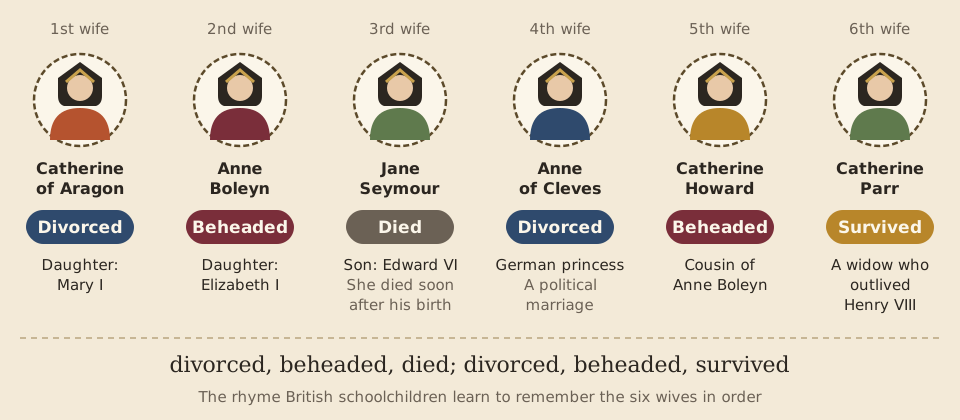
Henry VIII's six wives. British people remember what happened to them with a rhyme: divorced, beheaded, died; divorced, beheaded, survived.
Catherine of Aragon: a princess from Spain. Of all the children she had with Henry, only one lived: their daughter Mary. Once Catherine could no longer have children, Henry wanted a divorce.
Anne Boleyn: born in England. Her child with Henry was a daughter, Elizabeth. Many people in the country disliked her. She was charged with having affairs with other men and was put to death in the Tower of London.
Jane Seymour: at last gave Henry the son he longed for, Edward. Sadly, she died soon after giving birth.
Anne of Cleves: a princess from Germany. Henry married her to make a political alliance, and the marriage was quickly ended. Henry had chosen her after seeing a portrait of her by his court painter, Holbein, but he was disappointed when they actually met, and the marriage lasted only about six months. Anne wisely agreed to end it, and in return she got rich lands, a good income and the title of "the King's beloved sister". She outlived all the others and was the last of the six queens to die.
Catherine Howard: a cousin of Anne Boleyn. Like Anne, she was charged with having affairs, and she too was executed.
Catherine Parr: a widow whom Henry married near the end of his life. She lived longer than Henry and married again, but she died not long afterwards.
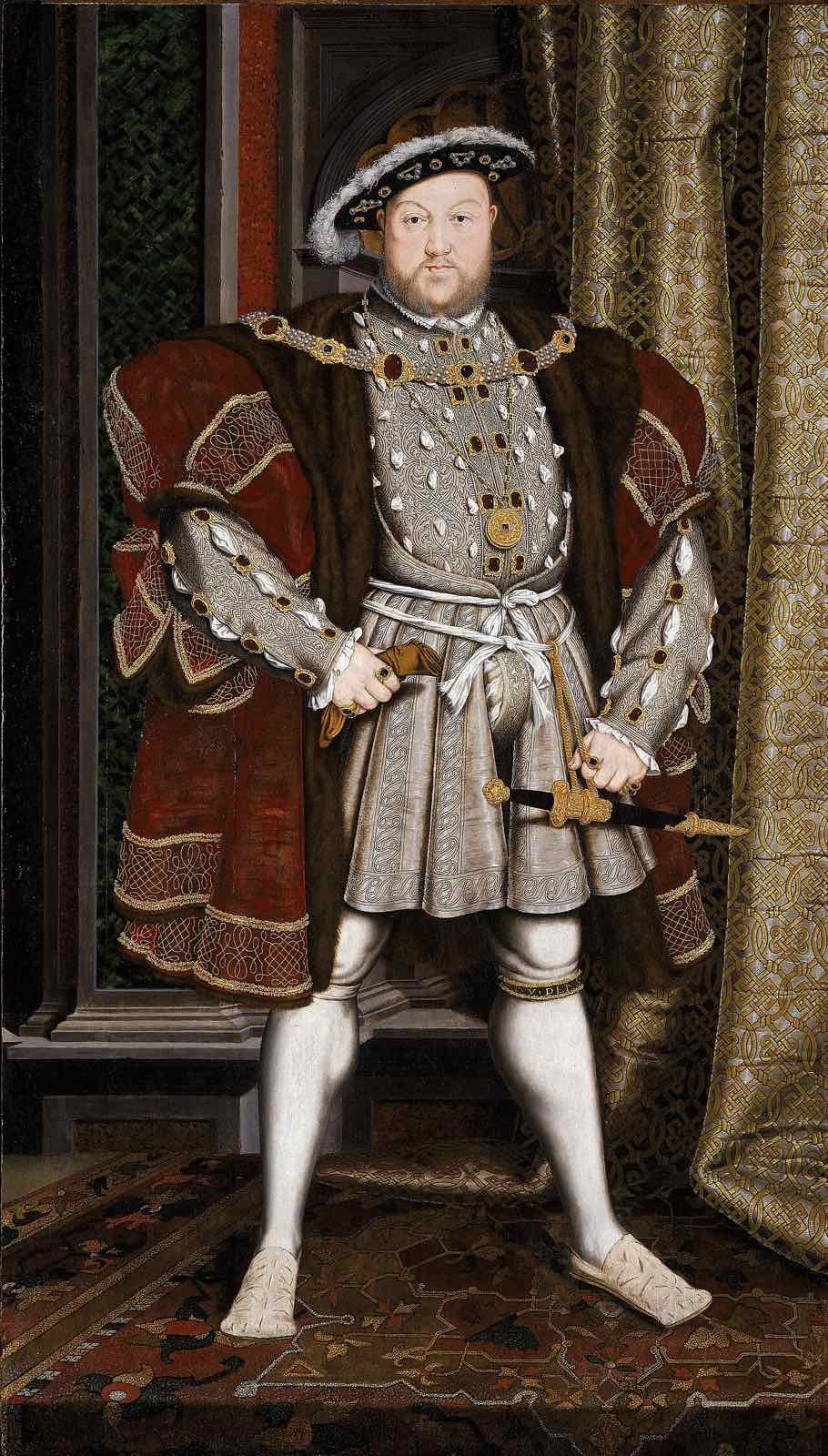
Henry VIII, painted by the workshop of Hans Holbein the Younger, around the 1540s. The wide-legged stance and huge shoulders were meant to make the king look powerful.
Workshop of Hans Holbein the Younger, public domain, via Wikimedia Commons
A new church so he could get divorced
Henry and his first wife Catherine had no son who survived, and he wanted to divorce her and marry someone else. But England was a Catholic country, and a divorce needed the permission of the Pope. The Pope said no.
So Henry cut England off from the Church of Rome and created the Church of England, where the king took the Pope's place. Now he appointed the bishops and set the rules for how people worshipped.
Quiz
Which TWO wives of Henry VIII were executed?
Anne Boleyn and her cousin Catherine Howard were executed. Jane Seymour died after giving birth to Edward, and Catherine Parr outlived Henry. In the rhyme, the two "beheaded"s are wives number 2 and number 5.
Quiz
Why did Henry VIII establish the Church of England?
The reason was a personal one: the Pope would not let him divorce Catherine of Aragon. The Armada came in the time of his daughter, Elizabeth I. Parliament refusing money and the union of England and Scotland both belong to the Stuart period in the next chapter.
The Reformation: where Protestants came from
While Henry was quarrelling with the Pope, a much bigger change was sweeping across Europe: the Reformation. This was a movement that challenged the Pope's authority and many of the beliefs and customs of the Roman Catholic Church.
Its supporters were called Protestants, and they formed churches of their own. Protestants and Catholics differed in three big ways:
Reading the Bible in your own language, not in Latin
No praying to saints or at shrines (holy places)
Your own relationship with God matters more than obeying the Church
Quiz
Which of the following statements is correct?
It's the other way round. Latin was the tradition of the Catholic Church; Protestants wanted people to read the Bible in their own language.
Wales and Ireland
Wales: formally joined to England
Henry VIII's stronger central government did not stop at England's borders: it reached into Wales and Ireland too. In his reign, Parliament passed laws known as the Act for the Government of Wales. They formally united Wales with England. From then on Wales had members in the House of Commons, and its courts and laws were reorganised.
The Tudors were Welsh themselves. The family came from Anglesey, an island off north Wales, and in 1485 Henry VII landed in south-west Wales and gathered soldiers as he marched towards Bosworth. So the family that tied Wales and England together was Welsh itself.
Ireland: Henry VIII becomes "King of Ireland"
At this time nearly everyone in Ireland was Catholic. Henry VII and Henry VIII pushed English control out beyond the Pale. Henry VIII also took the title King of Ireland. English laws were brought in, and local leaders had to obey the Lord Lieutenant, the king's governor in Dublin.
But the Reformation caused a backlash in Ireland. The English tried to force the Protestant religion on the Irish, and they also brought in English rules about who inherits land. The Irish chieftains (clan leaders) rose up, and years of brutal fighting followed.
Quiz
Is the statement below TRUE or FALSE?
The Act for the Government of Wales, passed while Henry VIII was king, formally joined Wales with England.
True. Don't mix it up with the Statute of Rhuddlan (1284, Edward I) from the last chapter, which put Wales under the English Crown. Henry VIII's laws went further: they formally united Wales with England and gave it representatives in Parliament.
Three children, three faiths
Henry VIII died in 1547. His three children came to the throne one after another, and with every new ruler the country's religion swung in a different direction.
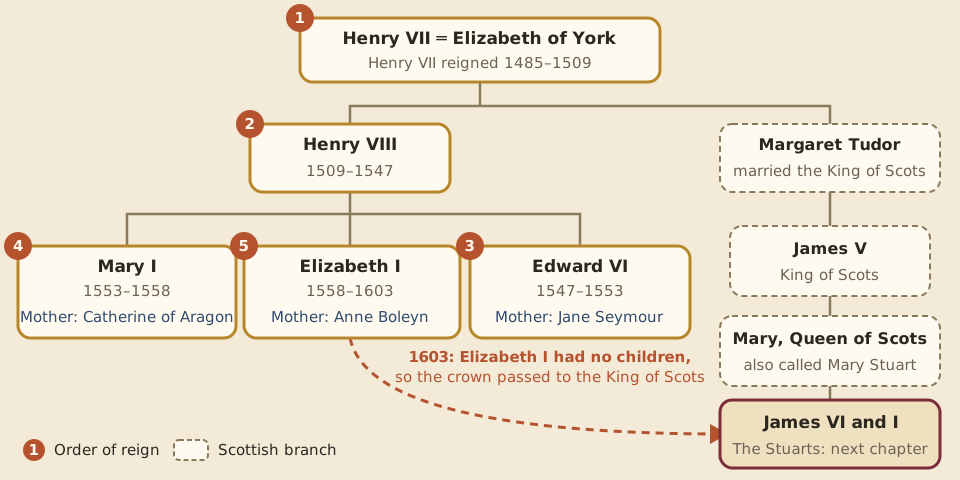
The Tudor family tree. The red numbers show the order in which they reigned: Edward was the youngest, but as a boy he came before his two older sisters. The dashed line on the right is the branch of the family that married into Scotland. The main characters of the next chapter come from there.
Edward VI: the boy Protestant king
Jane Seymour's son Edward VI became king at the age of 9. He was a firm Protestant. During his reign the Church of England got its Book of Common Prayer, which set out the words to be said in church services. Some churches still use a version of it today.
Edward was never strong. He reigned for just over six years and died when he was only 15.
Edward was afraid his Catholic sister Mary would become queen, so just before he died he left the crown to his Protestant cousin, Lady Jane Grey. She was queen for only nine days before crowds who supported Mary pushed her out, and she was executed the following year. Because her reign was so short, and many said it wasn't lawful, lots of lists of English monarchs leave her out.
Mary I: "Bloody Mary"
Next came Mary I, the daughter of Catherine of Aragon. She was a devout Catholic. She took England back to the Catholic Church and persecuted Protestants (punished them cruelly for their faith). Nearly 300 people were burned to death, which is why she became known as "Bloody Mary". Her reign was short too: she died five years later.
Mary I married the Spanish prince Philip, who later became King Philip II of Spain, and while Mary was alive he even used the title King of England. Thirty years later, the man who sent the Armada to attack England was Elizabeth I's former brother-in-law.
Elizabeth I: the queen who found a balance
Mary's half-sister Elizabeth I, the daughter of Anne Boleyn, became queen in 1558. She was a Protestant, and she made the Church of England the country's official church once again.
Her approach was clever. Everyone had to go to their local church, and the law fixed what services and prayers could be used. But she did not try to find out what people truly believed in private. In this way she steered a middle path between Catholics and the stricter Protestants, and kept England free of serious religious conflict. She never married.
Quiz
Which monarch was on the throne when the Book of Common Prayer was produced for the Church of England?
The Book of Common Prayer was written under the Protestant boy king, Edward VI. Watch out for C: under James I a new English Bible appeared, the King James Bible, which comes in the next chapter.
Quiz
Which of the following statements is correct?
"Bloody Mary" was a Catholic, and the people she persecuted were Protestants. The Protestant monarch linked to the Book of Common Prayer was her brother, Edward VI.
Quiz
Is the statement below TRUE or FALSE?
Elizabeth I was a Catholic who brought England back under the authority of the Pope.
False. Elizabeth I was a Protestant, and she restored the Church of England. It was her sister, Mary I, who took England back to the Catholic Church. A memory trick: Henry's three children go Protestant, Catholic, Protestant (Edward, Mary, Elizabeth), or "P, C, P".
1588: the Spanish Armada
In Elizabeth's time the English became more and more patriotic, which means proud of their country. English explorers set out to find new trade routes and tried to push into Spain's colonies in the Americas.
Catholic Spain had had enough. In 1588 King Philip II sent a huge fleet of warships, the Spanish Armada, to conquer England and bring back the Catholic faith. But the English beat it. The victory made Elizabeth I one of England's best-loved rulers ever.
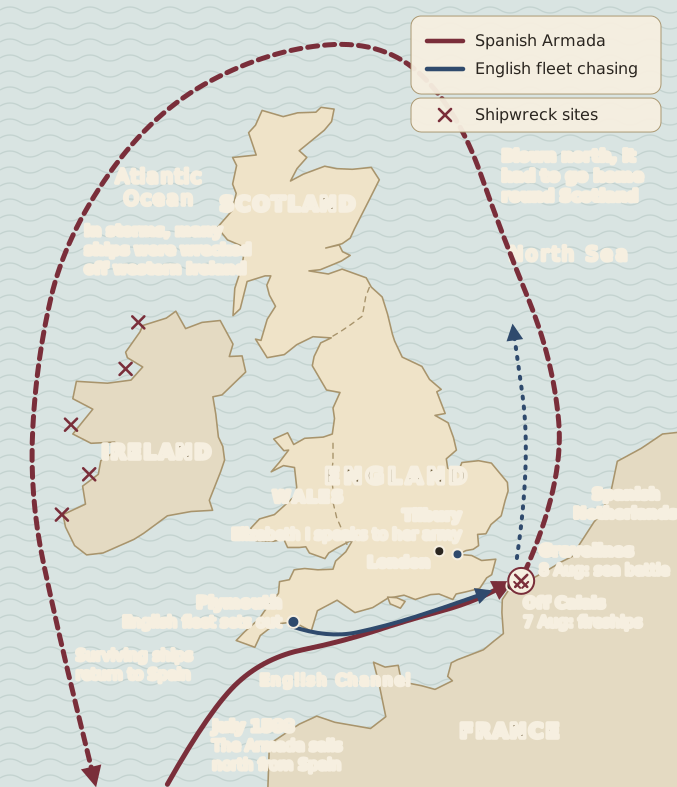
The Armada's route. It couldn't turn round and sail home through the Channel, so it had to go all the way round Britain, and storms did terrible damage on the way.
In the summer of 1588 the Armada sailed into the English Channel in a crescent (a curved shape like a new moon). The English fleet came out of Plymouth and followed it, firing as it went. When the Armada dropped anchor off Calais in France, the English set fire to a few empty ships in the middle of the night and sent them drifting into the Spanish fleet. The Spanish ships cut their anchor ropes and scattered in panic, and the next day they were beaten at the Battle of Gravelines.
Then a south wind pushed what was left of the Armada northwards. The only way home was round the top of Scotland and down the west coast of Ireland. On the way it ran into storms, and many ships were smashed on the rocks.
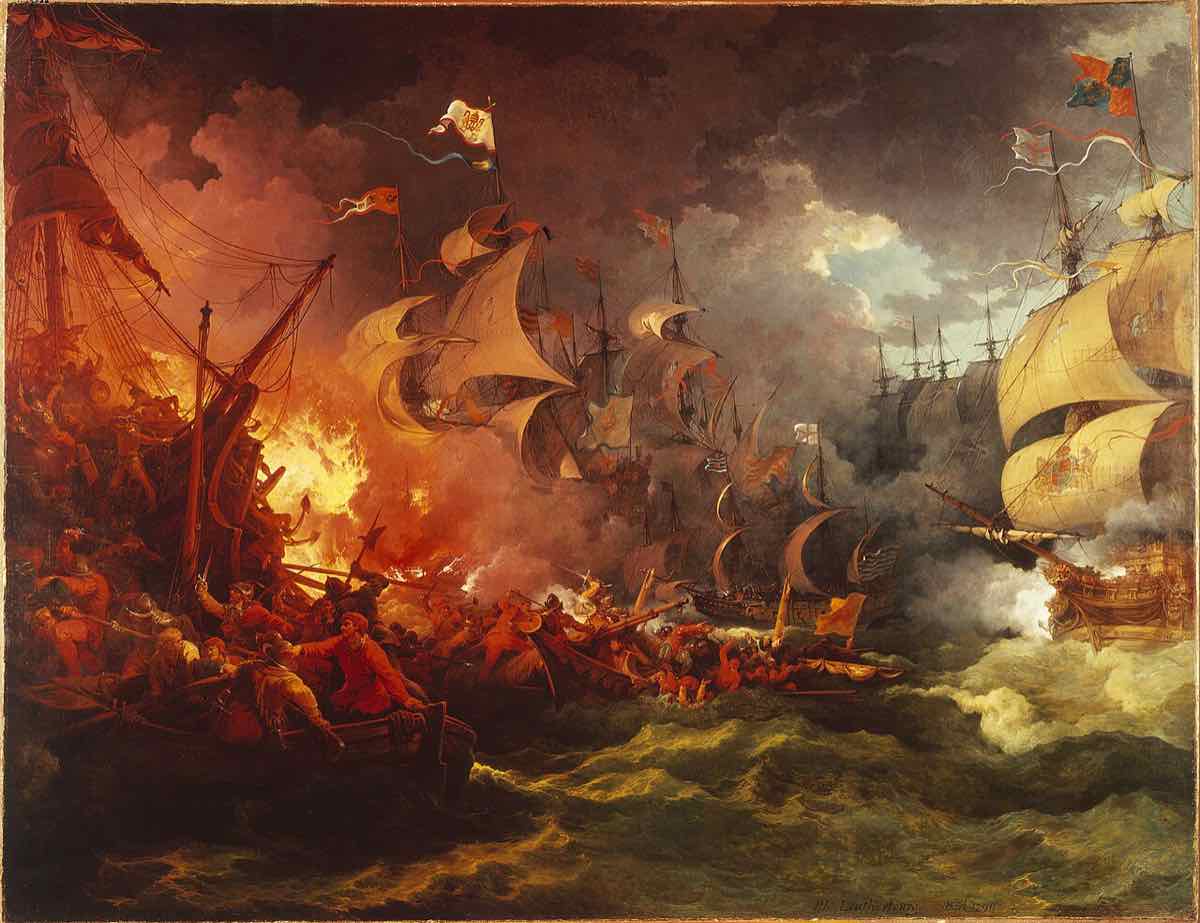
The battle against the Armada as Philip James de Loutherbourg imagined it in 1796. The painting is now at Royal Museums Greenwich.
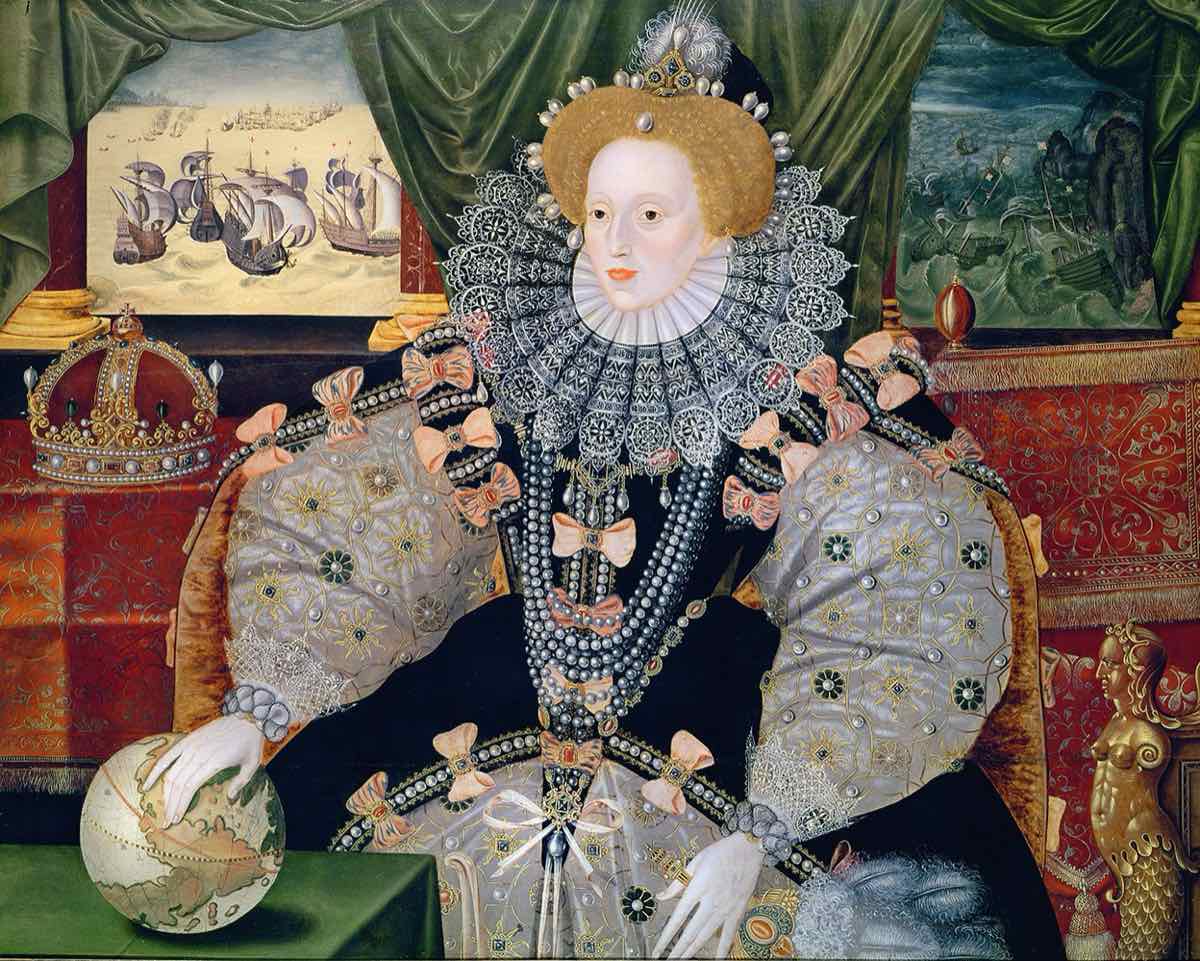
Painting by Philip James de Loutherbourg, public domain, via Wikimedia CommonsThe "Armada Portrait". Elizabeth I rests her right hand on a globe. In the background, the window on the left shows the Armada approaching, and the one on the right shows Spanish ships sinking in a storm.
Unknown artist (once thought to be George Gower), about 1588, public domain, via Wikimedia Commons
The best-known legend says that when the Armada was spotted, Drake was playing bowls (a game where you roll heavy balls across a lawn) on the grass above the sea at Plymouth, and insisted on finishing his game. The story only appears in writing decades later, so most historians treat it as a legend. Still, the tide and the wind really did keep the English ships in harbour for a while, so he had a point.
Another famous line comes from the speech Elizabeth I made to her soldiers at Tilbury: she might have the body of a weak woman, but she had the heart of a king. She really did visit the army and speak to them, but the version we know was written down decades later, so nobody can be sure of her exact words.
Sir Francis Drake and the Golden Hind
Among the leaders who beat the Armada was Sir Francis Drake. He helped to start England's long tradition as a great sea power. His ship, the Golden Hind, was among the earliest to sail right round the globe.
Drake sailed round the world between 1577 and 1580, the first English captain to do it. His ship began the voyage as the Pelican and was renamed the Golden Hind on the way, and when he got home Elizabeth I came on board and knighted him on the deck. Today a full-size copy of the Golden Hind sits on the south bank of the Thames in London, and you can go on board. To the Spanish, though, Drake was a pirate who kept robbing their ships.
Quiz
Sir Francis Drake's ship was among the first to circumnavigate the globe. What was it called?
The Golden Hind. The Mary Rose was Henry VIII's warship; HMS Victory was Nelson's flagship at the Battle of Trafalgar in 1805; and the Mayflower carried a group of Puritan settlers to America in 1620. All three are real, famous ships, which makes them good trap answers.
Quiz
Why did Spain send the Armada against England in 1588?
Spain was a Catholic country, and its aim was to conquer England and restore the Catholic faith. Henry VIII had died back in 1547, and it was the English, not the Spanish, who set up colonies on America's east coast.
Scotland: the Reformation and Mary, Queen of Scots
North of the border, Scotland was still a separate kingdom with its own rulers, and it had a Reformation of its own. It became Protestant too, but not in the same way as England. In 1560 the Scottish Parliament, where most members were Protestants, abolished the Pope's power in Scotland, and Catholic services were made illegal. The new Protestant Church of Scotland was led by people who had been elected to the job, and, unlike the Church of England, it was not a state church.
The leader of the Scottish Reformation was a preacher called John Knox. In 1558 he published a pamphlet attacking the very idea of women ruling countries, aimed at the Catholic queens of the time. Bad timing: that same year the Protestant Elizabeth I came to the throne, and she never liked Knox after that.
Mary, Queen of Scots
Scotland's queen at the time was Mary Stuart, usually known today as Mary, Queen of Scots. She was a Catholic. Her father died when she was just a week old, so she became queen as a baby. She spent most of her childhood in France.
Back in Scotland, rival groups fought for power around her. After her husband was murdered, many people thought she had a hand in it. She escaped to England, leaving the Scottish crown to her son, James VI, who was a Protestant.
Mary and Elizabeth I were cousins, and Mary expected help from her. Instead, Elizabeth feared that Mary had her eye on the English crown. She held Mary captive for 20 years, and in the end Mary was put to death for plotting against her.
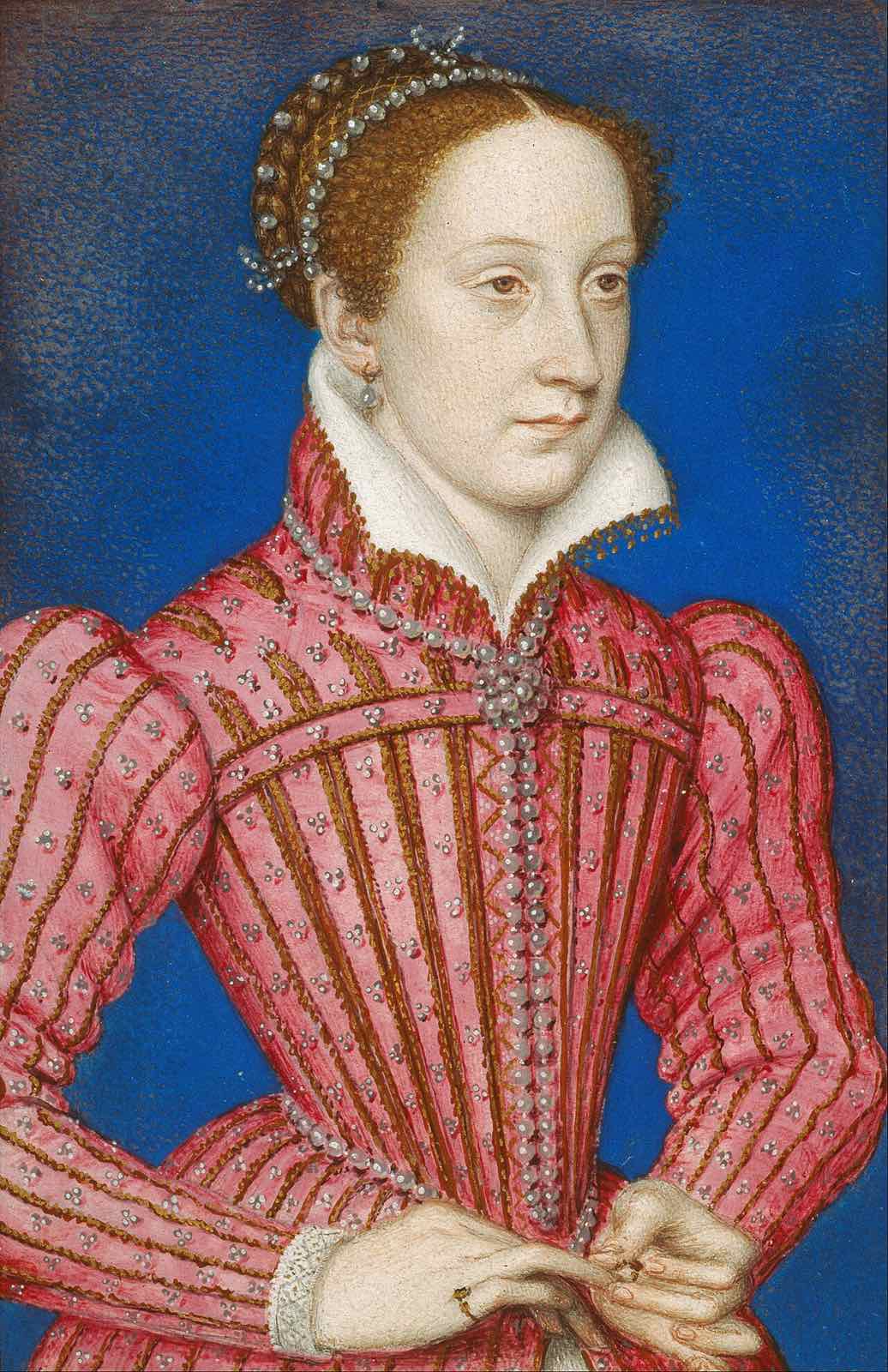
Mary, Queen of Scots, painted by the French court artist François Clouet in about 1558–1560. She was still living in France then, and was briefly Queen of France.
Painting by François Clouet, Royal Collection, public domain, via Wikimedia Commons
Quiz
Is the statement below TRUE or FALSE?
Mary, Queen of Scots, spent 20 years as Elizabeth I's prisoner before being put to death.
True. Elizabeth kept Mary prisoner for 20 years, and Mary was then executed for plotting against her. Remember too that Mary was a Catholic, while her son James VI was a Protestant.
The Elizabethan age: Shakespeare and the New World
Back in England, Elizabeth's reign is remembered for much more than a victory at sea. The greatest gift of the Elizabethan period to later generations was its poetry and drama, above all the plays and poems of William Shakespeare (1564–1616).
Shakespeare was born in Stratford-upon-Avon. He was both a playwright (someone who writes plays) and an actor, and he wrote a great many plays and poems. He put important moments from history on stage, but he didn't write only about kings and queens: he was among the first playwrights to show ordinary English men and women. Many people think he is the greatest playwright who ever lived. He also left a deep mark on the English language and invented lots of words we still use today.
Among his best-known plays are Hamlet, Macbeth, Romeo and Juliet and A Midsummer Night's Dream.
Shakespeare's acting company built the Globe Theatre on the south bank of the Thames in London. In 1613, during a performance of Henry VIII, a cannon fired on stage as a special effect set light to the thatched roof (a roof made of dried straw or reeds), and the whole theatre burned down in less than an hour. According to a letter written at the time, nobody died; one man's trousers caught fire, and someone put the flames out with a bottle of ale. Today's Shakespeare's Globe is a copy, rebuilt in 1997 near the original site, and it was the first building in London allowed a thatched roof since the Great Fire of 1666.
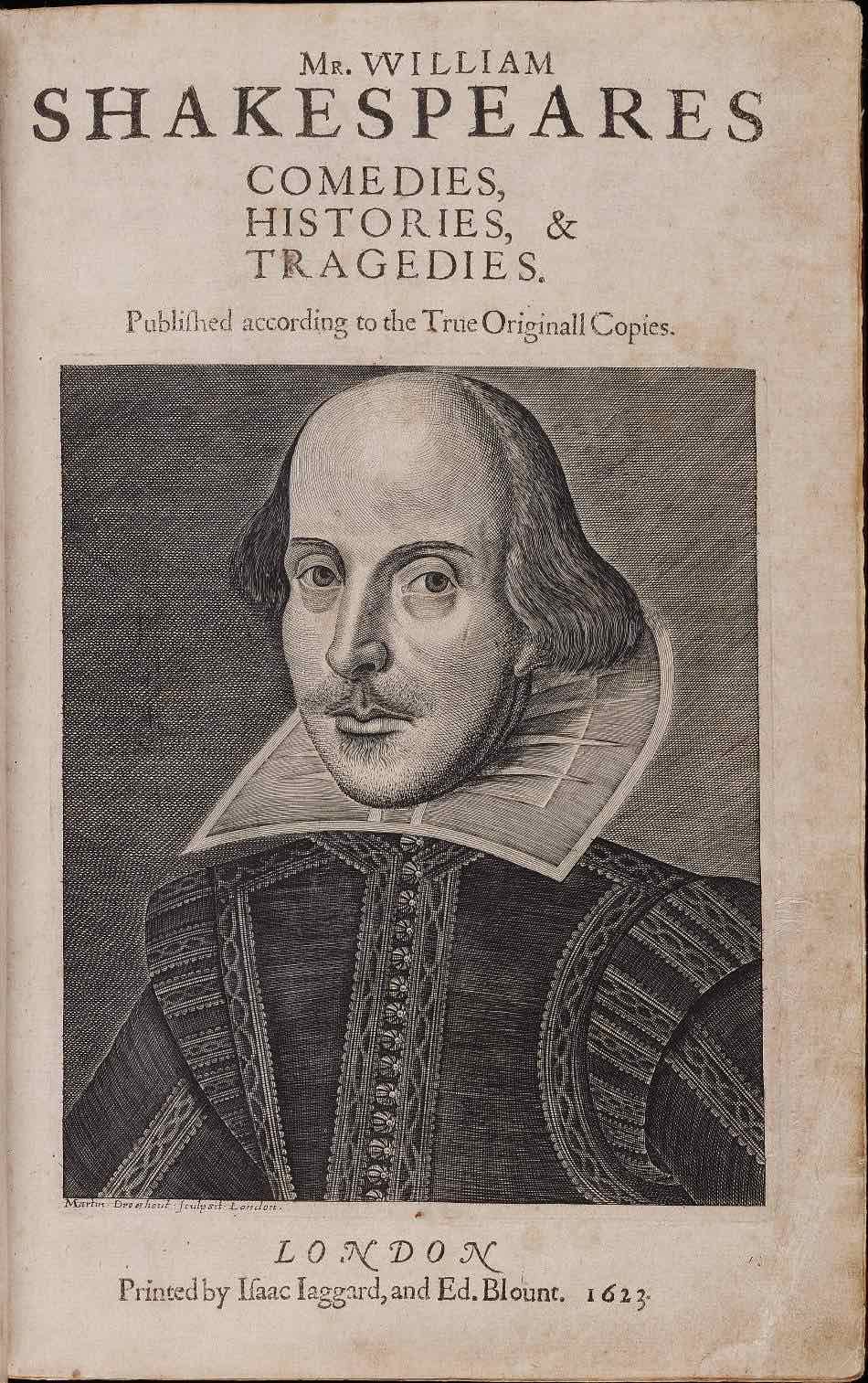
The title page of the "First Folio", the 1623 collection of Shakespeare's plays. Two actor friends put it together seven years after he died. Half the plays in it had never been printed before; without this book, Macbeth might have been lost for ever.
Engraving by Martin Droeshout, Beinecke Library and the Elizabethan Club, Yale University, public domain, via Wikimedia Commons
Lines from his work are still quoted all the time, and the test may ask which lines come from Shakespeare:
Once more unto the breach
Henry V: the king urges his soldiers to charge one more time
To be or not to be
Hamlet: Hamlet wonders whether it is better to live or to die
A rose by any other name
Romeo and Juliet: a rose would smell just as sweet if it had a different name
All the world's a stage
As You Like It: life is like a play, and we are all actors in it
The darling buds of May
Sonnet 18: the lovely young flowers of spring
The first colonies in America
It was also in this period that English settlers started colonising the east coast of America. Many more followed in the next century, and many of them were people who did not share the religious beliefs of the next two kings.
Because Elizabeth I never married, she was called "the Virgin Queen". In the 1580s the explorer Walter Raleigh sent people to the east coast of North America and named the land Virginia in her honour. One group of settlers built a colony on Roanoke Island, which later vanished without a trace and became known as the "Lost Colony". England's first settlement in America that lasted was Jamestown, founded in 1607, but that belongs to the next chapter.
Elizabeth I was the last of the Tudors. When she died in 1603, the crown passed to her relatives in Scotland, and a new royal family took over: the Stuarts.
Quiz
Which TWO of the following are lines from plays by William Shakespeare?
"Once more unto the breach" is from Henry V, and "To be or not to be" is from Hamlet. B comes from a 1940 speech by Winston Churchill. D is the song sung to a march by Edward Elgar, often performed on the Last Night of the Proms. Both of these come up in later chapters.
Chapter summary
Henry VII
Stronger central government, weaker nobles, careful with money
Henry VIII's six wives
Catherine of Aragon (divorced), Anne Boleyn (beheaded), Jane Seymour (died), Anne of Cleves (divorced), Catherine Howard (beheaded), Catherine Parr (survived)
Church of England
The Pope would not allow Henry VIII's divorce, so he set up the Church of England, with the king appointing bishops
Reformation
Protestants read the Bible in their own language, did not pray to saints and valued a personal relationship with God
Act for the Government of Wales
Under Henry VIII, Wales was formally united with England and gained seats in the House of Commons
Ireland
Henry VIII became "King of Ireland" and brought in English laws
Edward VI
Protestant; the Book of Common Prayer; died at 15
Mary I
Catholic; persecuted Protestants; "Bloody Mary"
Elizabeth I
Protestant; restored the Church of England; kept a religious balance; never married
1588 Spanish Armada
Spain tried to conquer England and restore Catholicism, and was defeated
Sir Francis Drake
One of the commanders against the Armada; the Golden Hind sailed round the world
1560 Scotland
The Scottish Parliament ended the Pope's authority; the Protestant Church of Scotland was not a state church
Mary, Queen of Scots
Catholic; fled to England; held prisoner by Elizabeth I for 20 years, then executed; her son James VI was a Protestant
Shakespeare
Born in Stratford-upon-Avon; Hamlet, Macbeth, Romeo and Juliet, A Midsummer Night's Dream; the Globe
Colonisation
Settlement of America's east coast began in Elizabeth I's time
 Reading the Bible in your own language, not in Latin
 No praying to saints or at shrines (holy places)
 Your own relationship with God matters more than obeying the Church