The Stuarts: Civil War, the Great Fire and the Glorious Revolution
A king is put on trial by his own Parliament and has his head cut off. Eleven years later, his son is invited back to be king. Less than thirty years after that, Parliament brings in a married couple from abroad to be king and queen, on one condition: from now on, the monarch has to listen to Parliament.
During the hundred or so years of the Stuarts, Britain moved from "the king decides" to "Parliament decides". Along the way came a plague, a fire that burned down half of London, and Newton's theory of gravity.
1603James VI of Scotland also becomes James I of England
1611The King James Version of the Bible is published
1642The English Civil War begins: Cavaliers against Roundheads
1649Charles I is executed and England becomes a republic
1660The Restoration: Charles II comes home and becomes king
1665–66The Great Plague and the Great Fire of London
1679The Habeas Corpus Act
1688The Glorious Revolution: William of Orange replaces James II
1689The Bill of Rights, the start of constitutional monarchy
1707The Act of Union creates the Kingdom of Great Britain
1714Queen Anne dies and the Stuart period ends
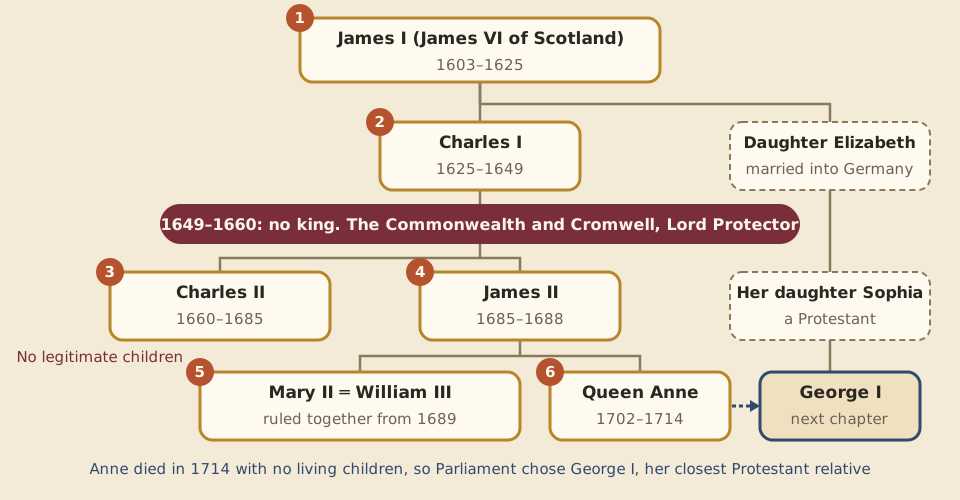
The Stuart family tree. The red numbers show the order in which they reigned, and the dark red bar in the middle marks the 11 years without a king.
1603: one king, two crowns
Elizabeth I never married, and when she died in 1603 she left no children. The throne went to a relative of hers: the son of Mary, Queen of Scots, who was already King James VI of Scotland. At the same time he took the crowns of England, Wales and Ireland, where he was known as James I.
From then on England and Scotland shared a king, but Scotland was still a separate country, with its own parliament and its own laws. Unlike his mother, James I was a Protestant.
That is why the same man has two numbers. Scotland had already had five kings called James, but England had never had one, so he was "the Sixth" in Scotland and "the First" in England. This happens a few more times later on, and the test likes to ask about it.
The King James Bible
One of the biggest achievements of James I's reign was a new English translation of the Bible. This is the King James Version, also called the Authorised Version, and it came out in 1611. It was not the first Bible in English, but many Protestant churches still use it today.
Printing it wasn't always smooth. In 1631 a London printer brought out a new edition but left the word "not" out of one of the Ten Commandments, so it told readers "Thou shalt commit adultery" (be unfaithful to your husband or wife). This edition became known as the "Wicked Bible". The printers were given a huge fine, most copies were destroyed, and only a handful survive today.
The Gunpowder Plot and the Union Flag
In 1605 a group of Catholics planned to blow up the Houses of Parliament and kill the Protestant king, James I. The plan failed, and Guy Fawkes, who was guarding the gunpowder, was caught on the spot. People in Britain still remember it with fireworks every 5 November, on Bonfire Night.
In 1606 the flags of England and Scotland were put together to make the first Union Flag. The red dragon of Wales isn't on it, because by then Wales had already been joined to England by Henry VIII's laws, which you met in the last chapter.
Quiz
After Elizabeth I's death in 1603, which ruler inherited her throne and was known in England as James I?
James VI of Scotland was the same man as James I of England, and he was the son of Mary, Queen of Scots. William of Orange belongs to 1688, while Robert the Bruce and Henry Tudor are figures from the Middle Ages.
Quiz
Which of the following statements is correct?
The King James Version was not the first English Bible, though many Protestant churches still use it. "Not the first" details like this are a favourite trap.
Ireland: the Ulster plantations
Ireland, James I's third kingdom, was still mostly Catholic, and the Tudors' attempts to force the Protestant faith on it had left deep anger. Under Elizabeth I and James I, many Irish people resisted being ruled by England's Protestant government, and there were several rebellions. The English government's answer was to encourage Protestants from Scotland and England to move to Ulster, in the north of Ireland, and take over land that had belonged to Catholic landowners.
These new communities were called plantations. A lot of the newcomers were from the south-west of Scotland, and some of the land was handed to companies in London. Later James I set up similar plantations in other parts of Ireland too. The plantations caused deep problems for England, Scotland and Ireland that lasted for centuries.
The trade guilds of the City of London paid towards the plantations, so in 1613 the city of Derry in the north of Ireland was renamed "Londonderry". Even today, the name someone chooses often shows their politics, and the plantations are one of the roots of the division between Protestants and Catholics in Northern Ireland.
Quiz
Is the statement below TRUE or FALSE?
Under Elizabeth I and James I, Protestant settlers from Scotland and England were encouraged to settle in Ulster, taking land from Catholic landholders.
True: these were the Ulster plantations. Notice that the settlers were Protestants and the landholders who lost their land were Catholics. If a question swaps them round, it's false.
King versus Parliament: the Divine Right of Kings
Back in England, a bigger struggle was building over who really held power: the king or Parliament. Elizabeth I had been very good at handling Parliament. She knew how to steer between what she wanted, what the House of Lords wanted and what the House of Commons wanted, as the Commons became more and more Protestant.
The kings who came after her were not so skilful. James I and his son Charles I both believed in the Divine Right of Kings: the idea that God himself chooses the king, so a king doesn't need Parliament's permission for anything he does.
Charles I, who became king of England, Wales, Ireland and Scotland, ruled in exactly this way. When Parliament disagreed with his religious and foreign policies, he simply stopped calling it. For 11 years he tried every way he could think of to raise money without Parliament's approval, until trouble in Scotland forced him to call it again.
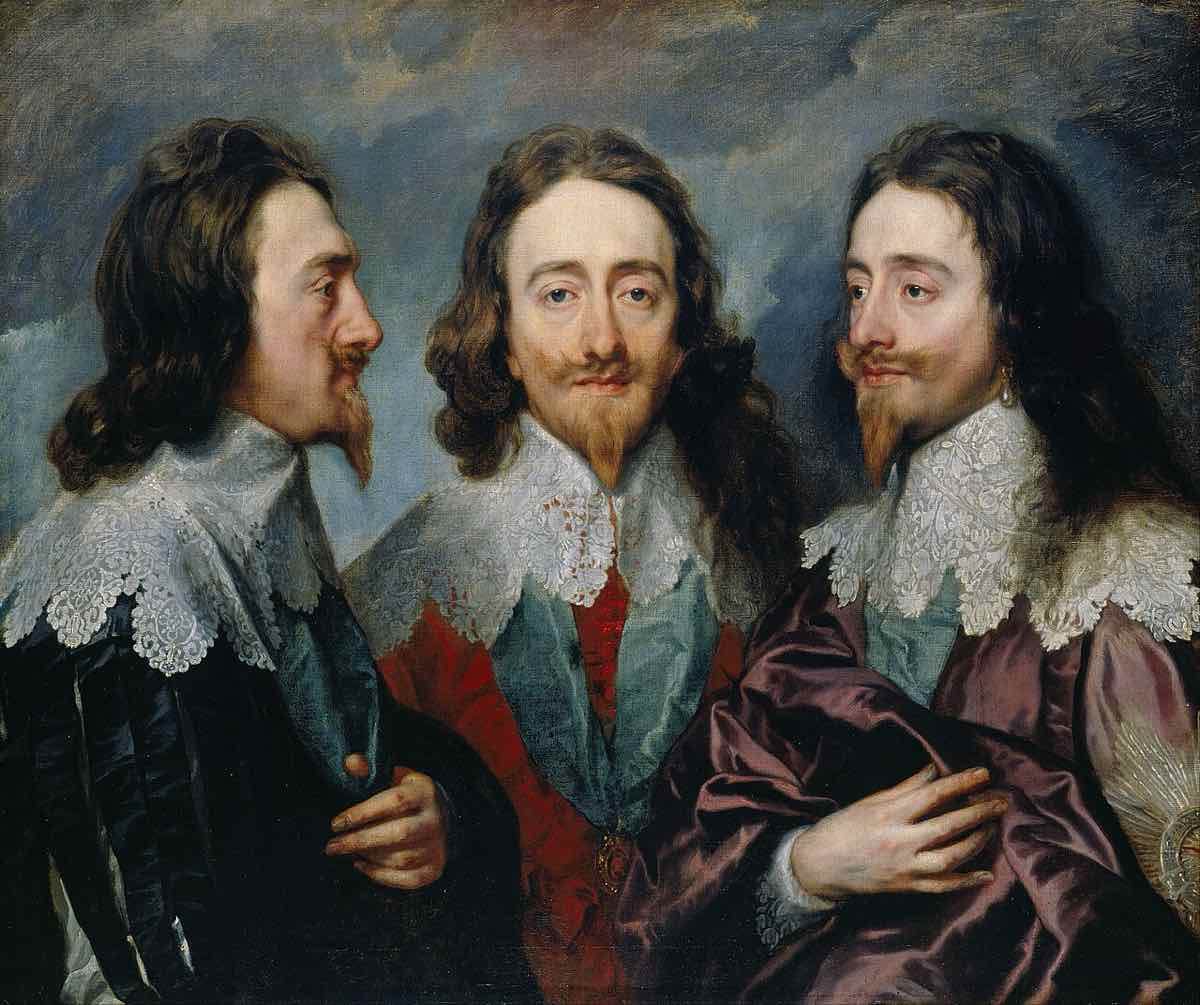
Anthony van Dyck's triple portrait of Charles I, 1635–1636. It was sent to Rome so that the sculptor Bernini could carve a marble bust of the king from it.
Painting by Anthony van Dyck, Royal Collection, public domain, via Wikimedia Commons
Quiz
James I and Charles I shared a belief that led Charles I to try to govern without Parliament. What was it called?
The Divine Right of Kings was the idea that God himself chose the king, so the king did not need Parliament's approval. Charles I acted on it and governed without Parliament for 11 years. Constitutional monarchy is the opposite idea and only began after 1688. Habeas corpus is the 1679 law against unlawful imprisonment, and the rule of law means that everyone, the king included, must obey the law.
The English Civil War
The spark was a prayer book. Charles I wanted Church of England services to have more ceremony, so he brought in a revised Prayer Book. He also tried to make the Presbyterian Church in Scotland use it. The Scots were furious and raised an army.
When the new prayer book was first used in St Giles' Cathedral in Edinburgh in 1637, the service turned into chaos. According to the popular story, a market trader called Jenny Geddes was so angry that she threw her stool at the minister. Historians aren't sure she ever existed, so this is probably a legend, but there is still a sculpture in the cathedral in her memory.
Charles I had no money to pay for an army against the Scots, so in 1640 he had to call Parliament and ask for funds. But many of its members were Puritans: Protestants who wanted religious teaching and worship to be strict and plain. They didn't like the king's religious ideas, and even when the Scottish army had marched into England, Parliament would not give him the money.
Then rebellion broke out in Ireland as well, because Irish Catholics were frightened by how strong the Puritans were becoming. Parliament seized the moment and demanded control of the English army, which would have taken a great deal of power away from the king. Charles lost his temper. He walked into the House of Commons in person to arrest five of Parliament's leaders, but someone had tipped them off and they had already left.
Since that day, no monarch has ever set foot inside the House of Commons. Every year at the State Opening of Parliament, the official who comes to summon MPs on the monarch's behalf, known as "Black Rod", walks up to the door of the Commons, and MPs slam it shut. Black Rod then has to knock three times before being let in, a reminder that the Commons won't let the monarch barge in.
In 1642 civil war broke out between the king and Parliament. The country split into two sides:
Cavaliers On the king's side. Remembered for their long curly hair and hats with feathers.
Roundheads On Parliament's side. The name came from the short haircuts some of them had.
Quiz
Which TWO statements about the English Civil War are correct?
Cavaliers backed the king; Roundheads backed Parliament. The war began in 1642. The date in C, 1745, is the Jacobite rising led by Bonnie Prince Charlie, which comes in the next chapter. A memory trick: "Cavalier" is related to "cavalry", soldiers on horseback, like the knights who served the king.
Oliver Cromwell and 11 years without a king
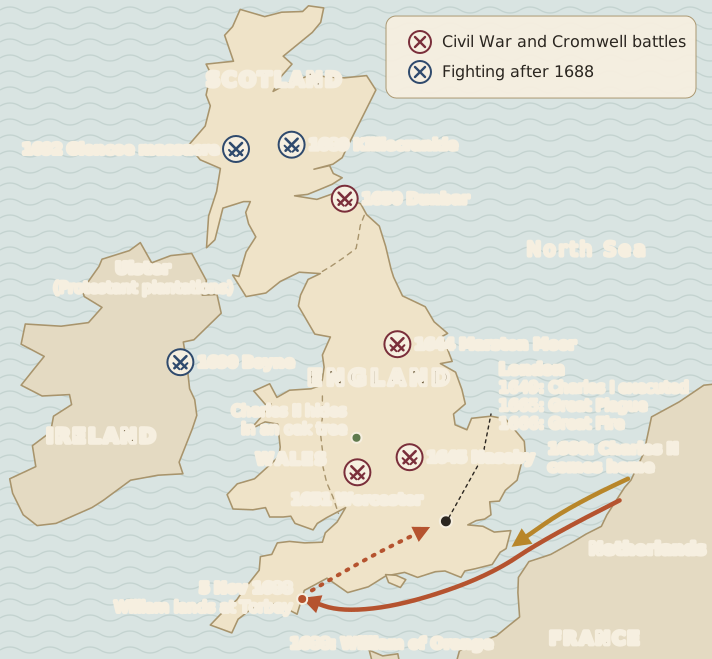
Places in this chapter. Dark red marks battles of the Civil War and Cromwell's time; blue marks fighting after the Glorious Revolution. William sailed from the Netherlands down the same Channel the Armada had used a hundred years before.
Parliament's forces beat the king's army at Marston Moor and then at Naseby. By 1646 the king had clearly lost the war.
Charles I was held prisoner by Parliament's army, but he still refused to make any deal with Parliament. In 1649 he was executed.
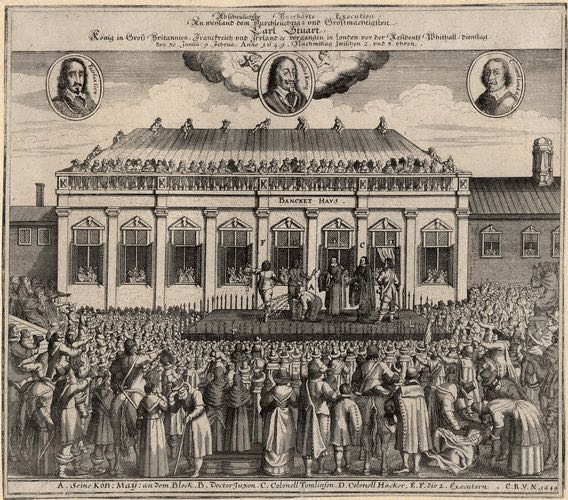
A German print from 1649 showing Charles I being beheaded outside the Banqueting House in Whitehall, London. It was 30 January 1649, a bitterly cold day, and Charles is said to have asked for an extra shirt so that he wouldn't shiver and make the crowd think he was afraid. He walked out to his death from this very building, whose ceiling is covered in huge paintings by Rubens that he himself had ordered to honour his father, James I, and the Divine Right of Kings.
Unknown artist, public domain, via Wikimedia Commons
The Commonwealth
England became a republic, known as the Commonwealth, with no king or queen. At first nobody was sure how the country should be run, and in practice the army was in control.
One of the army's generals, Oliver Cromwell, was sent to Ireland. A rebellion that had started there in 1641 was still going on, and there was also an army that fought for the king. Cromwell made the Irish obey the English Parliament, but his methods were so brutal that people in Ireland still argue about him today.
Scotland had never accepted the killing of Charles I. The Scots declared his son, Charles II, king and crowned him in Scotland. Charles II marched into England at the head of a Scottish army, but Cromwell beat him at Dunbar and again at Worcester. Charles fled from Worcester, at one point hiding up an oak tree, and finally escaped to Europe. Now Parliament controlled Scotland as well.
The oak tree was at Boscobel, in the middle of England, and the soldiers hunting for him passed right underneath. After he became king, the story was told again and again, and "The Royal Oak" became one of the most common pub names in Britain. Souvenir hunters slowly cut the original tree to pieces; the oak standing there today grew from one of its acorns' descendants.
After Ireland and Worcester, everyone saw Cromwell as the new republic's leader. He took the title Lord Protector and ruled until he died in 1658. His son Richard then became Lord Protector, but he could not control either the army or the government. By now the country had gone 11 years without a monarch, and without Cromwell there was no obvious leader and no settled way of governing. Many people longed for stability, and talk turned to bringing back a king.
Cromwell was never king: in 1657 Parliament offered him the crown, and he turned it down. After Charles II came back, Cromwell's body was dug up and hanged, and his head was stuck on a pole on the roof of Westminster Hall, where it stayed for more than twenty years. It then passed from owner to owner for nearly three centuries until, in 1960, it was buried at Sidney Sussex College, Cambridge, where Cromwell had studied.
Quiz
Is the statement below TRUE or FALSE?
Marston Moor and Naseby were the battles in which Cromwell defeated the Scottish army of Charles II.
False. Marston Moor and Naseby were battles of the English Civil War, where Parliament's army beat the army of Charles I; by 1646 Parliament had won. Cromwell defeated Charles II's Scottish army later, at Dunbar and Worcester.
Quiz
After Cromwell defeated him at Worcester, how did Charles II famously avoid being captured?
Charles II escaped from Worcester, at one point hiding in an oak tree, and then fled to Europe. He did not go to Ireland to join the Royalists. Escaping to the Isle of Skye is a story about a different prince: Bonnie Prince Charlie, after Culloden in 1746, whom you'll meet in the next chapter.
Quiz
What title was given to Oliver Cromwell as the leader of the new republic?
Cromwell was Lord Protector. He refused the crown and was never king. The job of Prime Minister only appeared in the 18th century, under George I, which you'll read about in the next chapter.
Quiz
Is the statement below TRUE or FALSE?
After Charles I was executed in 1649, his son immediately became King Charles II of England.
False. After 1649 England was a republic, the Commonwealth, with no king. Charles II was crowned in Scotland, but Cromwell beat him and he had to live in exile in Europe. He only came back to rule England in 1660.
The Restoration: Charles II comes back
In May 1660 Parliament asked Charles II, who was living in exile in the Netherlands, to return. He was crowned king of all four countries: England, Wales, Scotland and Ireland. He said plainly that he did not want "to go on his travels" ever again.
Charles II knew he couldn't always get his own way; sometimes he would have to strike a deal with Parliament. Most of the time, Parliament backed what he wanted to do. The Church of England became the official church once more, and neither Catholics nor Puritans were allowed any power.
1665: the Great Plague; 1666: the Great Fire
Plague swept through London in 1665 (the Great Plague), killing thousands, and the poorest districts suffered most. Then, in 1666, the Great Fire of London burned down a large part of the city. Many churches were lost, and so was the old St Paul's Cathedral.
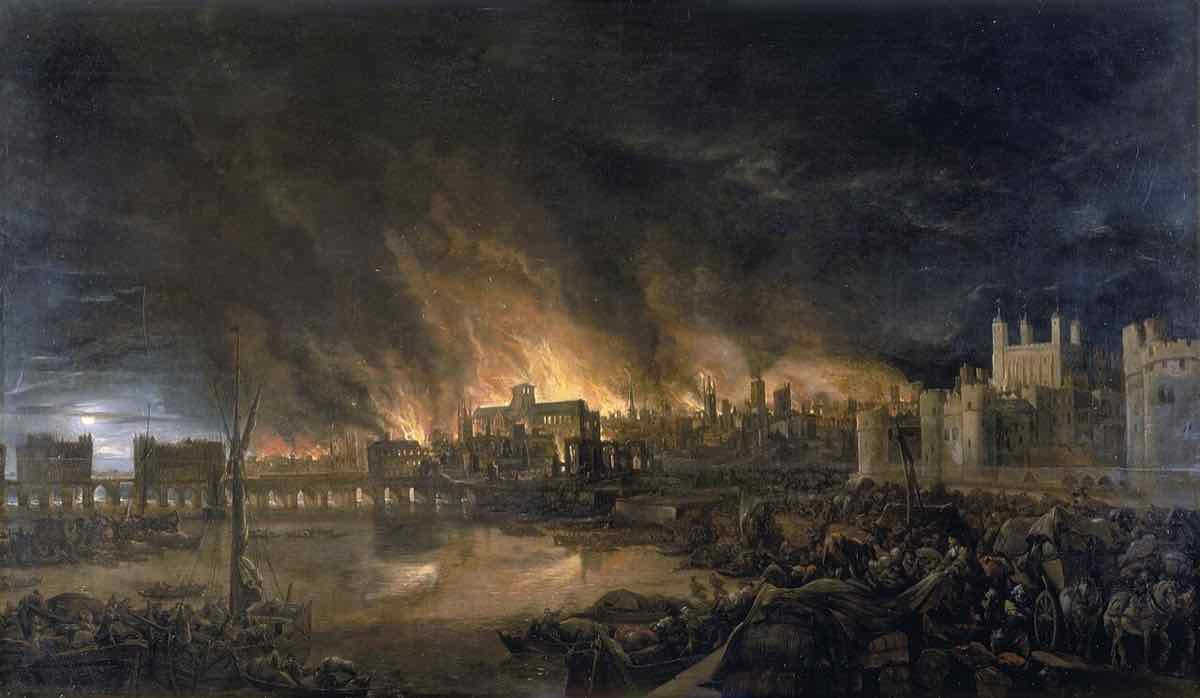
The Great Fire of London seen from the Thames, painted around 1675. On the left is the old London Bridge, which was still covered in houses at the time.
Unknown artist, Museum of London, public domain, via Wikimedia Commons
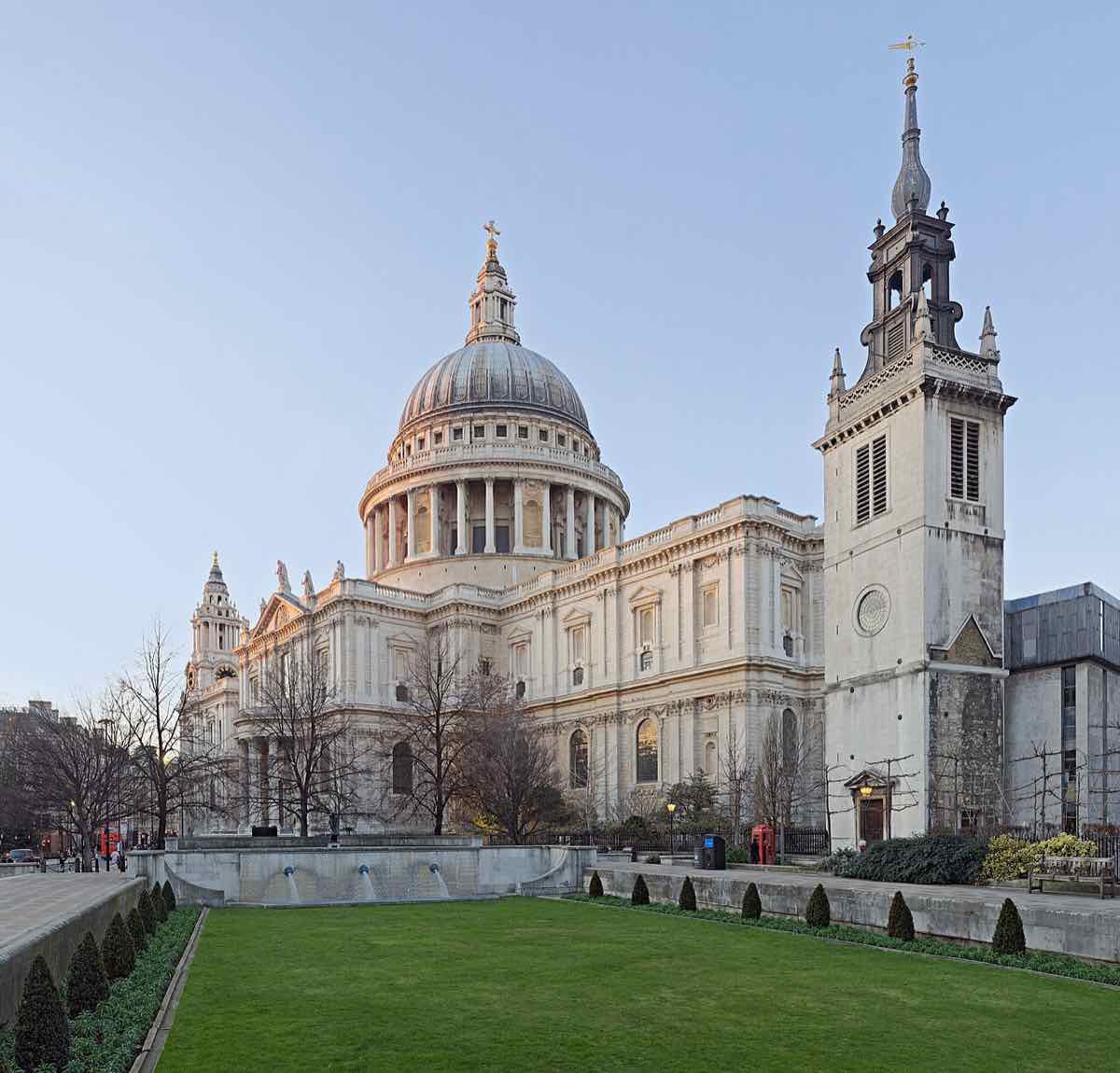
The city was rebuilt, and a new St Paul's Cathedral was designed by the famous architect Sir Christopher Wren. Samuel Pepys kept a diary describing what he saw. It was printed many years later, and people still read it today.
Wren's St Paul's Cathedral. Building began in 1675 and took more than thirty years. The lonely tower in front is the bell tower of another Wren church, left standing after bombing in the Second World War.
Photo: Diliff, CC BY-SA 3.0, via Wikimedia Commons
The fire started in a baker's shop in Pudding Lane and burned for four days, destroying about 13,000 houses. Pepys wrote in his diary that he dug a hole in his garden and buried his wine and a Parmesan cheese in it, hoping they would survive. Today the Monument to the Great Fire stands 61 metres tall, exactly the same as its distance from where the bakery stood. Wren himself is buried in St Paul's, and his gravestone says in Latin: "Reader, if you are looking for his monument, look around you."
The Habeas Corpus Act
In 1679 the Habeas Corpus Act became law, and it still matters a great deal today. Habeas corpus is a Latin phrase which roughly means "you must bring the person before the court". The Act made sure that nobody could be locked up without a lawful reason, and that everyone held in prison had the right to have their case heard by a court.
The law only just got through. According to Gilbert Burnet, a bishop at the time, when the House of Lords voted on it, one of the lords counting the votes jokingly counted a very fat lord as ten, so the law passed with a few "extra" votes. It's a fun story that can't be proved, but the records do show that the vote was extremely close.
The Royal Society and Newton
Charles II loved science. In his reign the Royal Society was founded to encourage "natural knowledge", meaning the study of the natural world. No other scientific society in the world has existed for longer: it is the oldest one still going. Two of its early members were Edmond Halley, who worked out when a famous comet would come back (it is named Halley's Comet after him), and Sir Isaac Newton.
Halley's comet is the one stitched into the Bayeux Tapestry in the 1066 chapter. He calculated that it came back roughly every 76 years and predicted it would return in 1758, but he died in 1742, so he never saw it. On Christmas Day 1758 the comet really did come back, and it was named after him.
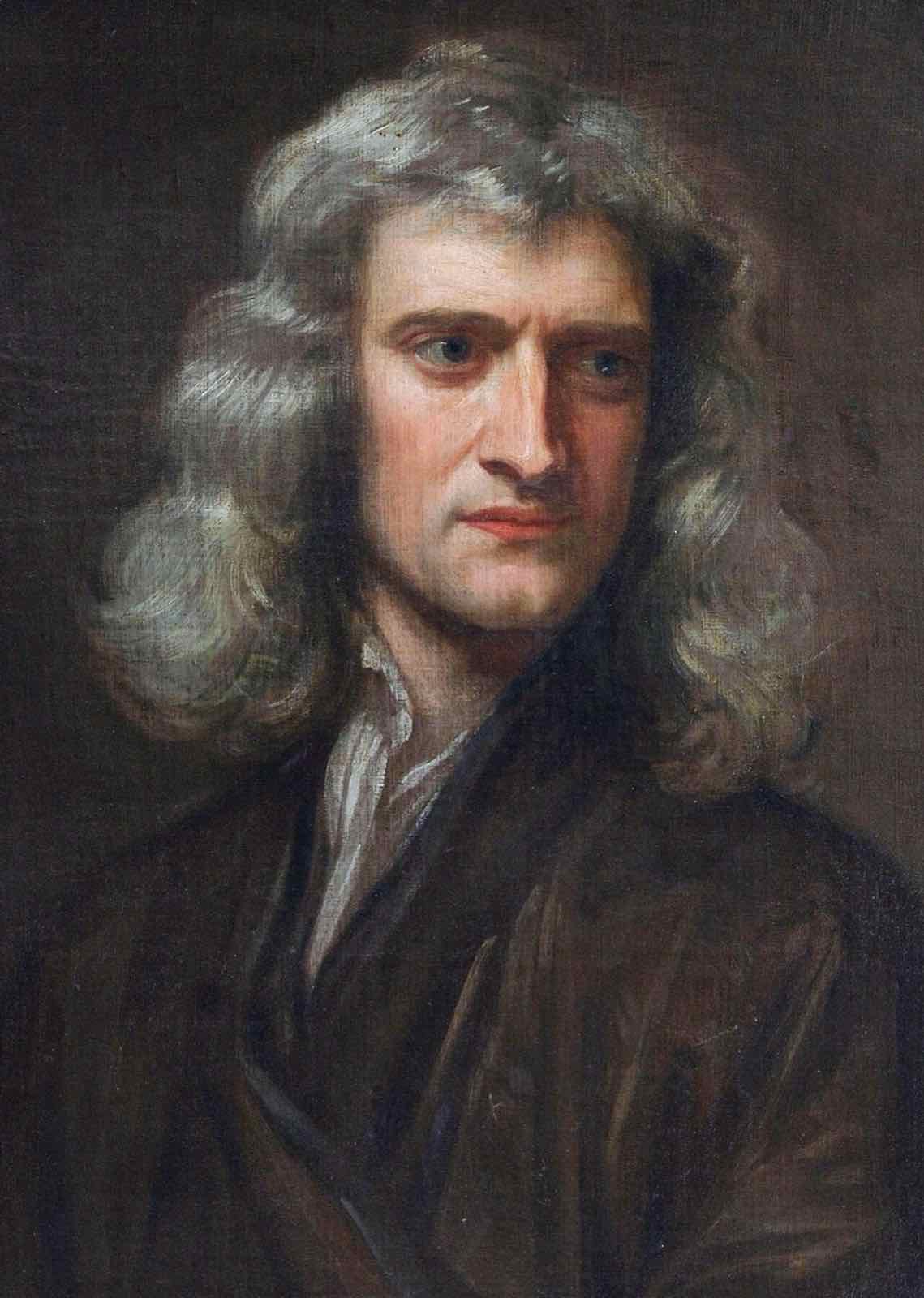
Newton (1643–1727) came from Lincolnshire in eastern England. He first got interested in science as a student at Cambridge University. His best-known book is the Philosophiae Naturalis Principia Mathematica ("Mathematical Principles of Natural Philosophy"). In it he explained that gravity works in the same way everywhere in the universe. He also discovered that white light contains all the colours of the rainbow.
Newton at 46, in a copy of Godfrey Kneller's 1689 portrait. He had published the Principia two years before.
After Godfrey Kneller, public domain, via Wikimedia Commons
Newton told the apple story to a friend himself, when he was an old man: he was sitting in the garden of his family home, saw an apple fall, and began to wonder why apples always fall straight down. The part about it hitting him on the head was added later. A descendant of that apple tree still grows by the gate of Trinity College, Cambridge.
Quiz
Which architect designed the new St Paul's Cathedral after the Great Fire of London in 1666?
Wren. The other three are real British designers too: Inigo Jones designed the Banqueting House, where Charles I was executed; Lutyens designed the Cenotaph in London; and Capability Brown was an 18th-century garden designer.
Quiz
Which of the following statements is correct?
The Habeas Corpus Act protects the right not to be locked up unlawfully and the right to a court hearing. It has nothing to do with voting. At the time only men who owned a certain amount of property could vote; all adult men only got the vote in the 20th century.
Quiz
Which Lincolnshire-born scientist explained that gravity works throughout the universe?
Newton. Halley was also an early member of the Royal Society, but he is famous for predicting a comet's return. Darwin (evolution) and Fleming (penicillin) were scientists of later times.
James II and the Glorious Revolution
When Charles II died, the crown passed to his brother. The new king was a Catholic. In England, Wales and Ireland he was James II; in Scotland he was James VII.
James II favoured Catholics and made some of them army officers, even though an Act of Parliament had banned this. He ignored Parliament and even had several Church of England bishops arrested. People in England feared that he wanted to turn the country Catholic again.
At first, though, people weren't too worried, because the next in line to the throne were his two daughters, who were both committed Protestants. Then, in 1688, the queen gave birth to a son. Suddenly it looked as if the next king would be a Catholic too.
A revolution without bloodshed
James II's elder daughter, Mary, had married William of Orange, her cousin. William was a Protestant and ruled the Netherlands. In 1688 a group of powerful English Protestants asked William to come over with an army and take the throne.
When William arrived, nobody fought him. James II ran away to France, leaving the throne to William. In England, Wales and Ireland he was William III, and in Scotland William II. He ruled side by side with his wife, Mary II.
People later called this the "Glorious Revolution". It was "glorious" because no battles were fought in England, and because it secured the power of Parliament: from then on, no monarch could simply rule alone.
William had landed at Torbay in south-west England on 5 November 1688, exactly 83 years after the Gunpowder Plot, and Protestants saw this as a sign from God. As James II fled, he is said to have thrown the Great Seal, the symbol of royal power, into the River Thames. There was also a rumour that his baby son wasn't the queen's at all, but a baby smuggled into her room in a warming pan (a covered metal pan used for warming beds). This was political propaganda, and there is no evidence for it.
England, Wales, Ireland
Scotland
James I
James VI
James II
James VII
William III
William II
The Boyne, Killiecrankie and Glencoe
James II was determined to win back his crown. Backed by French troops, he landed in Ireland. In 1690, in Ireland, William beat him at the Battle of the Boyne, a victory that some people in Northern Ireland still celebrate today. William took back control of Ireland, and James fled to France once more. After this, the Catholic Church in Ireland faced many restrictions, and Irish Catholics were shut out of government.
James had supporters in Scotland too. An armed rising on his behalf was quickly crushed at Killiecrankie. Every Scottish clan was then ordered to swear an oath accepting William as king. The MacDonalds of Glencoe missed the deadline, and as punishment they were massacred. The massacre left some Scots deeply distrustful of the new government.
Some people still believed that James was the rightful king, especially in Scotland. Some followed him into exile in France; others supported him in secret. James's supporters were called Jacobites, from Jacobus, the Latin form of James. Their story continues in the next chapter.
Quiz
Why were the MacDonalds of Glencoe massacred?
Every Scottish clan had to swear an oath accepting William as king. The MacDonalds of Glencoe swore theirs late and were massacred, which left some Scots distrustful of the new government. The other options come from other times: the Gunpowder Plot in 1605, the Prayer Book in the 1630s and Culloden in 1746.
Quiz
Which TWO statements about the Glorious Revolution of 1688 are correct?
A describes the Restoration of 1660, not the Glorious Revolution. Both stories involve the Netherlands, so they're easy to mix up. D is the wrong way round: James II, who was driven out, was the Catholic, and William, who replaced him, was the Protestant.
The Bill of Rights: the start of constitutional monarchy
A Declaration of Rights was read out at William and Mary's coronation. It confirmed that the king could no longer raise taxes or run the courts without Parliament's agreement. From now on, power was shared very differently between the Crown and Parliament, and it never went back.
Then the Bill of Rights of 1689 set down in law what Parliament was entitled to and how far the king's power could go:
Parliament decides who can be monarch, and the monarch must be a Protestant
A new Parliament must be elected at least every 3 years
Every year, the monarch must ask Parliament to approve money for the army and navy
Result: the king needs ministers who can win a majority of votes in both Houses
Whigs and Tories: the start of party politics
Two main groups formed in Parliament: the Whigs and the Tories. This is where party politics began. Today's Conservative Party is still sometimes called the Tories.
Both names began as insults from their enemies. "Whig" is said to come from a Scottish word for rebel Presbyterians, and "Tory" comes from an Irish word meaning an outlaw or a robber. After being called these names for long enough, each side started using them with pride.
A free press and constitutional monarchy
The years after 1688 also mattered a great deal for a free press, meaning newspapers and other printed material that the government does not control. From 1695 anyone could publish a newspaper without first getting a government licence, and the number of papers grew quickly.
The new laws after 1688 marked the start of constitutional monarchy, where a king or queen has to rule within limits set by Parliament. The monarch still mattered a great deal, but could not force through a policy or an action that Parliament opposed. After William III, the king's ministers slowly grew more powerful than the monarch.
But this was not modern democracy yet. Very few people could vote for Members of Parliament: only men who owned a certain amount of property, and women could not vote at all. In some areas one rich family decided who got elected; these seats were called "pocket boroughs". Other seats had almost nobody who could vote; these were called "rotten boroughs".
The most famous rotten borough was Old Sarum, near Salisbury. Almost nobody lived there: just an abandoned hill and a handful of landowners who had the vote. Yet it elected two Members of Parliament until the Reform Act of 1832 abolished it.
Quiz
Is the statement below TRUE or FALSE?
According to the Bill of Rights of 1689, only a Protestant could be king or queen.
True. The Bill of Rights gave Parliament control over who could be monarch and required the monarch to be a Protestant. Don't confuse it with Magna Carta of 1215: Magna Carta said the king must obey the law, while the Bill of Rights began the age of "Parliament decides".
A growing population: new arrivals
While kings and Parliament struggled over power, ordinary life was changing too. During these years, lots of people from Britain and Ireland sailed off to start new lives in colonies in America and other places. At the same time, newcomers were arriving:
In 1656, Jewish people settled in London. They were the first Jews to make a home here since the Middle Ages.
From 1680 to 1720, large numbers of refugees known as Huguenots fled to Britain from France. They were Protestants who had been persecuted in France because of their religion. Many were well educated and highly skilled, and they worked in science, banking, weaving and other crafts.
The English word "refugee" is thought to have come from the French réfugié around this time, and it was first used for the Huguenots. Many Huguenot weavers settled in Spitalfields in east London and became famous for weaving silk; you can still see their old houses there today. Jewish people had been allowed to settle again under Cromwell (they had been expelled from England in 1290), and Bevis Marks Synagogue, which opened in 1701, is the oldest synagogue in Britain that is still in use.
Quiz
Which TWO statements about the Huguenots are correct?
The Huguenots were French Protestants who had been persecuted for their faith, and they came to Britain between 1680 and 1720. Many were educated and skilled, working in science, banking, weaving and other crafts. B gets both the religion and the country wrong. D describes the Jewish people who settled in London in 1656.
Queen Anne and the 1707 Act of Union
After William and Mary, the crown passed to Mary's younger sister, Queen Anne. There has only ever been one Queen Anne, so she has no number after her name.
Anne had no children who survived, so nobody knew who would wear the crowns of England, Wales, Ireland and Scotland after her. So in 1707 the two sides agreed the Act of Union, called the Treaty of Union in Scotland. It created the Kingdom of Great Britain.
Scotland stopped being an independent country. But it held on to its own legal system, its own education system and its Presbyterian Church. Even today, Scotland's law and schools are different from England's.
Anne's own story explains the worry. She was pregnant at least 17 times, but none of her children outlived her, and her only son to survive early childhood, William, Duke of Gloucester, died in 1700 at the age of 11. So Parliament passed a law in advance naming her distant Protestant relatives, the House of Hanover in Germany, as next in line.
Money had a lot to do with Scotland agreeing to the union, too. In the 1690s Scotland put huge sums into a plan to start a colony at Darien in Central America; it failed completely and lost a large share of the nation's wealth. In the treaty, England agreed to pay Scotland compensation.
Queen Anne died in 1714, and with her the Stuart period came to an end. Parliament chose a German to be the next king, and a new figure appeared in British politics: the Prime Minister. That's all in the next chapter.
Quiz
What did the Act of Union of 1707 create?
In 1707 England and Scotland joined to form the Kingdom of Great Britain. B only came in 1801, when Ireland joined (next chapter). C is the republic set up after Charles I was executed in 1649. D was set up much earlier, in the Scottish Reformation of 1560.
Chapter summary
1603 James VI & I
James VI of Scotland became James I of England; Scotland stayed a separate country
King James Version
The King James (Authorised) Version of the Bible: not the first English Bible, but still in use
1605 Gunpowder Plot
Catholics tried to blow up the king and failed; Bonfire Night on 5 November
Plantations
English and Scottish Protestants settled in Ulster on land taken from Catholic landholders
Divine Right of Kings
James I and Charles I believed kings were appointed by God and did not need Parliament's approval
1642 Civil War
Cavaliers for the king, Roundheads for Parliament; Marston Moor and Naseby
1649 Commonwealth
Charles I was executed and England became a republic
Lord Protector
Cromwell's title; he was never king, and ruled until 1658
1660 Restoration
Charles II came back from the Netherlands to be king
1665 / 1666
The Great Plague / the Great Fire of London; Wren's new St Paul's; Pepys's diary
1679 Habeas Corpus
No unlawful imprisonment; everyone held has the right to a court hearing
Royal Society
The oldest surviving scientific society; Halley and Newton
Isaac Newton
Born in Lincolnshire; gravity; white light contains all the colours of the rainbow
1688 Glorious Revolution
The Catholic James II was replaced by the Protestants William III and Mary II, with no fighting in England
1689 Bill of Rights
The monarch must be a Protestant; a new Parliament at least every 3 years; the start of constitutional monarchy
1690 Boyne
William beat James II in Ireland; James's supporters were called Jacobites
Whigs and Tories
The beginning of party politics
1695 Free press
Newspapers no longer needed a government licence
1656 / 1680–1720
Jewish people come back to London / Huguenots, French Protestants, come to Britain
1707 Act of Union
The Kingdom of Great Britain; Scotland kept its own law, education and Presbyterian Church
 Parliament decides who can be monarch, and the monarch must be a Protestant
 A new Parliament must be elected at least every 3 years
 Every year, the monarch must ask Parliament to approve money for the army and navy
 Result: the king needs ministers who can win a majority of votes in both Houses