The Proms and seven composers
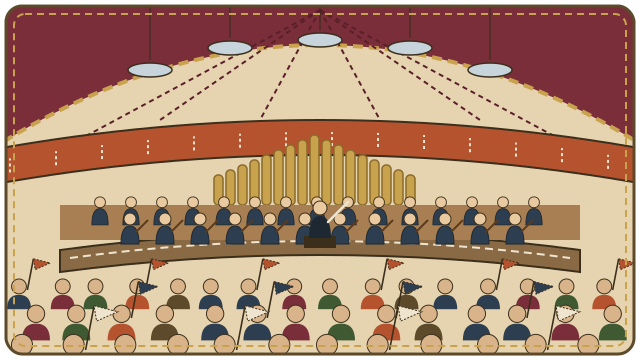
Music in Britain covers a huge range, from classical to modern pop, and there are concert venues and music events all over the country.
The best-known classical event is the Proms: every summer, eight weeks of orchestral concerts in several venues, one of them the Royal Albert Hall in London. Since 1927 the season has been organised by the BBC. The final concert, the Last Night of the Proms, is the most famous, and like the other concerts it is shown on television.
The name is short for "promenade concerts", and to promenade means to stroll about. When the concerts began in 1895, the seats in the middle of the hall were taken out, so people could buy a cheap ticket and stand or walk around while they listened. Today the centre of the Royal Albert Hall is still kept for "Prommers" with standing tickets.
Classical composers at a glance
Land of Hope and Glory, which the whole hall sings on the Last Night of the Proms, was written by Sir Edward Elgar. There are seven composers to know, and the most common question is which piece belongs to whom:
| Henry Purcell 1659–95 | Organist at Westminster Abbey. His work included church music and operas, and he created a sound that was clearly British and different from music elsewhere in Europe. His influence on British composers can still be heard today. |
|---|---|
| George Frederick Handel 1685–1759 | Born in Germany, he made his home in Britain and became a British citizen in 1727. For George I he wrote Water Music, and for George I's son, George II, he wrote Music for the Royal Fireworks. Choirs often perform his oratorio (a long piece for choir and orchestra) Messiah, especially around Easter. |
| Gustav Holst 1874–1934 | Wrote The Planets, in which each movement is about a planet of the solar system. He turned one movement, Jupiter, into the tune of I vow to thee my country, a hymn often sung in British churches. |
| Sir Edward Elgar 1857–1934 | Born in Worcester, England. He is best known for the Pomp and Circumstance Marches. March No. 1, known as Land of Hope and Glory, is normally played on the Last Night of the Proms. |
| Ralph Vaughan Williams 1872–1958 | Composed for orchestras and choirs. His music owes a lot to traditional English folk songs. |
| Sir William Walton 1902–83 | His work ranges from film scores to opera, and he wrote marches for the coronations of George VI and Elizabeth II. His best-known pieces are Façade, which later became a ballet, and Belshazzar's Feast, a work for a large choir. |
| Benjamin Britten 1913–76 | Famous above all for his operas, such as Peter Grimes and Billy Budd. His A Young Person's Guide to the Orchestra takes a tune by Purcell and uses it to show off each section of the orchestra in turn. He also started the Aldeburgh festival in Suffolk, which is still a major international event. |
Quiz
Since 1927, which organisation has run the Proms, the summer season of orchestral concerts?
The BBC has organised the Proms since 1927, which is why the concerts are on TV. The National Trust looks after historic buildings and countryside.
Quiz
Which composer wrote the opera Peter Grimes and started the Aldeburgh festival in Suffolk?
Britten is known for his operas, especially Peter Grimes and Billy Budd, and he founded the Aldeburgh festival. His Young Person's Guide to the Orchestra is built on music by Purcell, so the two names often turn up in the same question.