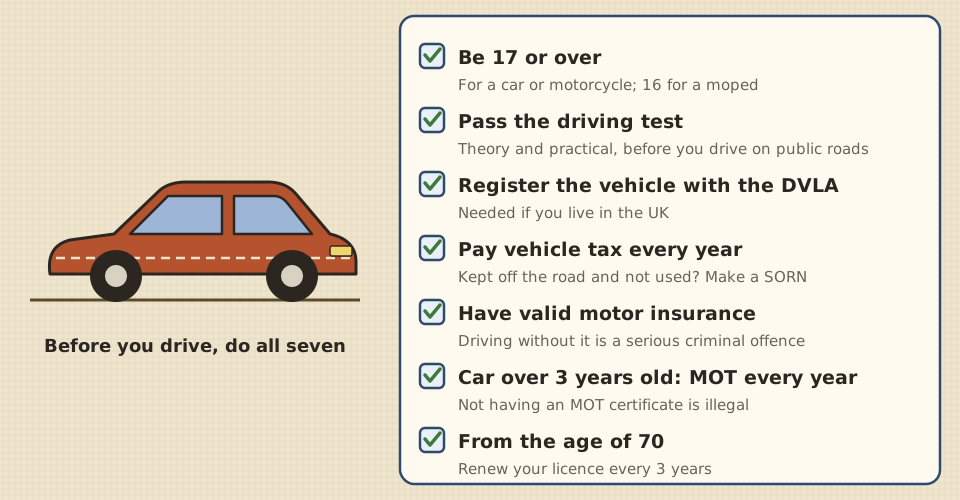
In the UK, you must be at least 17 to drive a car or ride a motorcycle, and you need a driving licence to use public roads. To get a UK licence you must pass a driving test, which checks your knowledge and your practical driving skills. You must be at least 16 to ride a moped (a small, low-powered motorbike), and there are other age rules and special tests for driving large vehicles.
Your licence is valid until you are 70. After that, you renew it every 3 years.
In Northern Ireland, new drivers must display an "R" plate (for "restricted driver") on their car for 1 year after passing their test.
A licence issued abroad can be used for up to 12 months in the UK; after that, if you want to keep driving, you must get a full UK licence. Check the GOV.UK page about driving on a non-GB licence to make sure yours is accepted.
Seven things to do before you drive.
Rules for the vehicle
If you live in the UK, your car or motorcycle must be registered with the Driver and Vehicle Licensing Agency (DVLA). Every year you have to pay vehicle tax, and when the vehicle changes owner, the tax can't be handed on to the new keeper. If you keep the vehicle off the road and don't use it, you must make a Statutory Off Road Notification (SORN) to the DVLA; a SORN can't be passed to a new owner either. You must also have valid motor insurance: driving without insurance is a serious criminal offence. If your vehicle is more than three years old, it needs an MOT test every year, and it is against the law not to have an MOT certificate.
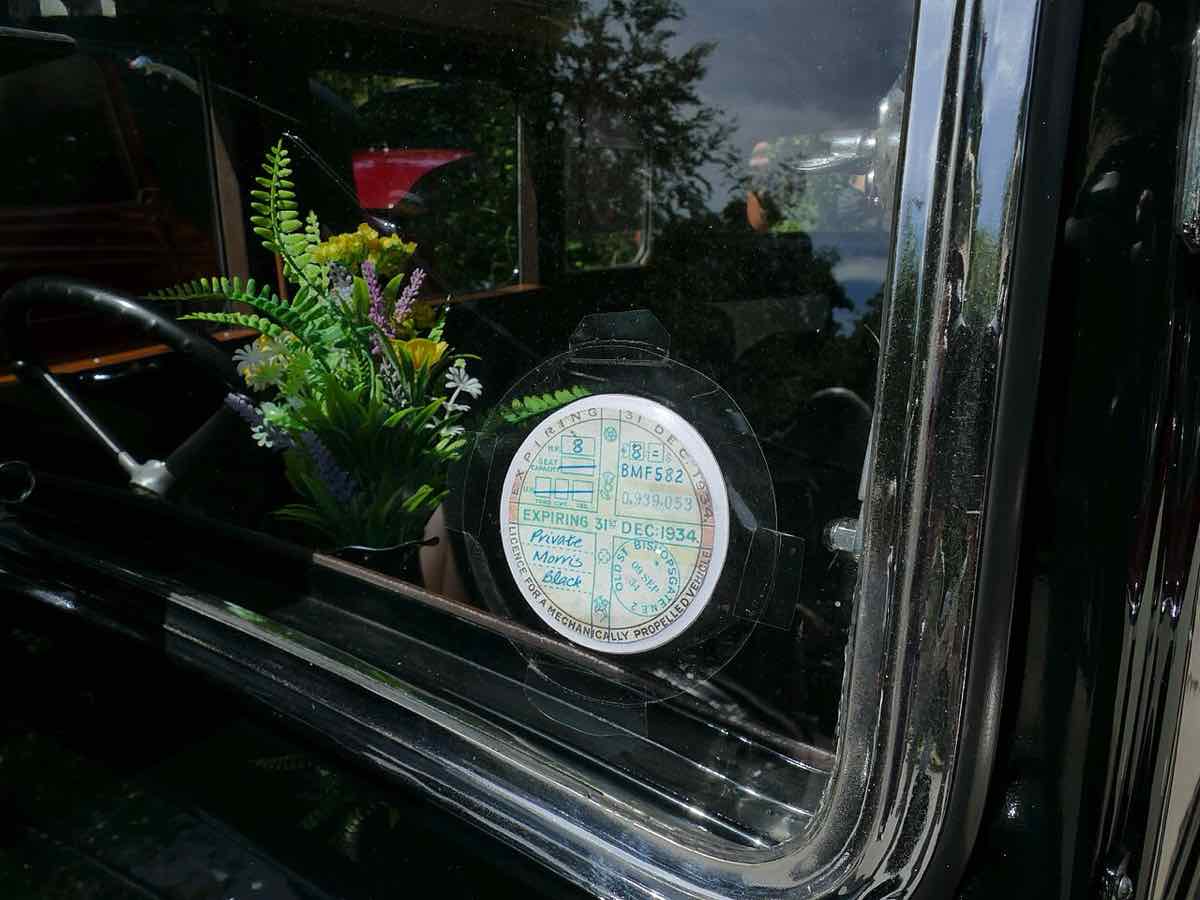
An old-style paper tax disc, seen at a classic car show. Until October 2014, every car in the UK had to display one on its windscreen.
Photo: Stephen Craven / Geograph, CC BY-SA 2.0, via Wikimedia Commons
MOT stands for Ministry of Transport, a ministry that was renamed long ago, though the test kept its name. When the test began in 1960 it only applied to cars more than 10 years old; in 1967 that was cut to 3 years. Learning to drive works like this: you apply for a provisional licence, take lessons with an instructor, and then pass a theory test (multiple-choice questions plus a hazard perception test) and a practical driving test.
Quiz
Which TWO of the following statements about minimum ages are correct?
The minimum age is 16 for a moped, and 17 for a car or a motorcycle. A motorcycle is bigger and more powerful than a moped, so its minimum age is higher.
Quiz
Which TWO of the following are legal requirements for driving your own car in the UK?
Motor insurance is a must: driving without it is a serious criminal offence. And once a car is over three years old, it needs an MOT every year. You don't have to carry your passport in the car, and you don't retake the test every five years: your licence lasts until you are 70.
Quiz
What must you do if your car is kept off the road and you are not using it?
A vehicle that is parked off the road and not used needs a SORN (Statutory Off Road Notification) sent to the DVLA. Like vehicle tax, a SORN does not pass to the next owner if you sell the vehicle or give it away. The MOT is a yearly test for vehicles over three years old, not a six-monthly one.