In a democracy, all adults have a voice in how the country is run. They might vote on decisions themselves, or elect people to decide for them.
At the start of the 19th century, though, Britain was not a democracy in today's sense. There were elections, and Members of Parliament (MPs) were chosen, but only a small group of people could vote: men over 21 who owned a certain amount of property.
As the century went on, the right to vote (the franchise) was given to more and more people, and political parties started to welcome ordinary men and women as members.
The Chartists' six demands
In the 1830s and 1840s, a group known as the Chartists campaigned for reform. They wanted six changes:
1A vote for every man
2An election every year
3Every region treated equally in the voting system
4Secret ballots
5Any man able to stand as an MP
6Pay for MPs
At the time, most people thought the movement had failed. Yet by 1918, most of these reforms had come true.
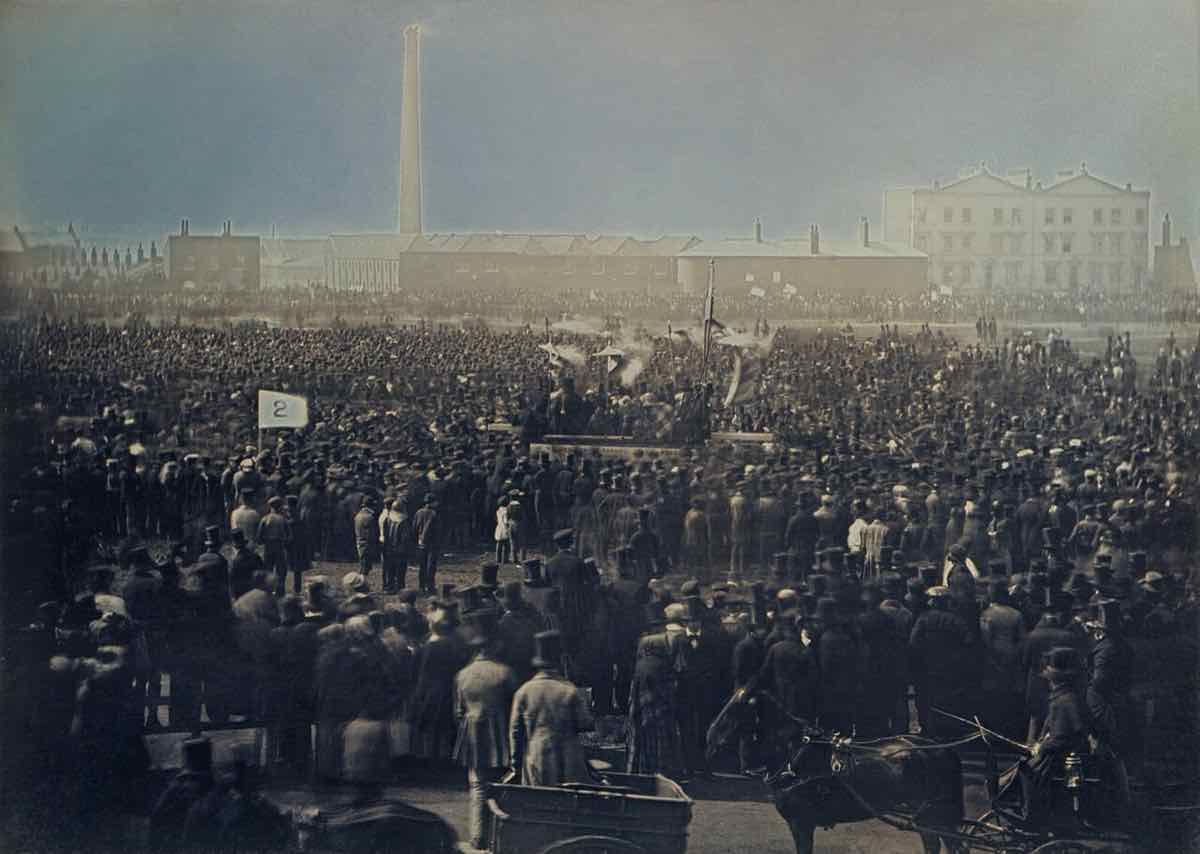
The great Chartist meeting on Kennington Common in London, 10 April 1848. It is one of the earliest photographs ever taken of a large crowd.
Photo: William Edward Kilburn, public domain, via Wikimedia Commons
The Chartists' demands were then met one by one: no property was needed to become an MP from 1858, voting became secret in 1872, MPs were first paid in 1911, and all adult men had the vote by 1918. Constituencies were also made more equal in size in the late 19th century. Only one demand never came true, a new election every year. A UK General Election still has to be held at least every five years, not every year.
From a few men to everyone aged 18
1800Early 1800s: only men over 21 who own a certain amount of property can vote
1830s1830s and 1840s: the Chartists demand six reforms; at the time they are thought to have failed
1918Most of the Chartists' reforms are now in place, and women over 30 get the vote
1928Men and women over 21 can all vote, on equal terms
1969The voting age is lowered to 18 for men and women alike
Quiz
In 1928, who gained the right to vote?
Keep the three years apart: 1918, women over 30; 1928, men and women over 21; 1969, lowered to 18. A vote only for men with property was the situation at the start of the 19th century.
Quiz
Which TWO of these changes did the Chartists campaign for?
Pay for MPs and secret ballots were two of the six demands. The Chartists wanted a vote for every man; they did not ask for votes for women, and women over 30 only got the vote in 1918. They didn't call for an end to the monarchy either.
Quiz
Is the statement below TRUE or FALSE?
The voting age for both men and women was lowered to 18 in 1969.