A constitution that isn't written down
A constitution is the rulebook for how a country is governed. It covers every institution that helps to run the country and the ways their power is kept under control. It also includes laws and conventions (customs that everyone follows, even though they aren't written in law).
The UK's constitution is not set out in one single document, so people describe it as an unwritten constitution. The main reason is that, unlike the USA or France, Britain has never had a revolution that swept away its whole system of government for good. Instead, its most important institutions grew up slowly over hundreds of years.
Should the constitution be written down in one place? British people don't agree. Some think it should be. Others feel that an unwritten constitution is more flexible and helps government to work better.
Having no single document doesn't mean having no rules. Britain's constitution is spread across many sources: Magna Carta from 1215, the Bill of Rights from 1689, laws passed by Parliament over the years, decisions made by the courts, and conventions that everyone quietly follows. Only a handful of countries, such as New Zealand and Israel, also manage without one written constitution.
The institutions that hold the country together
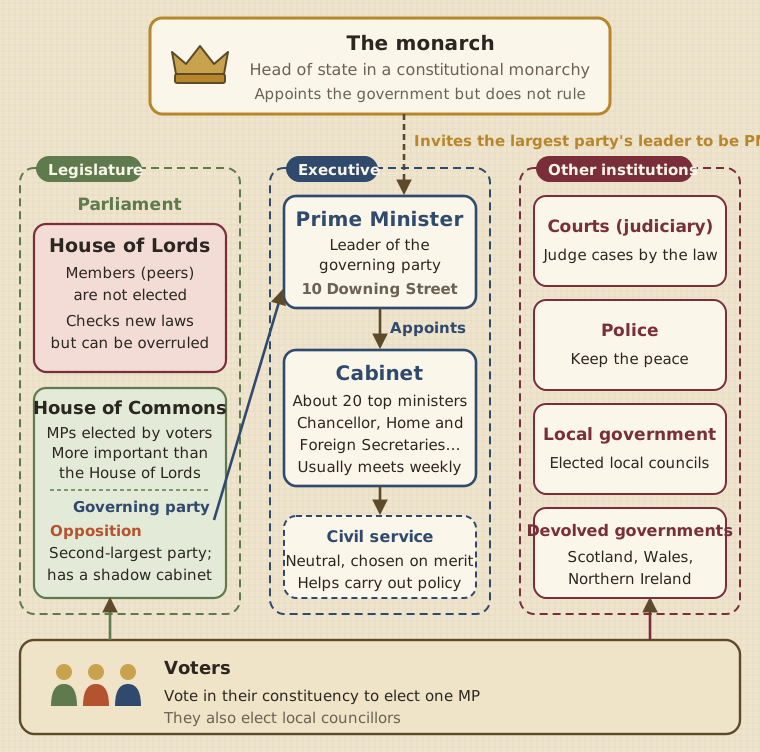
The UK's system of government has several parts. The main ones are:
- the monarchy
- Parliament, made up of the House of Lords and the House of Commons
- the Prime Minister
- the cabinet
- the judiciary, meaning the courts
- the police
- the civil service
- local government
On top of this, Scotland, Wales and Northern Ireland have devolved governments, which can make their own laws on some subjects.