1215 onwards
Magna Carta: the king must obey the law too
Under the feudal system of the Middle Ages, lords owed the king soldiers, but they also expected him to respect their rights. When was that idea first put in writing? The answer begins in 1215. That year King John fell out badly with his nobles. (There has only ever been one King John, which is why he has no number after his name.) He kept raising taxes and losing wars, and in the end the nobles had had enough. At Runnymede, a meadow beside the River Thames west of London, they made him accept a document called Magna Carta. The name is Latin for "Great Charter". Until then, almost nothing officially limited what a king could do.
The big idea behind it was simple: even the king has to follow the law. It protected the nobles' rights and stopped the king from raising taxes, or making and changing laws, just as he pleased.
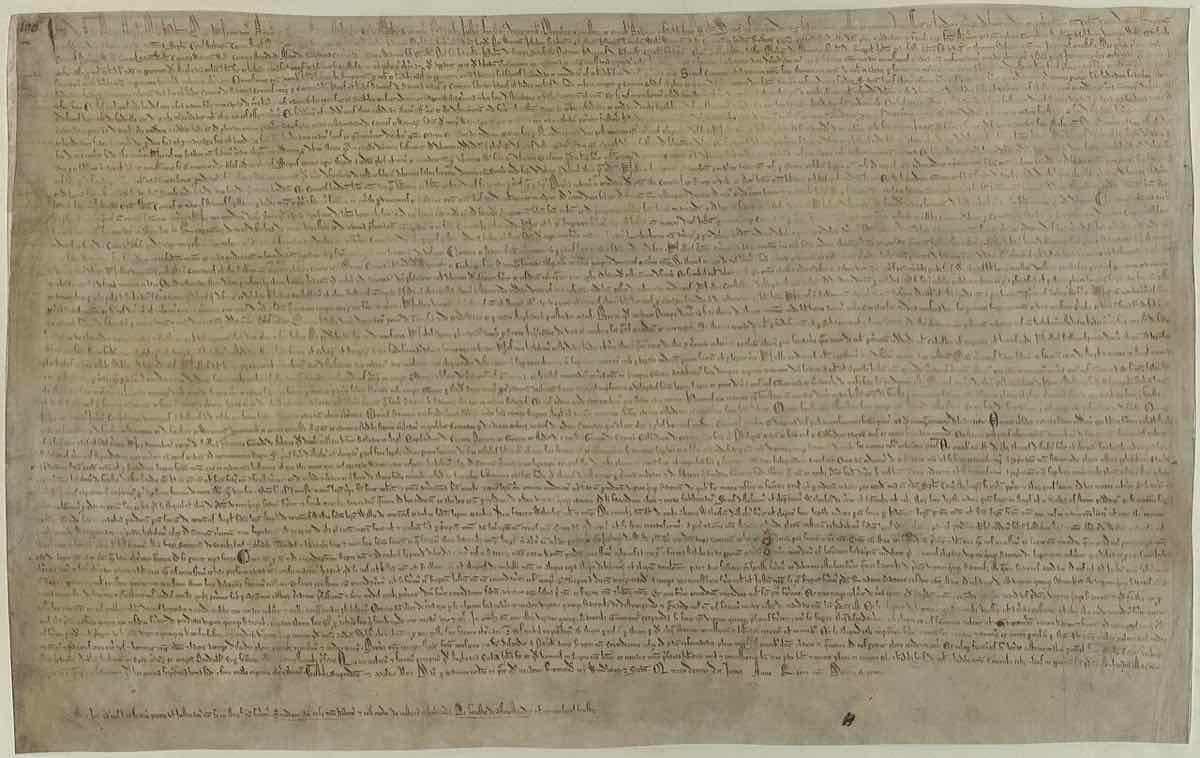
In practice, Magna Carta lasted only about ten weeks. That August the Pope declared it invalid, and the king and the nobles were soon at war again; later kings issued several new versions, and only slowly did it become one of the foundations of English law. King John never actually signed it, either: his royal seal was attached instead. Only four copies from 1215 survive, two in the British Library and two belonging to the cathedrals of Lincoln and Salisbury.
The birth of Parliament
Kings had always had a circle of advisers, including powerful nobles and leaders of the Church. Whenever the king needed money, he called them together for a meeting. That is how Parliament began. Over time it divided into two parts, or "Houses":
Nobles, great landowners and bishops
Knights (usually smaller landowners) and rich people from the towns
Only a tiny number of people could vote for members of the House of Commons, though. Scotland's Parliament was made up of three groups, called the Estates: the lords, the commons and the clergy (church leaders).
In this period the idea that judges should be independent of the government also started to take shape. In England, judges settled cases by following earlier decisions and old traditions, and this built up into the common law. In Scotland the law was "codified", which means it was written down as a set of rules.
Quiz
What did the Magna Carta establish in 1215?
The heart of Magna Carta is that the king must obey the law too. Votes for all adults only came in the 20th century; England and Scotland started sharing a parliament in 1707; and it was Henry VIII who broke the English Church away from Rome.
Quiz
In the Middle Ages, who sat in the House of Commons?
A describes members of the House of Lords. The Commons was made up of knights (smaller landowners) and rich people from the towns.