1547–1558
Three children, three faiths
Henry VIII died in 1547. His three children came to the throne one after another, and with every new ruler the country's religion swung in a different direction.
1547–1558
Henry VIII died in 1547. His three children came to the throne one after another, and with every new ruler the country's religion swung in a different direction.
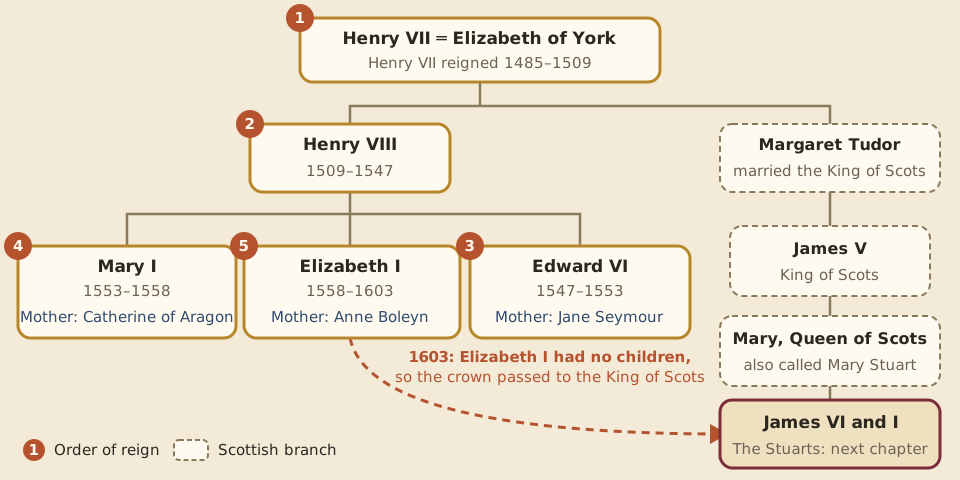
Jane Seymour's son Edward VI became king at the age of 9. He was a firm Protestant. During his reign the Church of England got its Book of Common Prayer, which set out the words to be said in church services. Some churches still use a version of it today.
Edward was never strong. He reigned for just over six years and died when he was only 15.
Edward was afraid his Catholic sister Mary would become queen, so just before he died he left the crown to his Protestant cousin, Lady Jane Grey. She was queen for only nine days before crowds who supported Mary pushed her out, and she was executed the following year. Because her reign was so short, and many said it wasn't lawful, lots of lists of English monarchs leave her out.
Next came Mary I, the daughter of Catherine of Aragon. She was a devout Catholic. She took England back to the Catholic Church and persecuted Protestants (punished them cruelly for their faith). Nearly 300 people were burned to death, which is why she became known as "Bloody Mary". Her reign was short too: she died five years later.
Mary I married the Spanish prince Philip, who later became King Philip II of Spain, and while Mary was alive he even used the title King of England. More than thirty years later, the man who sent the Armada to attack England was Elizabeth I's former brother-in-law.
Mary's half-sister Elizabeth I, the daughter of Anne Boleyn, became queen in 1558. She was a Protestant, and she made the Church of England the country's official church once again.
Her approach was clever. Everyone had to go to their local church, and the law fixed what services and prayers could be used. But she did not try to find out what people truly believed in private. In this way she steered a middle path between Catholics and the stricter Protestants, and kept England free of serious religious conflict. She never married.
Quiz
Which monarch was on the throne when the Book of Common Prayer was produced for the Church of England?
The Book of Common Prayer was written under the Protestant boy king, Edward VI. Watch out for C: under James I a new English Bible appeared, the King James Bible of 1611.
Quiz
Which of the following statements is correct?
"Bloody Mary" was a Catholic, and the people she persecuted were Protestants. The Protestant monarch linked to the Book of Common Prayer was her brother, Edward VI.
Quiz
Is the statement below TRUE or FALSE? Elizabeth I was a Catholic who brought England back under the authority of the Pope.
False. Elizabeth I was a Protestant, and she restored the Church of England. It was her sister, Mary I, who took England back to the Catholic Church. A memory trick: Henry's three children go Protestant, Catholic, Protestant (Edward, Mary, Elizabeth), or "P, C, P".