In the time of Elizabeth I the English became more and more patriotic, which means proud of their country. English explorers set out to find new trade routes and tried to push into Spain's colonies in the Americas.
Catholic Spain had had enough. In 1588 King Philip II sent a huge fleet of warships, the Spanish Armada, to conquer England and bring back the Catholic faith. But the English beat it. The victory made Elizabeth I one of England's best-loved rulers ever.
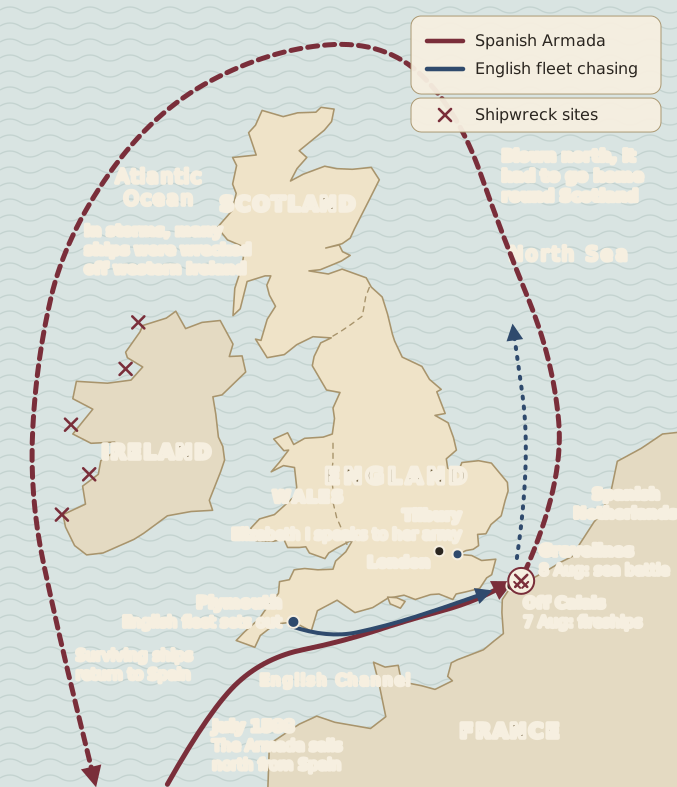
The Armada's route. It couldn't turn round and sail home through the Channel, so it had to go all the way round Britain, and storms did terrible damage on the way.
In the summer of 1588 the Armada sailed into the English Channel in a crescent (a curved shape like a new moon). The English fleet came out of Plymouth and followed it, firing as it went. When the Armada dropped anchor off Calais in France, the English set fire to a few empty ships in the middle of the night and sent them drifting into the Spanish fleet. The Spanish ships cut their anchor ropes and scattered in panic, and the next day they were beaten at the Battle of Gravelines.
Then a south wind pushed what was left of the Armada northwards. The only way home was round the top of Scotland and down the west coast of Ireland. On the way it ran into storms, and many ships were smashed on the rocks.
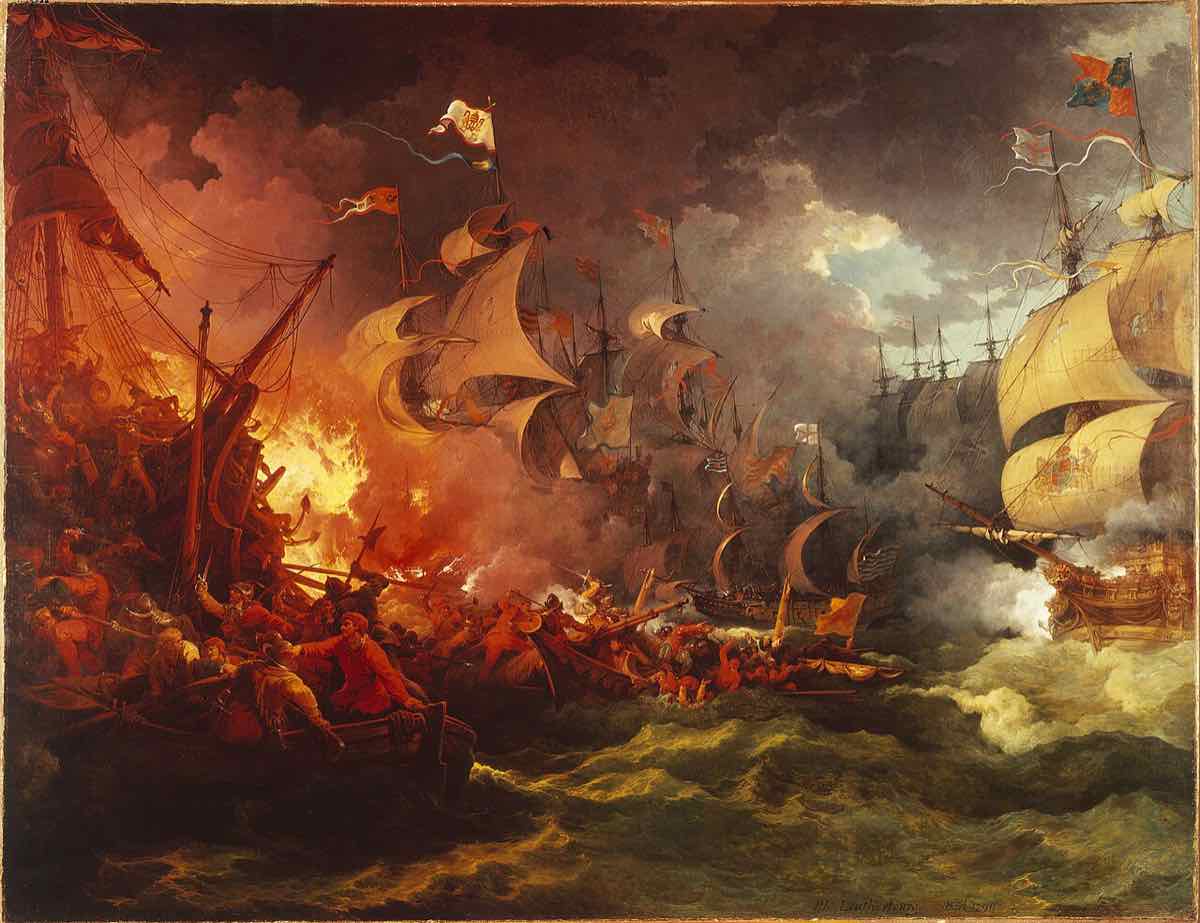
The battle against the Armada as Philip James de Loutherbourg imagined it in 1796. The painting is now at Royal Museums Greenwich.
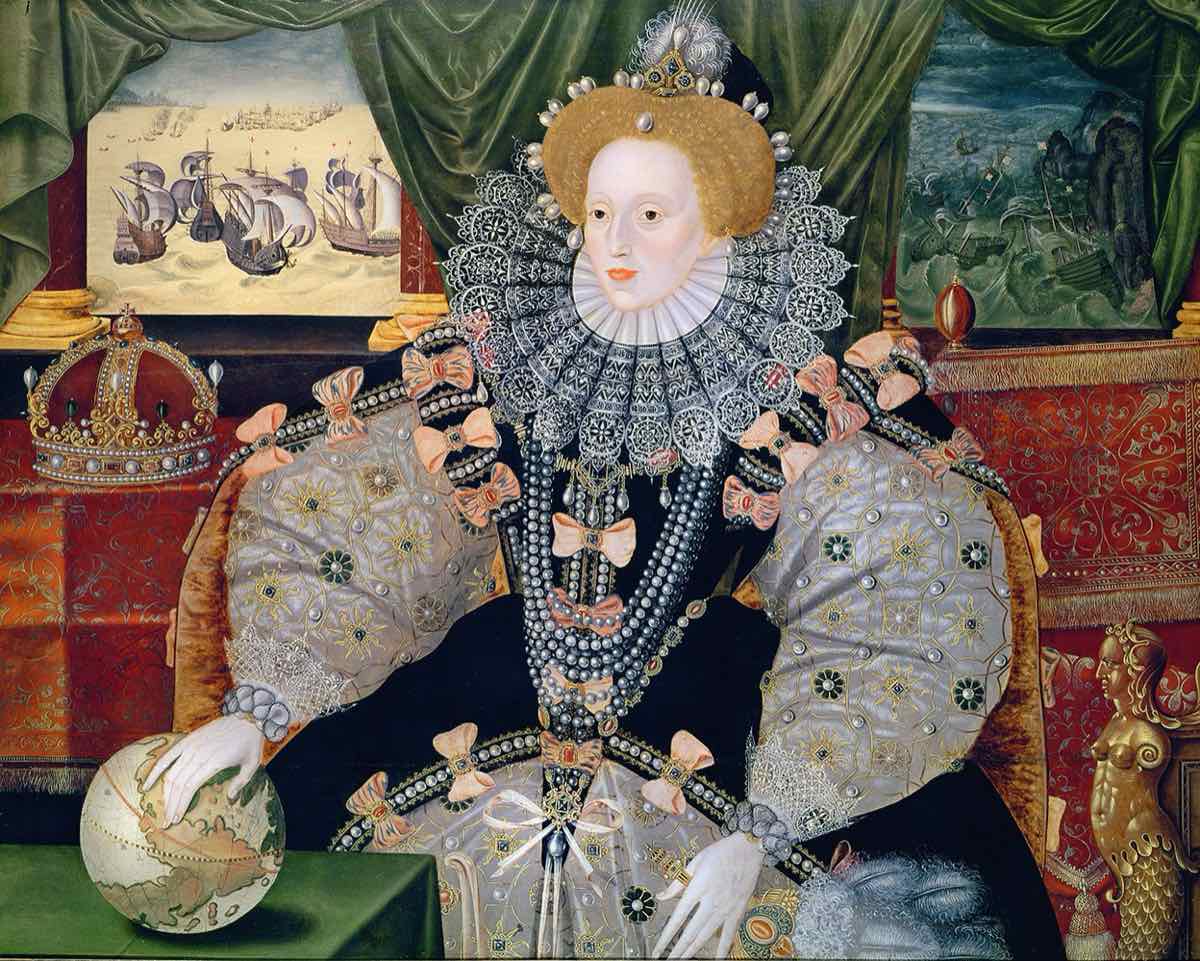
Painting by Philip James de Loutherbourg, public domain, via Wikimedia CommonsThe "Armada Portrait". Elizabeth I rests her right hand on a globe. In the background, the window on the left shows the Armada approaching, and the one on the right shows Spanish ships sinking in a storm.
Unknown artist (once thought to be George Gower), about 1588, public domain, via Wikimedia Commons
The best-known legend says that when the Armada was spotted, Drake was playing bowls (a game where you roll heavy balls across a lawn) on the grass above the sea at Plymouth, and insisted on finishing his game. The story only appears in writing decades later, so most historians treat it as a legend. Still, the tide and the wind really did keep the English ships in harbour for a while, so he had a point.
Another famous line comes from the speech Elizabeth I made to her soldiers at Tilbury: she might have the body of a weak woman, but she had the heart of a king. She really did visit the army and speak to them, but the version we know was written down decades later, so nobody can be sure of her exact words.
Sir Francis Drake and the Golden Hind
Among the leaders who beat the Armada was Sir Francis Drake. He helped to start England's long tradition as a great sea power. His ship, the Golden Hind, was among the earliest to sail right round the globe.
Drake sailed round the world between 1577 and 1580, the first English captain to do it. His ship began the voyage as the Pelican and was renamed the Golden Hind on the way, and when he got home Elizabeth I came on board and knighted him on the deck. Today a full-size copy of the Golden Hind sits on the south bank of the Thames in London, and you can go on board. To the Spanish, though, Drake was a pirate who kept robbing their ships.
Quiz
Sir Francis Drake's ship was among the first to circumnavigate the globe. What was it called?
The Golden Hind. The Mary Rose was Henry VIII's warship; HMS Victory was Nelson's flagship at the Battle of Trafalgar in 1805; and the Mayflower carried a group of Puritan settlers to America in 1620. All three are real, famous ships, which makes them good trap answers.
Quiz
Why did Spain send the Armada against England in 1588?
Spain was a Catholic country, and its aim was to conquer England and restore the Catholic faith. Henry VIII had died back in 1547, and it was the English, not the Spanish, who set up colonies on America's east coast.