1530s–1540s
Wales and Ireland under the Tudors
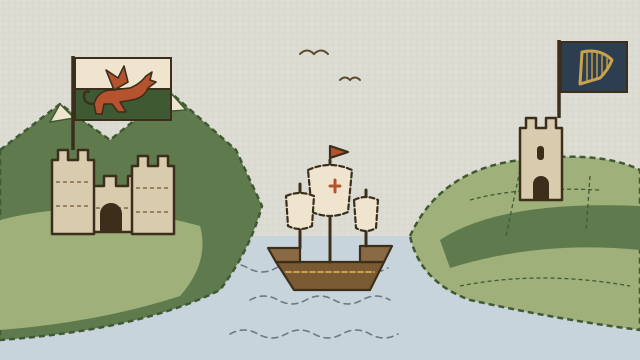
Wales: formally joined to England
The Tudor king Henry VIII's stronger central government did not stop at England's borders: it reached into Wales and Ireland too. In his reign, Parliament passed laws known as the Act for the Government of Wales. They formally united Wales with England. From then on Wales had members in the House of Commons, and its courts and laws were reorganised.
The Tudors were Welsh themselves. The family came from Anglesey, an island off north Wales, and in 1485 Henry VII landed in south-west Wales and gathered soldiers as he marched towards Bosworth. So the family that tied Wales and England together was Welsh itself.
Ireland: Henry VIII becomes "King of Ireland"
At this time nearly everyone in Ireland was Catholic. Henry VII and Henry VIII pushed English control out beyond the Pale. Henry VIII also took the title King of Ireland. English laws were brought in, and local leaders had to obey the Lord Lieutenant, the king's governor in Dublin.
But the Reformation caused a backlash in Ireland. The English tried to force the Protestant religion on the Irish, and they also brought in English rules about who inherits land. The Irish chieftains (clan leaders) rose up, and years of brutal fighting followed.
Quiz
Is the statement below TRUE or FALSE? The Act for the Government of Wales, passed while Henry VIII was king, formally joined Wales with England.
True. Don't mix it up with the Statute of Rhuddlan (1284, Edward I), mentioned earlier, which put Wales under the English Crown. Henry VIII's laws went further: they formally united Wales with England and gave it representatives in Parliament.