1789–1815
Fighting Napoleon: Trafalgar and Waterloo
Only a few years after its 13 colonies in North America won their independence, Britain faced an even bigger rival in Europe. In 1789 revolution broke out in France, and before long the new French government was at war with Britain. Napoleon (Napoleon I), who later made himself Emperor of France, carried the war on.
The Battle of Trafalgar, 1805
At the Battle of Trafalgar the British navy defeated the combined fleets of France and Spain. The British fleet was led by Admiral Nelson, who was killed during the fighting. In London, Nelson's Column in Trafalgar Square was built in his memory. His flagship, HMS Victory, is now in Portsmouth, and you can go on board.
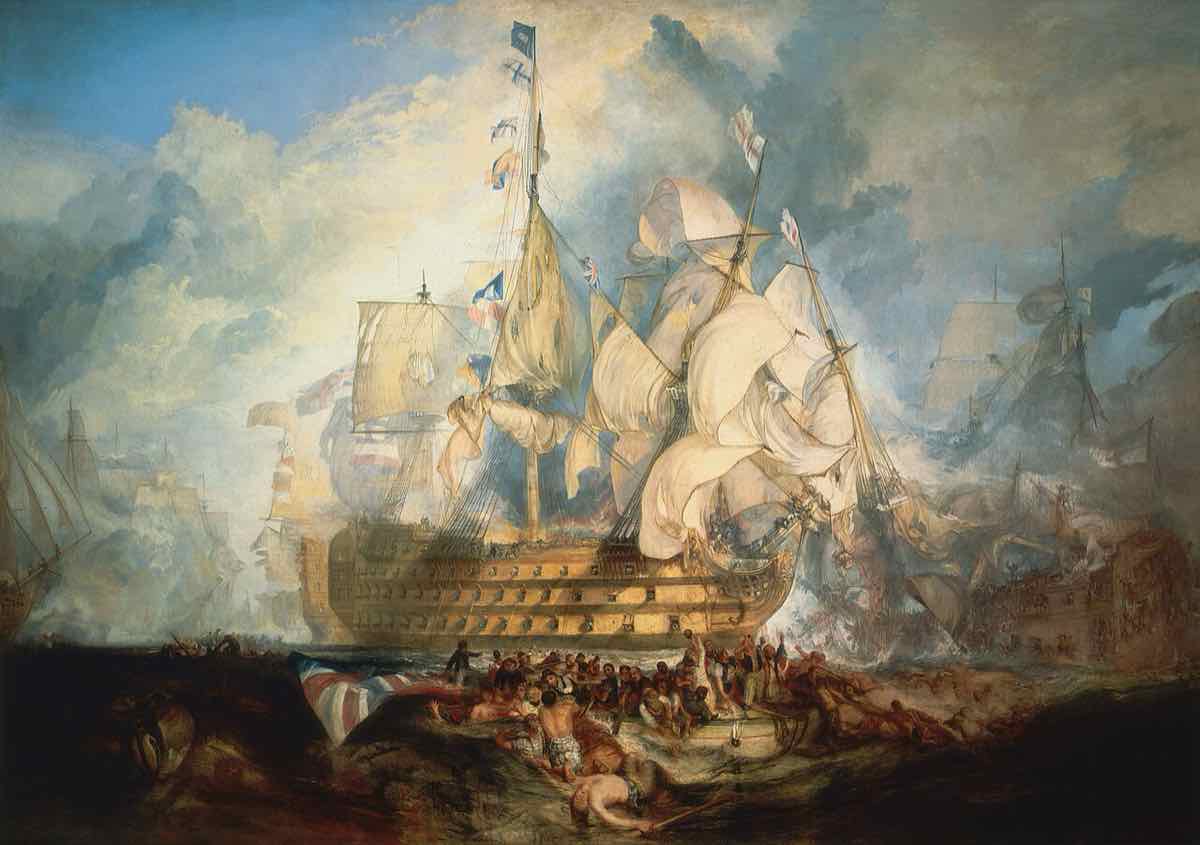
Before the battle Nelson sent the whole fleet a flag signal that became famous: "England expects that every man will do his duty." During the fighting a French sniper shot him, and he died on board HMS Victory. To bring his body home in one piece, the sailors put it in a large barrel of brandy. People say they secretly drank from the barrel, which is why rum was nicknamed "Nelson's blood" in the navy, but that is only a legend.
Nelson's Column was finished in 1843. It is about 52 metres tall including the base, the statue at the top is more than 5 metres high, and the bronze panels around the base were made by melting down cannons taken from the French.
The Battle of Waterloo, 1815
In 1815 the Duke of Wellington defeated Napoleon at the Battle of Waterloo, which ended the wars with France. Wellington was nicknamed the "Iron Duke" and later became Prime Minister.
He also gave his name to a boot. Wellington liked to wear a new style of long boot, other wealthy men copied him, and the British still call tall rain boots "wellies", short for Wellington boots.
Quiz
Is the statement below TRUE or FALSE? Admiral Nelson died during the Battle of Trafalgar, and visitors can go aboard his flagship, HMS Victory, in Portsmouth today.
Both parts are true. A common trap is mixing up Nelson and Wellington: Nelson means the navy, Trafalgar, 1805, killed in battle; Wellington means the army, Waterloo, 1815, later Prime Minister.