Britain Since 1945: The Welfare State, the Sixties and Devolution
In July 1945 Britain had just won the Second World War. Yet Winston Churchill, the man who had led the country through it, lost the general election by a huge margin. Voters didn't want a war hero. They wanted a new kind of country, one that would look after people "from the cradle to the grave".
This chapter starts with that election and follows the story all the way to January 2020, when the UK left the European Union.
1945Labour wins and Clement Attlee becomes Prime Minister
1947Nine countries, including India, Pakistan and Ceylon, become independent
1948The National Health Service (NHS) begins; people from the West Indies are invited to work in Britain
1960sThe Swinging Sixties: the Beatles and the Rolling Stones; laws on divorce and abortion are relaxed
1973The UK joins the European Economic Community (EEC)
1979Margaret Thatcher becomes the first woman Prime Minister
1982The Falklands War
1997Tony Blair leads Labour to victory
1998The Good Friday Agreement is signed in Northern Ireland
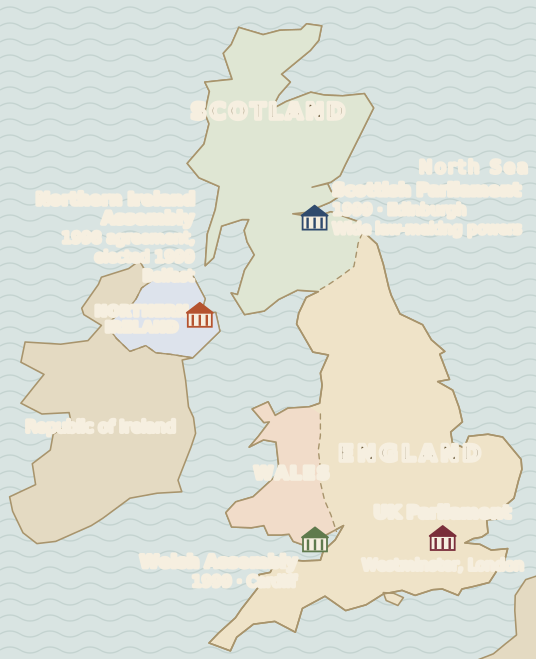
1999The Scottish Parliament, the Welsh Assembly and the Northern Ireland Assembly start work
2007Gordon Brown takes over as Prime Minister
2010The Conservatives and the Liberal Democrats form a coalition government, with David Cameron as Prime Minister
2015The Conservatives win a majority on their own; Cameron stays on as Prime Minister
2016On 23 June the UK votes to leave the EU (51.9% to 48.1%); Theresa May becomes Prime Minister on 13 July
2019Boris Johnson takes over from May on 24 July
2020The UK formally leaves the European Union on 31 January
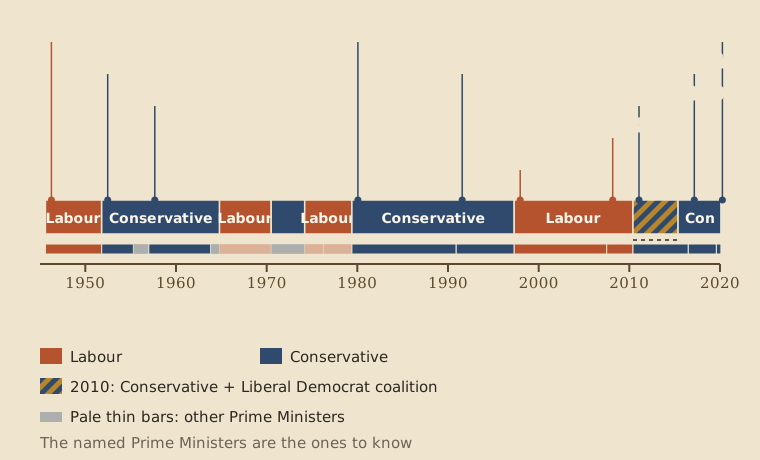
Over 75 years, Labour (red) and the Conservatives (blue) took turns in government. The 10 Prime Ministers named above are the ones to know.
The welfare state: from the cradle to the grave
Britain had won the war, but its economy was worn out, and people wanted change. At the 1945 general election Labour won by a landslide, and the new Prime Minister was Clement Attlee. He promised to build the welfare state set out in a report written during the war.
The result took a while to arrive. People voted on 5 July, but the count was not announced until 26 July, because the votes of soldiers serving abroad had to be brought home first. Many voters still admired Churchill, but they felt that rebuilding the country should be left to Labour and its promise of a welfare state. For Churchill's wartime story, see the previous chapter; he became Prime Minister again in 1951.
The Beveridge Report: defeating five giants
The report came out in 1942. It was written by the economist William Beveridge, and its official title was Social Insurance and Allied Services. Beveridge said there were five "Giant Evils" in British society that had to be defeated:
Want (being poor and in need)
Disease
Ignorance (lack of education)
Squalor (bad, dirty housing)
Idleness (here it means unemployment)
The report became the foundation of the modern welfare state. Beveridge himself was a Liberal politician, and he later sat in the House of Lords as Lord Beveridge.
Aneurin Bevan and the NHS
In 1948 the Minister for Health, Aneurin "Nye" Bevan, led the creation of the National Health Service (NHS). It promised everyone a basic level of health care, and patients paid nothing when they used it (it was free at the point of use).
The new service opened on 5 July 1948. That day Bevan went to Park Hospital near Manchester to "take it over" from the local council, as a symbol of the change. Its first NHS patient was Sylvia Diggory (Beckingham before she married), a 13-year-old girl who was being treated there for a liver problem. The hospital is now called Trafford General Hospital.
The government also set up a national system of benefits, called social security, so that people were looked after "from the cradle to the grave".
At the same time, the Attlee government nationalised several key industries, putting them under state ownership: the railways, coal mines, gas, water and electricity.
R. A. Butler and the 1944 Education Act
Education was another part of the welfare state. The Conservative politician R. A. Butler (later Lord Butler) was put in charge of education in 1941. He brought in the Education Act 1944, often called The Butler Act, which gave every child in England and Wales a free secondary school education. The split between "primary" and "secondary" schools that most areas still have today also comes from this law.
Quiz
As Minister for Health, who was responsible for setting up the NHS in 1948?
It was Bevan. Beveridge wrote the 1942 report; the two names look alike, so they are the easiest pair to mix up. One way to remember: Beveridge wrote the report, Bevan built the NHS. Florence Nightingale was a pioneer of nursing in the 19th century.
Quiz
Which politician was behind the 1944 Education Act that made secondary schooling free in England and Wales?
It was R A Butler, which is why the law is also called the Butler Act. Note that he was a Conservative, while Attlee and Bevan were Labour and Beveridge was a Liberal.
Two writers born in Wales
Two writers also belong to this part of the story. The first is the Welsh poet Dylan Thomas (1914–1953). He loved reading and performing his work to audiences, including on BBC radio. His best-known works are the radio play Under Milk Wood, which was first performed in 1954, after his death, and Do Not Go Gentle into That Good Night, a poem he wrote in 1952 for his father, who was dying. He died in New York aged only 39. His home town of Swansea remembers him with a statue and the Dylan Thomas Centre, among other places.
The second is Roald Dahl (1916–1990), who was born in Wales to Norwegian parents. During the Second World War he served in the Royal Air Force, and in the 1940s he started to publish books and short stories. He is best known for his children's books, though he wrote for adults too. Among the most famous are George's Marvellous Medicine and Charlie and the Chocolate Factory, and several have been turned into films.
From Empire to Commonwealth
While the welfare state was being built at home, the British Empire abroad began to break up. In 1947 Britain gave independence to nine countries, among them India, Pakistan and Ceylon (today's Sri Lanka). In the 20 years that followed, colonies in Africa, the Caribbean and the Pacific gained their independence too.
In the same period, Britain developed its own atomic bomb. It also joined NATO (the North Atlantic Treaty Organization), a new alliance set up to protect its members against an attack by the Soviet Union and its allies.
From 1951 to 1964 the Conservatives were in power. The economy recovered in the 1950s, and life for working people kept getting better. The Prime Minister, Harold Macmillan, gave a famous speech about the "wind of change", about decolonisation (colonies becoming independent) and independence for the countries of the Empire.
Macmillan gave that speech in February 1960, to the parliament of South Africa in Cape Town. Standing in front of a government that practised apartheid (keeping people apart by race), he said that a "wind of change" of African national feeling was blowing through the whole continent, and that people had to accept it, whether they liked it or not. His audience was not impressed.
Quiz
Which of the following statements is correct?
The countries that became independent in 1947 included India, Pakistan and Ceylon (now Sri Lanka). Canada, Australia and New Zealand were "dominions" that had governed themselves since long before; they did not become independent that year.
Migration after the war: rebuilding Britain together
Even as the Empire broke up, Britain was looking overseas for help at home. Rebuilding the country after the war was an enormous job, and Britain was badly short of workers. The government's first step was to invite workers from Ireland and the rest of Europe to come and help. In 1948, people from the West Indies (the Caribbean) were invited to come and work too.
In the 1950s there were still not enough workers, so the country kept encouraging people to come, for economic reasons. Many industries went looking for staff overseas. For example:
Recruitment centres were opened in the West Indies to find bus drivers.
Textile and engineering companies in the Midlands and the north of England sent people to India and Pakistan to find workers.
Over roughly 25 years, many people came from the West Indies, India and Pakistan, and later from Bangladesh, to work and make their homes in Britain.
But in the late 1960s the government passed new laws to limit immigration. From then on, people coming to live in Britain had to have close links with the country through birth or family background, and the numbers fell. Even so, in the early 1970s Britain took in 28,000 people of Indian descent who had been expelled from Uganda. They had been forced out in 1972, when Idi Amin, the dictator of Uganda, ordered all Asian people living there to leave the country within 90 days. Many of them held British passports, and many settled in cities such as Leicester and built up businesses from nothing.
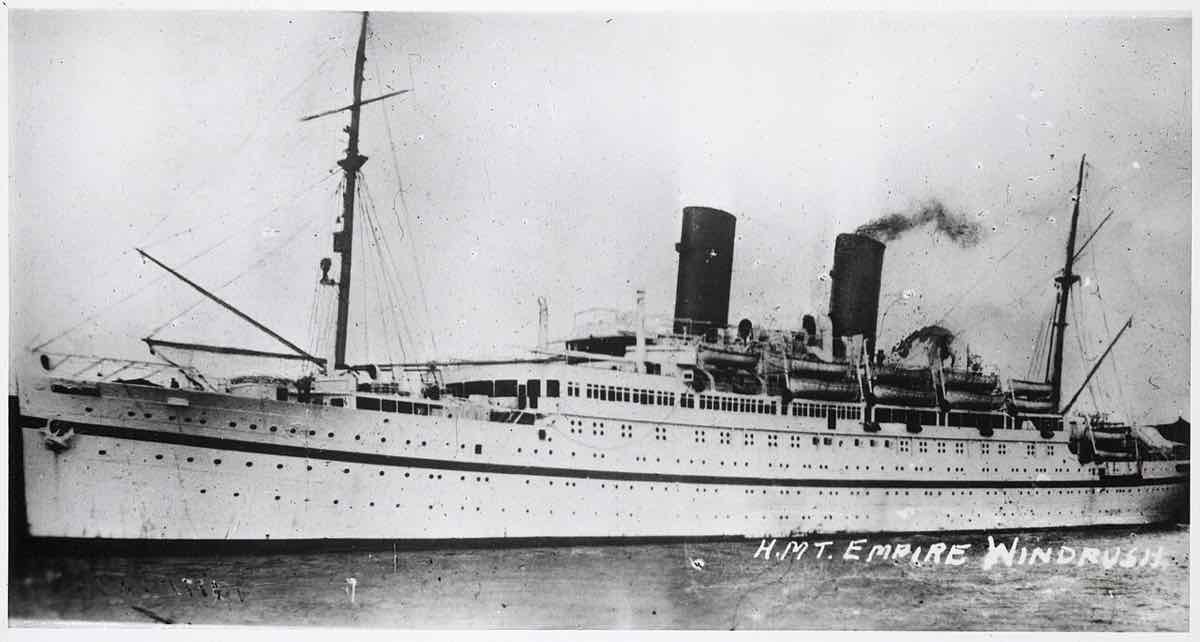
The Empire Windrush, which brought the first large group of Caribbean migrants to Britain in 1948. It docked at Tilbury, east of London, on 22 June 1948, and most of its more than one thousand passengers came from the Caribbean. People who moved from the Caribbean to Britain between 1948 and the early 1970s became known as the "Windrush generation". Since 2018, 22 June has been marked every year as Windrush Day.
Photo: Royal Navy official photographer, public domain, via Imperial War Museums (IWM) and Wikimedia Commons
Quiz
Is the statement below TRUE or FALSE?
In the 1950s, recruitment centres in the West Indies looked for people to work as bus drivers in Britain.
True. Watch out for a different version of this question: it was textile and engineering firms, not bus companies, that went to India and Pakistan to find workers.
The Swinging Sixties
The 1960s were ten years of huge social change, known as "the Swinging Sixties". Fashion, cinema and pop music all boomed. The best-known bands of the day were The Beatles and The Rolling Stones. Many people were better off than before, and lots of them bought cars and household appliances (electrical machines for the home).
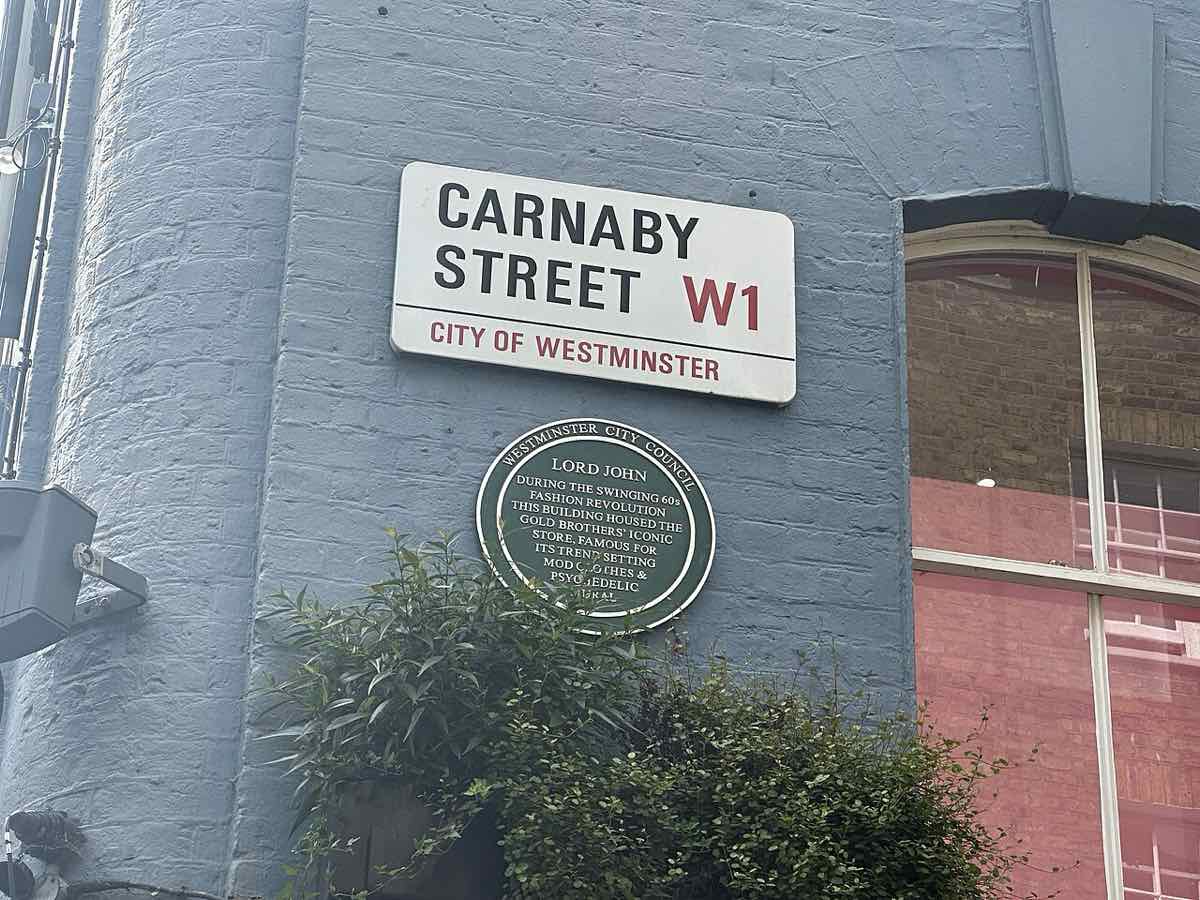
Carnaby Street in London was the fashion centre of the Swinging Sixties. The plaque on the wall remembers one of the famous clothes shops of the time. The designer most linked with 1960s London fashion is Mary Quant, who made the miniskirt hugely popular.
Photo: Matt Brown, CC BY 4.0, via Wikimedia Commons
Social laws were also relaxed in this decade, for example the laws on divorce and abortion in England, Wales and Scotland. Women's position at work got better too. In those days many employers expected women to give up their jobs when they married. Parliament later passed laws giving women the right to equal pay for the same work, and making it illegal for employers to treat women unfairly because of their sex.
The fight for equal pay owed a lot to one strike. In 1968 the women who sewed car seat covers at Ford's factory in Dagenham walked out, because they had been classed as "unskilled" and were paid less. Their strike helped lead to the Equal Pay Act of 1970, and their story was later made into the film Made in Dagenham.
In technology, Britain and France worked together on Concorde, a passenger plane that could fly faster than the speed of sound (it was supersonic). In architecture, tower blocks and new styles using concrete and steel became common.
Quiz
Which of the following statements is correct?
Both bands belong to the Swinging Sixties, when British fashion, cinema and pop music boomed. Punk came later, in the late 1970s.
Quiz
Which TWO areas of social law were liberalised in the 1960s?
The laws on divorce and abortion were relaxed. Immigration laws were actually tightened in the late 1960s, and limiting the power of trade unions was the work of Margaret Thatcher's governments in the 1980s.
Great British inventions of the 20th century
Through all these changes, British scientists and engineers kept coming up with great inventions. Some of the best known actually came before 1945, so we look at them in two groups: before and after the war. Alexander Fleming, who discovered penicillin, belongs to the story of the Second World War, so you met him in the previous chapter.
Before the war (1920s and 1930s)
Television: developed in the 1920s by the Scot John Logie Baird, who in 1932 sent the first TV broadcast from London to Glasgow.
Radar: the Scot Robert Watson-Watt suggested that radio waves could be used to find enemy aircraft, and the first successful test came in 1935. In the Second World War, radar helped Britain spot German planes early during the Battle of Britain.
The Turing machine: an idea for a theoretical machine, put forward by the mathematician Alan Turing in the 1930s. It became a foundation of modern computer science.
Insulin: the Scottish doctor and researcher John Macleod was one of the people who discovered insulin, which made diabetes possible to treat.
The jet engine: developed in the 1930s by Frank Whittle, an engineer in the Royal Air Force.
Quiz
Which British mathematician came up with a theoretical device in the 1930s that helped lay the foundations of modern computing?
Alan Turing described the Turing machine in the 1930s, and the idea shaped computer science and the modern computer. Berners-Lee invented the World Wide Web, Baird developed television and Watson-Watt developed radar.
After 1945
Hovercraft Cockerell · 1950s
Concorde Britain and France · 1969
Structure of DNA Crick · 1953
Cash machine Goodfellow · 1960s
IVF ("test-tube" baby) Edwards and Steptoe · 1978
Dolly the sheep Wilmut and Campbell · 1996
MRI scanner Mansfield
World Wide Web Berners-Lee · 1990
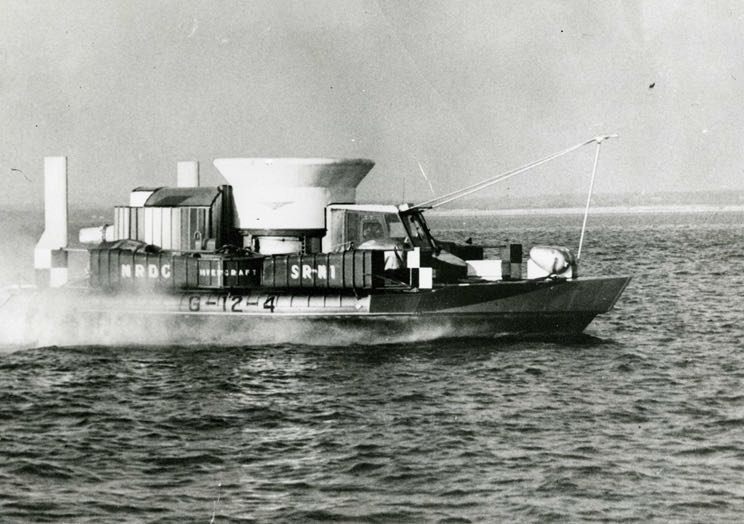
The hovercraft: invented in the 1950s by Sir Christopher Cockerell.
The structure of DNA: worked out in 1953 by researchers at universities in London and Cambridge. Francis Crick was one of the people given the Nobel Prize for it. The discovery has been very important for medicine and for solving crimes.
The radio telescope: Sir Bernard Lovell moved from working on radar into astronomy. At Jodrell Bank in Cheshire he built a radio telescope that was the biggest in the world for many years, and it is still in use.
Concorde: built by Britain and France together. It first flew in 1969, started carrying passengers in 1976 and was taken out of service in 2003.
The Harrier jump jet: a military plane that can take off straight up, designed and developed in the UK.
The ATM (cash machine, or "cashpoint"): invented by James Goodfellow in the 1960s. Barclays Bank opened the first one in Enfield, north London, in 1967. The first person to take money out of it was the comedy actor Reg Varney.
IVF (in vitro fertilisation): pioneered in Britain by Sir Robert Edwards and Patrick Steptoe. The world's first "test-tube baby" was born in Oldham, Lancashire, in 1978. She was Louise Brown, born on 25 July 1978.
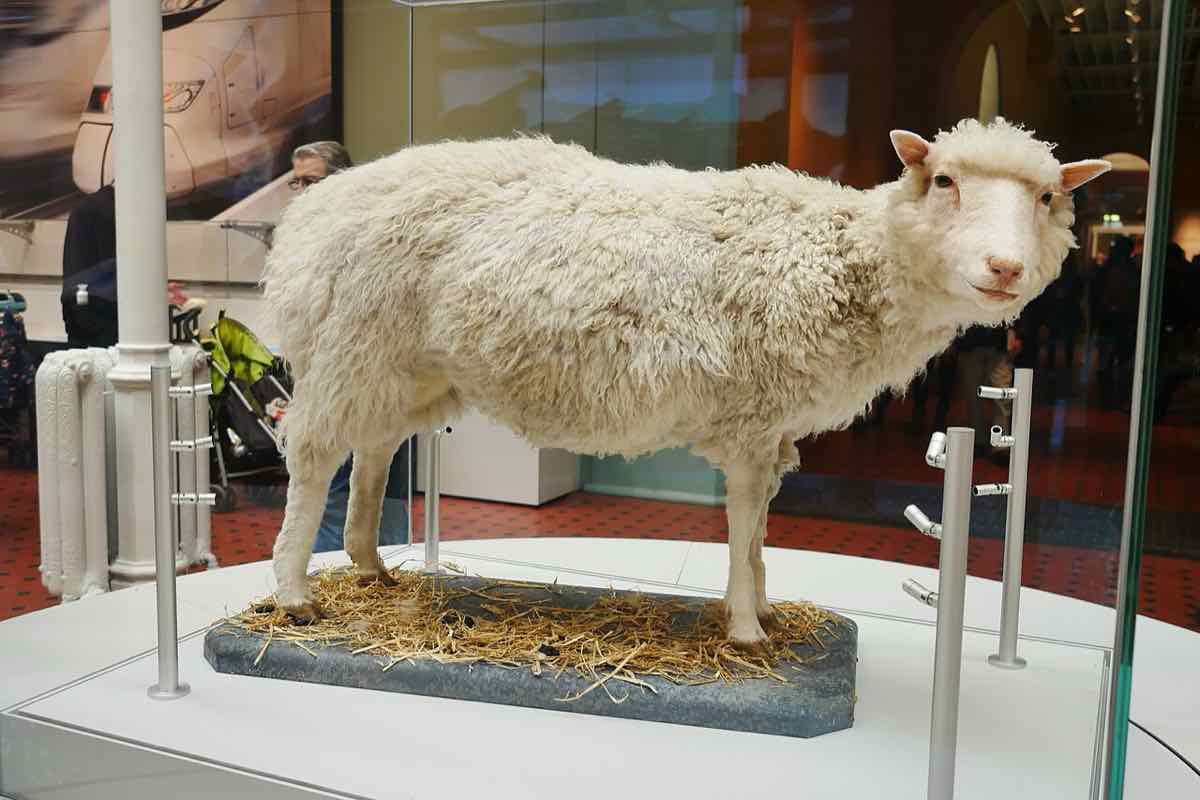
Dolly the sheep: in 1996 a team led by Sir Ian Wilmut and Keith Campbell became the first to clone a mammal.
The MRI scanner (magnetic resonance imaging): Sir Peter Mansfield was one of its inventors. It lets doctors see inside the body without an operation.
The World Wide Web: invented by Sir Tim Berners-Lee. The first information was sent over it on 25 December 1990.
SR.N1, the first practical hovercraft, designed by Cockerell, photographed during Royal Navy trials around 1963. Cockerell's first experiment was much simpler: he put a cat-food tin inside a coffee tin and used a hairdryer (some say the blowing end of a vacuum cleaner) to blow air into the gap. With the tins upside down on a set of kitchen scales, he found that the moving air could push them up. In 1959 the SR.N1 crossed the English Channel.
The National Archives UK, no known copyright restrictions, via Wikimedia CommonsDolly the sheep, now in the National Museum of Scotland in Edinburgh. She was born in July 1996 at the Roslin Institute near Edinburgh. Because she was cloned from a cell taken from a mammary gland (the part of the body that makes milk), the researchers named her after the country singer Dolly Parton, famous for her large bust.
Photo: Sgerbic, CC BY-SA 4.0, via Wikimedia Commons
Quiz
Who invented the hovercraft in the 1950s?
Cockerell invented the hovercraft. Whittle is the jet engine, Baird is television and Berners-Lee is the World Wide Web. These four often turn up in the same question.
Quiz
Is the statement below TRUE or FALSE?
In 1978 the world's first IVF ('test-tube') baby arrived in Oldham, Lancashire.
True. IVF was pioneered in Britain by Robert Edwards and Patrick Steptoe. Don't confuse it with Dolly the sheep in 1996.
Quiz
Which TWO of the following statements are correct?
Goodfellow invented the cash machine; the jet engine was Whittle. Crick worked on the structure of DNA; the hovercraft was Cockerell.
The 1970s: economic trouble and the Troubles
Through the 1950s and 1960s, most people had grown used to steady jobs and rising wages. In the late 1970s the long boom after the war came to an end. Prices and the cost of raw materials shot up, and the value of the pound against other money kept changing. This caused balance of payments problems: the goods Britain bought from abroad were worth more than the goods it sold abroad.
Many industries and services were hit by strikes, and relations between the trade unions and the government grew tense. Some people began to feel that the unions had too much power and were damaging the country.
Two winters stood out. In early 1974 a miners' strike caused power shortages, and businesses were only allowed to use electricity three days a week, which became known as the Three-Day Week. In the winter of 1978–79 came a wave of big strikes. Rubbish piled up in the streets with no one to collect it, and newspapers borrowed a line from Shakespeare to call it the "Winter of Discontent". It helped pave the way for Margaret Thatcher's election in 1979.
The 1970s were also the worst years of the conflict in Northern Ireland. People who wanted Northern Ireland to join the Republic of Ireland and people who wanted it to stay in the UK were locked in a long conflict known as the Troubles. In 1972 the UK government suspended the Northern Ireland Parliament and began to run Northern Ireland directly from London. In the decades after 1969, around 3,000 people were killed in the violence in Northern Ireland.
The same decade also gave Northern Ireland a sporting hero to cheer: Mary Peters. She was born in Manchester and moved to Northern Ireland as a child. In 1972 she won an Olympic gold medal in the pentathlon (one competition made up of five athletics events). Afterwards she raised money for local athletics, managed the British women's Olympic team and kept working to promote sport and tourism in Northern Ireland. For this work she was made a Dame in 2000.
Quiz
In which event did Mary Peters win an Olympic gold medal in 1972?
Mary Peters, who was born in Manchester and grew up in Northern Ireland, won gold in the pentathlon in 1972; she was made a Dame in 2000. Rowing brings to mind Sir Steve Redgrave, cycling Sir Chris Hoy and tennis Sir Andy Murray, all sports stars from later decades.
Quiz
Which of the following statements is correct?
In 1972 the UK government suspended the Northern Ireland Parliament and direct rule began. The Good Friday Agreement wasn't signed until 1998, and the Northern Ireland Assembly was elected in 1999.
The Common Market and the European Union
The 1970s also brought a big change in Britain's place in Europe. In 1957 six countries set up the European Economic Community (EEC): France, West Germany, Italy, Belgium, the Netherlands and Luxembourg. People often called it the "Common Market", because its members could trade with each other freely. When the European Union (EU) was created in 1993, the EEC became part of it. The UK was a full member of the EU, but it never swapped the pound for the euro (it did not use the euro). Then, on 31 January 2020, it formally left. You'll find the story of how that happened at the end of this chapter.
Getting in had not been easy. The UK first asked to join in the 1960s, but the French president, Charles de Gaulle, said no twice, in 1963 and 1967. Only after he left office in 1969 could the UK get in, in 1973. In 1975 the UK held a referendum, and about two-thirds voted to stay.
Quiz
In which year did six countries, among them France and West Germany, set up the European Economic Community (EEC)?
1957, and the UK wasn't one of the six. 1993 is when the European Union was formed and the EEC became part of it, and 2020 is when the UK left the EU. 1973 is the year the UK joined.
Thatcher and Major: 18 years of Conservative government (1979–1997)
After the strikes of the 1970s, voters turned in 1979 to a very different kind of leader. Margaret Thatcher was Britain's first woman Prime Minister. She led a Conservative government from 1979 to 1990, longer than any other Prime Minister of the 20th century. Her father ran a grocer's shop in Grantham, Lincolnshire, and she studied chemistry and trained as a lawyer. She became an MP in 1959, Secretary of State for Education and Science in 1970, and leader of the Conservative Party in 1975.
Her government changed the economy dramatically:
Industries owned by the state were privatised (sold to private companies), and new laws limited the power of the trade unions.
Deregulation (removing rules and controls) helped the City of London grow into a world centre for investment, insurance and other financial services.
Shipbuilding, coal mining and other traditional industriesdeclined.
Abroad, she worked closely with the US President, Ronald Reagan. She was also one of the first Western leaders to welcome the new kind of leadership in the Soviet Union, and these changes in the end helped bring the Cold War to a close.
Her famous nickname, the "Iron Lady", actually came from the other side. It first appeared in 1976 in Red Star, a Soviet army newspaper, as a criticism of her tough line against the Soviet Union. But she liked it, and later used it about herself in speeches.
In 1982 Argentina invaded the Falkland Islands, which are a British overseas territory in the South Atlantic. Britain sent a naval task force, and the islands were won back by military action.
In 1990 Thatcher was replaced as Prime Minister by John Major. He helped to start the peace process in Northern Ireland.
Quiz
Is the statement below TRUE or FALSE?
Margaret Thatcher, the UK's first woman Prime Minister, led a Labour government from 1979 to 1990.
The party is wrong: Thatcher was Conservative. The years 1979–1990 and "first woman Prime Minister" are both correct. Questions that change just one word like this are very common.
Blair, Brown and devolution (1997–2010)
In 1997Tony Blair led Labour to victory. His government brought in devolution, which means passing some powers from the UK Parliament to the nations of the UK. It set up the Scottish Parliament and the Welsh Assembly, and both started work in 1999.
The Scottish Parliament has wide powers to make its own laws.
The Welsh Assembly was given fewer law-making powers, but a lot of control over public services.
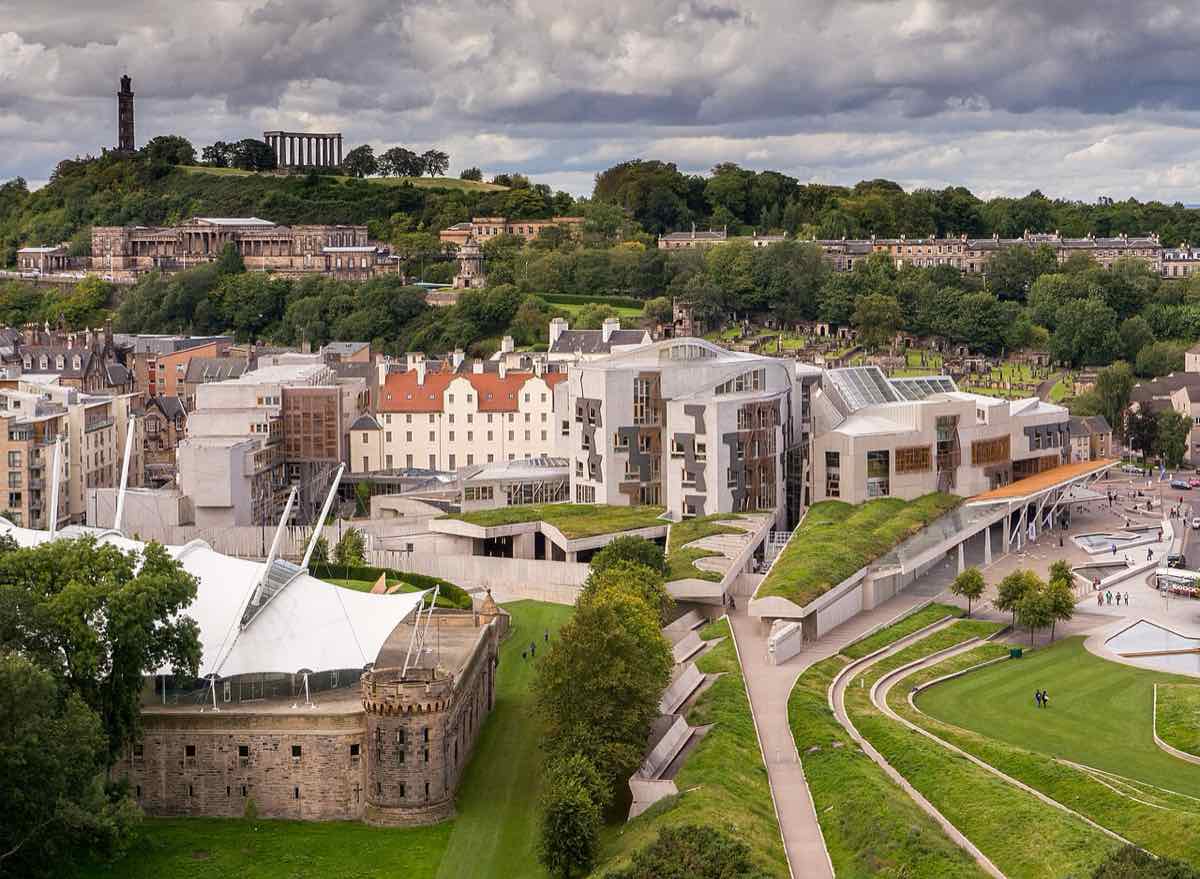
The UK Parliament sits at Westminster in London. Since 1999, Scotland, Wales and Northern Ireland have each had their own parliament or assembly as well.The Scottish Parliament building at Holyrood, Edinburgh, opened in 2004.
Photo: Ermell, CC BY-SA 4.0, via Wikimedia Commons
In Northern Ireland, Blair's government carried on the peace process that Major had started, and in 1998 the Good Friday Agreement (also called the Belfast Agreement) was signed. The Northern Ireland Assembly was first elected in 1999, but it was suspended in 2002 and only brought back in 2007. Most paramilitary groups (armed groups that are not part of an official army) have now destroyed their weapons and stopped their activities.
In 2007 Gordon Brown took over from Blair as Prime Minister.
Afghanistan and Iraq
In the 1990s Britain played a leading part in the international forces that freed Kuwait (after Iraq invaded it in 1990) and in the conflict in the former Yugoslavia. After 2000, British forces took part in the worldwide fight against terrorism, including military operations in Iraq and Afghanistan. The last British combat troops left Iraq in 2009. In Afghanistan the UK was part of the International Security Assistance Force (ISAF), which had a mandate from the United Nations; the Afghans were to take over responsibility for security by the end of 2014.
Quiz
Which TWO were introduced by the Labour government led by Tony Blair after 1997?
Blair's government set up the Scottish Parliament and the Welsh Assembly. The NHS was created in 1948 by Attlee's government (Bevan), and privatisation was a policy of Thatcher's government.
2010 to 2020: a coalition, a referendum and Brexit
Labour's 13 years in power ended at the general election of May 2010, when no party won a majority of seats. This had not happened in Britain since February 1974. The Conservatives and the Liberal Democrats formed a coalition government. The Conservative leader, David Cameron, became Prime Minister, and the Liberal Democrat leader, Nick Clegg, became Deputy Prime Minister.
2015: a surprise majority
Before the general election of 7 May 2015, almost every opinion poll predicted another hung parliament, with no party holding a majority. Instead the Conservatives won enough seats to govern alone, their first overall majority since 1992, and David Cameron carried on as Prime Minister. Their old coalition partners, the Liberal Democrats, crashed from 57 seats to just 8.
The result surprised almost everyone. When the BBC's exit poll came out at 10pm on election night, it gave the Liberal Democrats only about 10 seats. Paddy Ashdown, a former leader of the party, said live on television that if the poll was right he would publicly eat his hat. The real result was even worse for his party: 8 seats.
23 June 2016: the EU referendum
Cameron had promised that a Conservative government would let the people decide whether the UK should stay in the European Union. The referendum (a vote by the whole country on one question) took place on 23 June 2016. Cameron campaigned to stay, but the result went the other way, by a narrow margin: 51.9% voted to leave and 48.1% to remain. More than 72% of registered voters took part. England and Wales voted to leave, while most voters in Scotland and Northern Ireland wanted to stay. The next morning, Cameron announced that he would step down.
May, Johnson and the day the UK left
On 13 July 2016Theresa May, who had been Home Secretary, took over from Cameron. She was the second woman to become Prime Minister, after Margaret Thatcher. Her task was to agree the terms of leaving with the EU, but MPs voted down the deal she negotiated three times in early 2019, and in May that year she announced that she would stand down. Boris Johnson, a former Mayor of London, succeeded her on 24 July 2019. In December 2019 he called a general election with the slogan "Get Brexit Done" and won a large majority.
At 11pm UK time on 31 January 2020, the UK formally left the European Union, 47 years after joining. This departure became known as Brexit, short for "British exit". It is also where our story ends.
The moment itself passed quietly. Some people wanted Big Ben to ring out at 11pm, but the bell had been silenced for repair work on the Elizabeth Tower, and the idea was dropped. Instead, a countdown clock was shown on the front of 10 Downing Street, and the Royal Mint brought out a 50p coin dated 31 January 2020, with the words "Peace, prosperity and friendship with all nations".
In the Stone Age, people could walk from Britain to mainland Europe; in 2020, the UK left the European Union. Between those two moments lies the long history that has made the country what it is today.
Quiz
In the referendum of 23 June 2016, what share of the vote went to leaving the European Union?
51.9% voted to leave. 48.1% is the share that voted to remain, so don't swap the two. About two-thirds (67%) is how many voted to stay in the earlier referendum of 1975.
Quiz
Which TWO of the following statements are correct?
May followed Cameron on 13 July 2016, and Johnson followed May on 24 July 2019, not Cameron. The 2015 election gave the Conservatives a majority of their own, so no coalition was needed. The UK left the EU on 31 January 2020.
Chapter summary
1942 Beveridge Report
Five giant evils: Want, Disease, Ignorance, Squalor, Idleness; the basis of the welfare state
1944 Butler Act
R A Butler's (Conservative) Education Act: free secondary schooling in England and Wales
1945 Attlee
Labour government: the welfare state; railways, coal mines, gas, water and electricity nationalised
1947 Independence
Nine countries, including India, Pakistan and Ceylon (Sri Lanka)
1948 NHS
Nye Bevan sets up the NHS; the same year, people from the West Indies are invited to work in Britain
Dylan Thomas / Roald Dahl
Dylan Thomas: Welsh poet, Under Milk Wood, Swansea. Roald Dahl: born in Wales to Norwegian parents, RAF in the Second World War, Charlie and the Chocolate Factory
Migration
Bus drivers recruited in the West Indies; textile and engineering firms recruited in India and Pakistan; later Bangladesh too; 28,000 people of Indian origin from Uganda in the early 1970s
Wind of change
Macmillan's speech on decolonisation; Conservatives in power 1951–64
1960s
The Swinging Sixties: the Beatles, the Rolling Stones; divorce and abortion laws relaxed; equal pay; Concorde
Inventions
Before the war: TV, Baird (1932 London–Glasgow); radar, Watson-Watt (1935); the Turing machine; insulin, Macleod; the jet engine, Whittle (for Fleming and penicillin, see the previous chapter). After the war: radio telescope, Lovell; hovercraft, Cockerell; Concorde and the Harrier; DNA, Crick, 1953; cash machine, Goodfellow, 1967; IVF, Oldham, 1978; Dolly the sheep, 1996; MRI, Mansfield; World Wide Web, Berners-Lee, 1990
1970s
End of the boom, balance of payments problems, strikes; direct rule in Northern Ireland from 1972; about 3,000 deaths
Mary Peters
Olympic pentathlon gold in 1972; promoted sport and tourism in Northern Ireland
EEC / EU
Six countries set up the EEC in 1957; it became part of the EU in 1993; the UK was a member but did not use the euro, and left on 31 January 2020
1979 Thatcher
First woman Prime Minister, Conservative; privatisation, limits on the unions; 1982 Falklands War
1990 Major
Helped start the Northern Ireland peace process
1997 Blair
Labour; Scottish Parliament and Welsh Assembly; 1998 Good Friday Agreement
NI Assembly
Elected 1999, suspended 2002, restored 2007
2007 / 2010
Brown takes over; in 2010 a Conservative–Liberal Democrat coalition, with Cameron as Prime Minister
2015
The Conservatives win a majority; Cameron stays on as Prime Minister
2016 referendum
23 June: 51.9% leave, 48.1% remain; Theresa May becomes Prime Minister on 13 July
2019 / 2020
Boris Johnson Prime Minister from 24 July 2019; the UK formally leaves the EU on 31 January 2020
 Hovercraft
 Concorde
 Structure of DNA
 Cash machine
 IVF ("test-tube" baby)
 Dolly the sheep
 MRI scanner
 World Wide Web