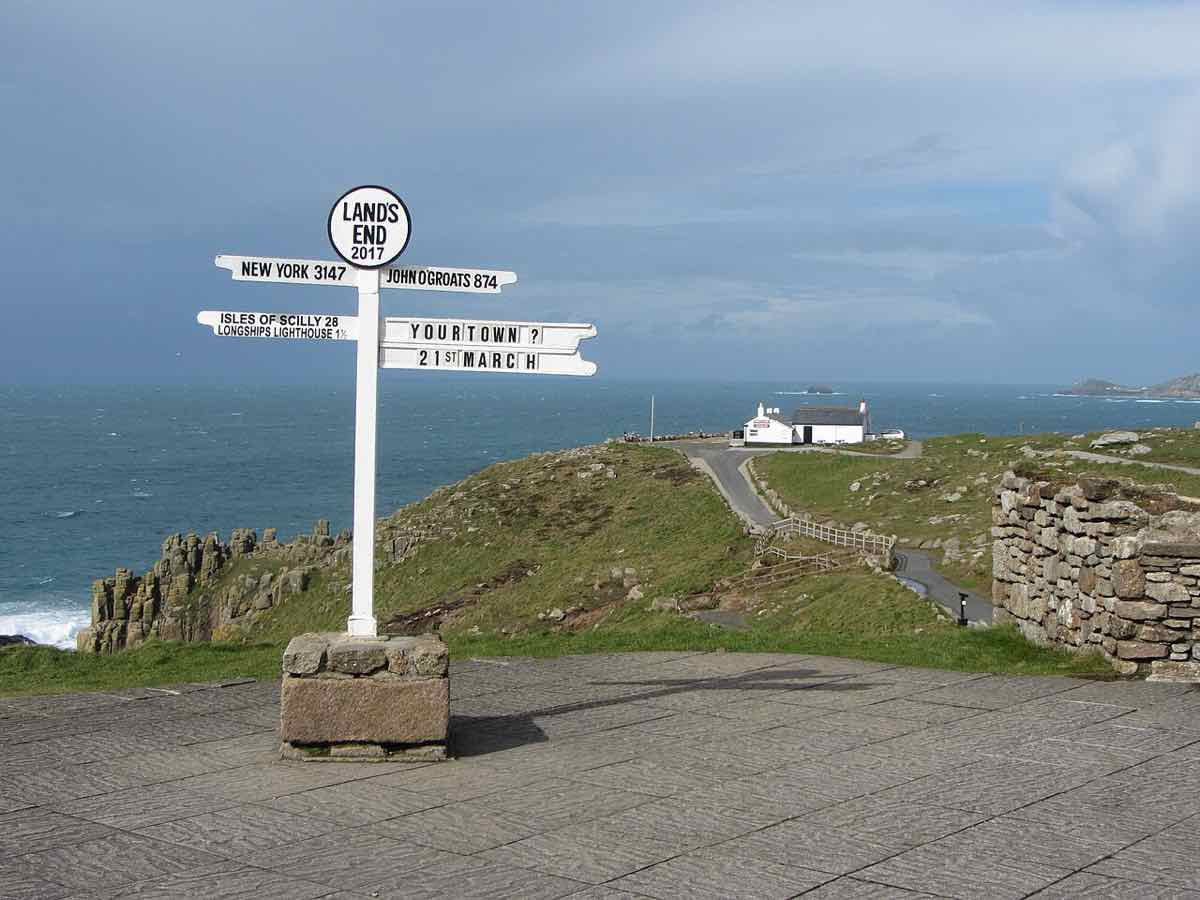
At Land's End, the far south-western tip of England, a famous signpost shows how far it is to John O'Groats, at the northern tip of Scotland. Every year people set off from here and travel all the way north on foot or by bike, often to raise money for charity. It's the longest journey you can make on the island of Great Britain.
On the way you would pass big cities and quiet countryside, hear many different accents and languages, and see churches, mosques and Hindu temples. This chapter covers two sections of chapter 4 of the handbook, The UK today and Religion: the UK's cities, how many people live here, which languages they speak and what they believe.
Four nations, four capitals
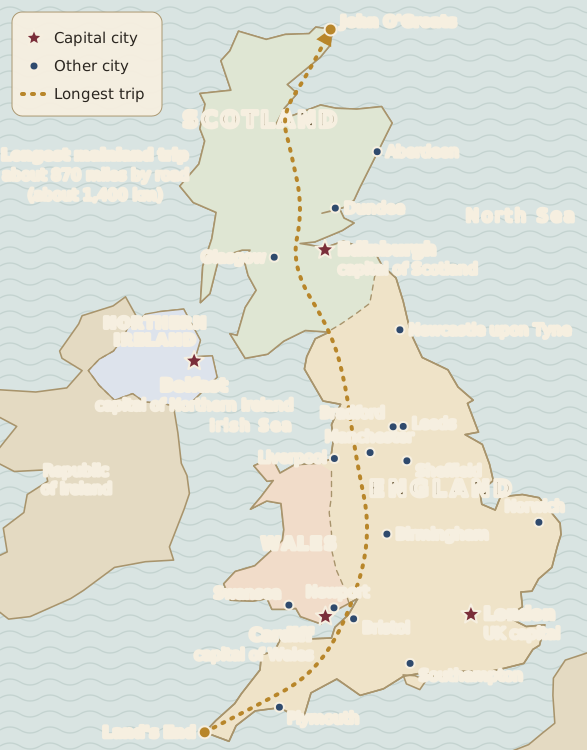
The UK is in north-west Europe. On the mainland, the two places furthest apart are John O'Groats, at the top of Scotland, and Land's End, at the far south-western tip of England. They are roughly 870 miles apart, or about 1,400 kilometres.
Strictly speaking, neither number is quite what it seems. The 870 miles is the distance by road; in a straight line the two places are only about 600 miles (around 970 km) apart. And John O'Groats isn't even the most northerly point of the mainland. That is Dunnet Head, about 18 km to the west, but John O'Groats is far better known, so people still treat it as the finishing line.
Most people live in a town or city, but large parts of Britain are still countryside. Lots of people head out of town on holiday or at weekends to go walking, camping or fishing.
Stars mark the four capitals and dots mark other main cities. The dotted line is the road route from Land's End to John O'Groats, about 870 miles.
The UK is made up of four countries, and each one has its own capital city:
London: the capital of England, and of the whole UK
Edinburgh: the capital of Scotland
Cardiff: the capital of Wales
Belfast: the capital of Northern Ireland
Each country also has other main cities. A test question might ask which city is in Scotland or which is in Wales, so it's worth knowing where each one is. Here they are in alphabetical order:
England
Birmingham, Bradford, Bristol, Leeds, Liverpool, London, Manchester, Newcastle upon Tyne, Norwich, Plymouth, Sheffield, Southampton
Wales
Cardiff, Newport, Swansea
Scotland
Aberdeen, Dundee, Edinburgh, Glasgow
Northern Ireland
Belfast
The signpost at Land's End is one of the most photographed spots for visitors.
Photo: Gareth James / Geograph, CC BY-SA 2.0, via Wikimedia Commons
Quiz
Which TWO of the following statements are correct?
Scotland's capital is Edinburgh, not Glasgow, even though Glasgow has more people. The capital of Wales is Cardiff; Swansea is just another Welsh city. The biggest city isn't always the capital, and the test likes to use this as a trap.
Quiz
Is the statement below TRUE or FALSE?
The journey from John O'Groats in the far north of Scotland to Land's End in the far south-west of England is roughly 870 miles.
True. It is about 870 miles, which is roughly 1,400 kilometres. Remember that this is the distance by road, not in a straight line.
Quiz
In which part of Europe is the United Kingdom located?
The UK is in north-west Europe. Spain and Portugal are in the south-west of Europe, and Finland and the Baltic states are in the north-east, so A and B are wrong.
Pounds and pence: the money in your pocket
The UK's currency is the pound sterling, written with the symbol £. One pound is worth 100 pence (written "p" for short).
The 8 coins and 4 notes in everyday use (a rough sketch: sizes and colours are only approximate). The 20p and 50p coins have seven sides, so they're easy to spot.
Banks in Scotland and Northern Ireland print their own banknotes, with designs that differ from Bank of England notes. These notes are valid all over the UK, but a shop or business can choose not to take them. So don't be surprised if a shop assistant in London looks twice at a Scottish note.
Quiz
Which of the following statements is correct?
Scottish and Northern Irish notes can be used anywhere in the UK; a shop is simply allowed to say no. Option A mixes up "a shop may refuse them" with "they only work in Scotland".
Beyond English: Welsh and Gaelic
The way people speak changes a lot from one part of the UK to another. English itself has many accents and dialects: a person from Liverpool and a person from Glasgow can sound almost as if they speak different languages.
Some parts of the UK also have a language of their own:
Wales: lots of people speak Welsh. It is not a kind of English but a separate language. Children can learn it at school, and it is also taught at university.
Scotland: in parts of the Highlands and Islands, some people speak Gaelic, which is also a separate language from English.
Northern Ireland: some people speak Irish Gaelic.
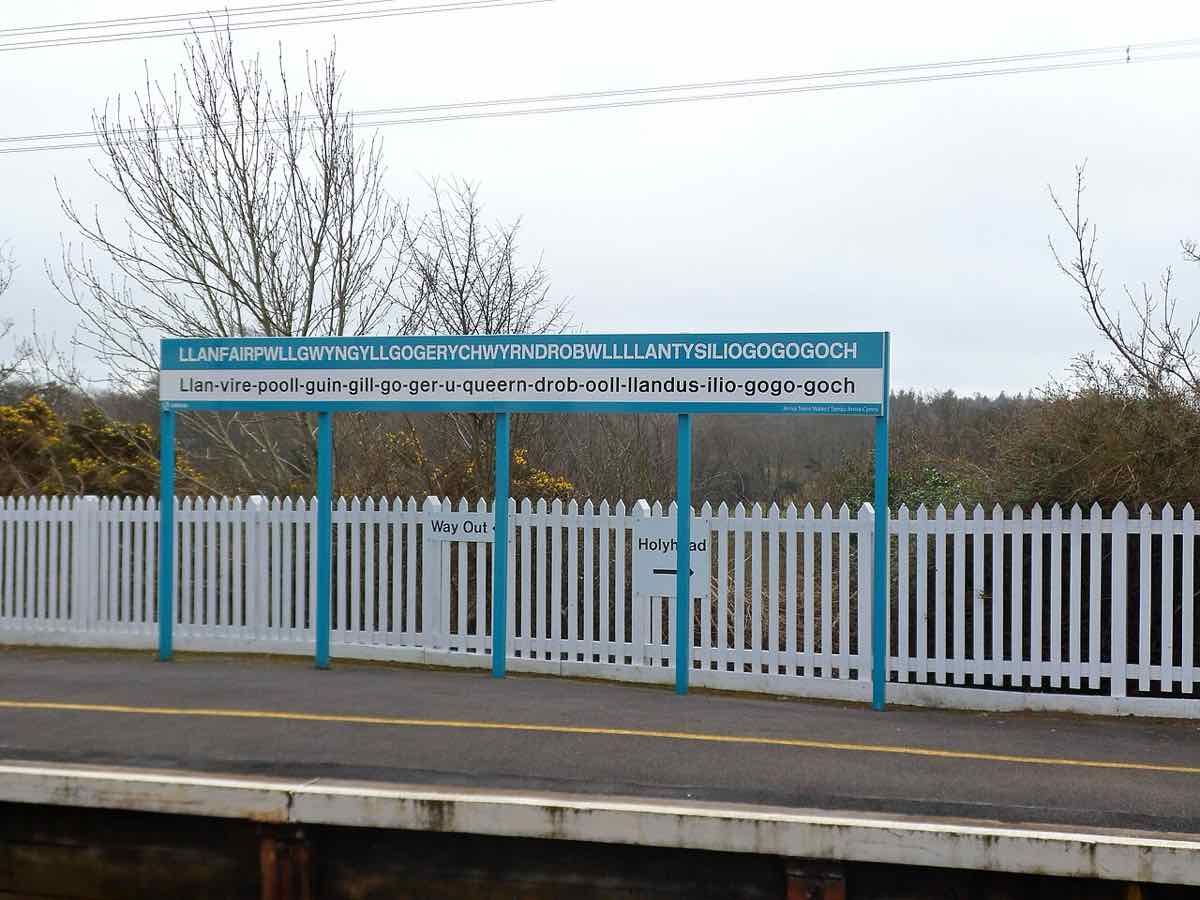
The station sign of a small village on Anglesey, in Wales. The village's Welsh name has 58 letters. Written out in full, the name is Llanfairpwllgwyngyllgogerychwyrndrobwllllantysiliogogogoch: it is often called the longest place name in Europe, and local people just say Llanfair PG. Road signs across Wales are in both Welsh and English.
Photo: Meirion / Geograph, CC BY-SA 2.0, via Wikimedia Commons
Quiz
In which part of the UK do some people speak Irish Gaelic?
Irish Gaelic is spoken in Northern Ireland. In the Highlands and Islands of Scotland people speak (Scottish) Gaelic, and in Wales they speak Welsh. The names are very similar, so look out for the word "Irish".
Population: from 4 million to 66 million
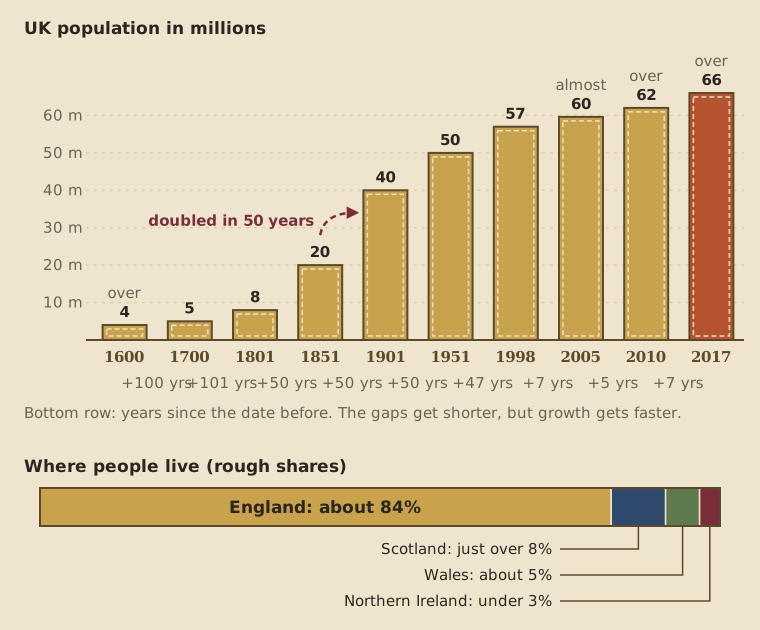
In 1600, when Elizabeth I was on the throne, the population was only a little over 4 million. By 2017 it had passed 66 million. Here is how it changed over these four hundred years:
The top chart shows the population from 1600 to 2017. Notice that the years are not evenly spaced: in the 50 years from 1851 to 1901, the population doubled. The bottom chart shows each nation's share of the UK population.
In recent years the population has grown faster than before. There are two reasons: people moving to the UK and people living longer.
People are spread very unevenly across the four nations. About 84% live in England, and that share has stayed much the same over time. Scotland has just over 8%, Wales about 5% and Northern Ireland under 3%.
Living longer
People in Britain now live longer than at any time in history, because living standards and health care have both improved. There are more people aged 85 or older than ever before. That has a cost: more money is needed for pensions and health care.
Quiz
Roughly what share of the UK's population lives in England?
About 84% live in England, so the other three nations together have only about 16%: Scotland just over 8%, Wales about 5% and Northern Ireland under 3%.
Quiz
Is the statement below TRUE or FALSE?
Because life expectancy in the UK is falling, the number of people aged 85 and over is lower than ever before.
False: it's the other way round. People in the UK now live longer than ever, and there are more people aged 85 and over than at any time before. This makes pensions and health care more expensive.
Ethnic diversity: more mixed than a century ago
Compared with a hundred years ago, the UK today is much more varied, both in people's ethnic backgrounds and in their religions. Because of immigration after the Second World War, nearly 10% of people have at least one parent or grandparent who was born abroad. The UK is a multinational, multiracial society whose culture is rich and varied.
People in the UK have family roots all over the world, and the mix is changing fast, especially in big cities such as London. That makes exact figures hard to pin down. In surveys, the group that most people choose is white. It covers people whose families came from Europe, America, Australia, Canada or New Zealand. Other large groups are of Asian, black and mixed descent.
Much of this mix goes back to the years after the Second World War. In 1948 the ship Empire Windrush brought the first large group of migrants from the Caribbean, and many more people later came from India, Pakistan and other countries (see Britain Since 1945). That is the story behind the "nearly 10%" of people with a parent or grandparent born abroad.
Quiz
Is the statement below TRUE or FALSE?
As a result of immigration after the Second World War, almost one in ten people in the UK has a parent or grandparent who was born abroad.
True. "Nearly 10%" is roughly one person in every ten.
An equal society
In the UK it is against the law to treat someone unfairly because of their sex, or because they are married or not married. Men and women have equal rights at work, in owning property, and in marriage and divorce. When parents are married, the mother and father share equal responsibility for their children.
Today women make up about half of the people in work. On average, girls get better results at school than boys, and more women than men go to university.
Women have far more job opportunities than in the past. They work in every part of the economy, and more women than ever hold senior jobs, including in fields that used to be mostly male. At the same time, men now do a wider range of jobs than before. Nobody expects women to stay at home any more, and many carry on working after having children. In many families both partners work and share the childcare and housework.
It is a big change in a short time. A hundred years ago, women in Britain couldn't even vote: some women got the vote in 1918, and women only gained the same voting rights as men in 1928 (see The Two World Wars). Today the main law protecting people from discrimination is the Equality Act 2010, which protects nine "characteristics", including sex, age, race, religion, and marriage or civil partnership.
Quiz
Which of the following statements is correct?
Married parents are equally responsible for their children, so B is wrong. A is correct: on average girls do better at school, and more women than men go to university.
Quiz
Is the statement below TRUE or FALSE?
Women make up only about a quarter of the people working in the UK today.
False. Women make up about half of the UK's workforce, not a quarter. Today women work in every sector of the economy.
Religion: a historically Christian country
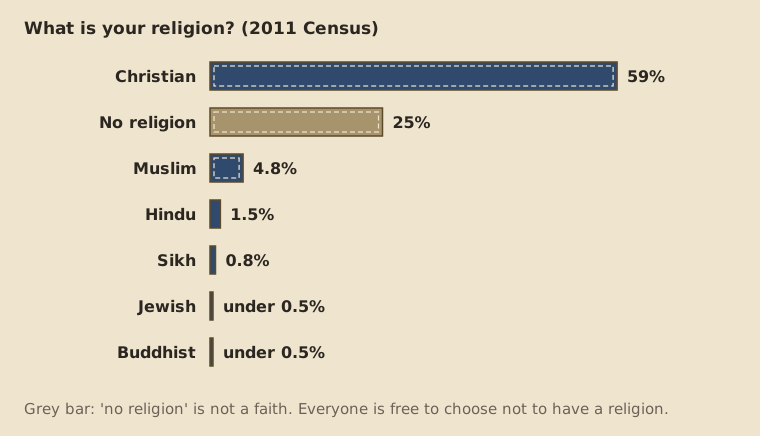
Historically, the UK is a Christian country. Here are the results of the 2011Census, the count of everyone living in the country that takes place every ten years:
The numbers to remember for the test: Christian 59% and no religion 25%. Every other religion is much smaller.
Across the UK you'll also find places of worship for other faiths: mosques, Hindu temples, synagogues (Jewish), gurdwaras (Sikh) and Buddhist temples. But the law gives everyone the right to pick their own religion, or to have none at all. When the 2011 Census asked, a quarter of people (25%) answered that they had no religion.
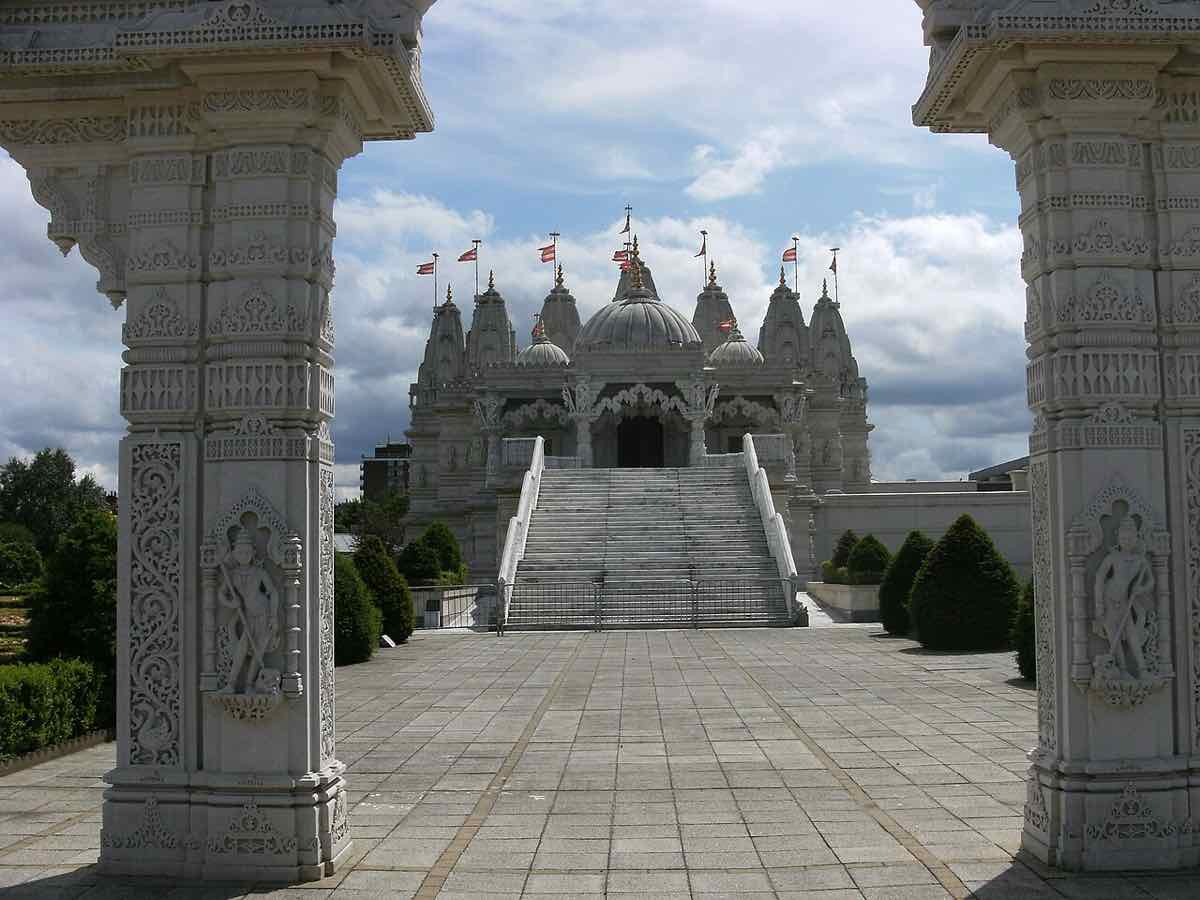
The Hindu temple in Neasden, north-west London, built from marble and limestone and opened in 1995.
Photo: Mark Ahsmann, CC BY-SA 3.0, via Wikimedia Commons
Quiz
According to the 2011 Census, roughly what percentage of people in the UK described themselves as Christian?
59% said they were Christian. 25% is the share who said they had no religion; the test often puts these two numbers side by side.
The Church of England
England's Church and state are linked by the constitution. The state's official Church is the Church of England. In other countries it is known as the Anglican Church, and in Scotland and the USA it is called the Episcopal Church. It's a Protestant Church that goes back to the Reformation of the 1530s, when Henry VIII broke with Rome (see The Tudors).
The monarch is head of this Church.
Its spiritual leader is the Archbishop of Canterbury.
The monarch has the right to appoint the Archbishop and other senior clergy, but in practice the Prime Minister and a committee chosen by the Church usually decide.
A number of its bishops have seats in the House of Lords.
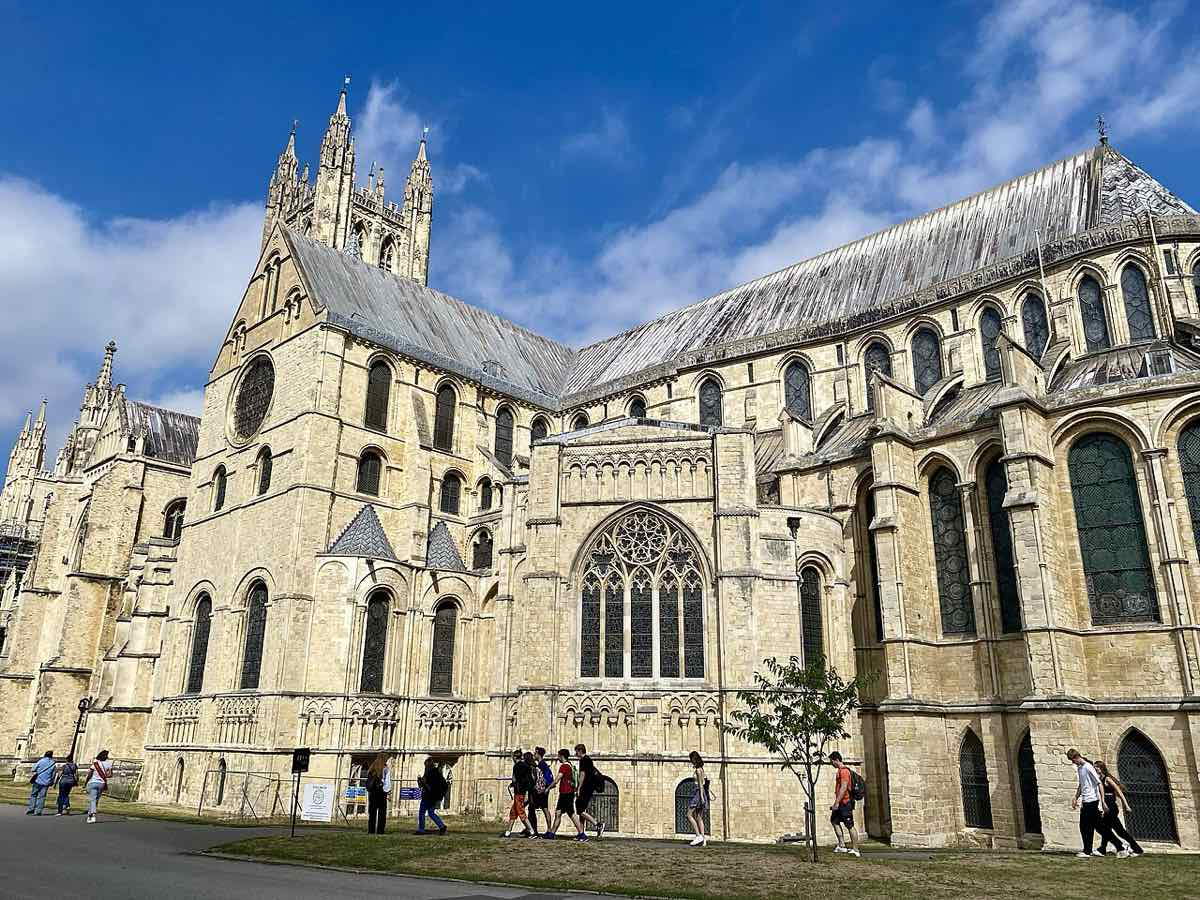
Canterbury Cathedral in Kent is the home church of the Archbishop of Canterbury.
Photo: No Swan So Fine, CC BY-SA 4.0, via Wikimedia Commons
The Church of Scotland and other Churches
Scotland's national Church is the Church of Scotland. It is a Presbyterian Church, run by ministers and elders rather than bishops. Its main meeting is called the General Assembly, and the person who chairs it is the Moderator. Each Moderator serves for just one year and often speaks for the Church in public.
Wales and Northern Ireland have no established Church (no official state Church). Other Protestant groups in the UK include Baptists, Methodists, Presbyterians and Quakers. There are other Christian denominations too, and the largest of them is the Roman Catholic Church.
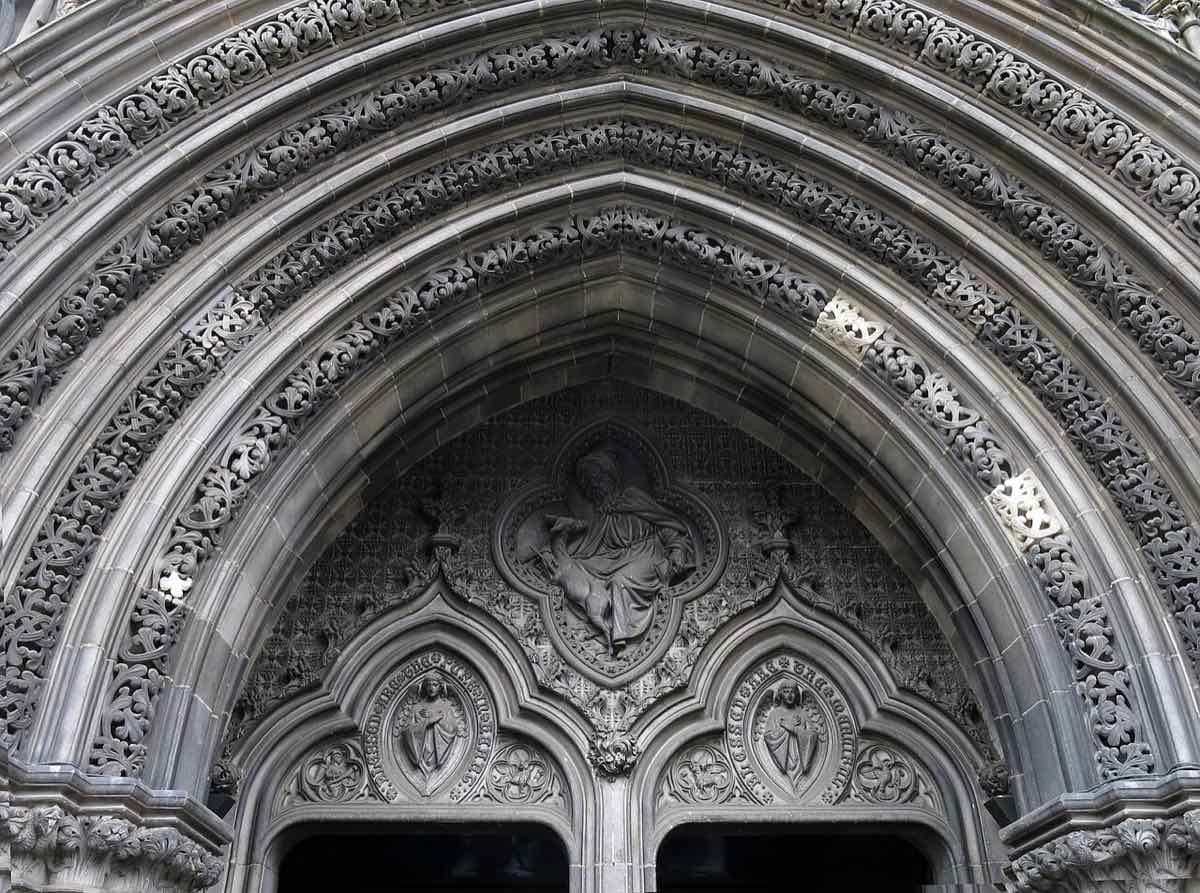
Wales used to be part of the Church of England. In 1920 the Church in Wales was separated from the state and became the independent Church in Wales, which is why Wales has no established Church today. In Scotland, Presbyterian Churches have no bishops at all. So although St Giles' in Edinburgh is called a cathedral, it was a bishop's seat only for two short periods in the 17th century; its other name is the High Kirk of Edinburgh.
St Giles' Cathedral in Edinburgh belongs to the Church of Scotland. Look for the crown-shaped spire on top.
Photo: Enric, CC BY-SA 4.0, via Wikimedia Commons
Quiz
Which TWO statements about churches in the UK are correct?
The Moderator serves for one year, not for life, and neither Wales nor Northern Ireland has an established Church. The monarch heads the Church of England, and the Archbishop of Canterbury is its spiritual leader.
Quiz
Who heads the Church of England?
The monarch heads the Church of England. The Archbishop of Canterbury is its spiritual leader, which makes A a common trap. The Prime Minister usually has a say in choosing senior church leaders but does not head the Church, and the Moderator chairs the General Assembly of the Church of Scotland.
Four patron saints, four special days
Each of the four nations has its own patron saint, a saint who is thought to watch over that country, and every saint has a day of their own:
1 Mar St David's Day Wales
17 Mar St Patrick's Day Northern Ireland
23 Apr St George's Day England
30 Nov St Andrew's Day Scotland
1 March: St David's Day, Wales
17 March: St Patrick's Day, Northern Ireland
23 April: St George's Day, England
30 November: St Andrew's Day, Scotland
Only Scotland and Northern Ireland make their saint's day an official holiday, and even in Scotland some businesses and offices stay open. There are celebrations all over the UK, especially in places where many people have Scottish, Northern Irish or Irish roots.
In England and Wales these days are not public holidays any more, but people still celebrate them with parades and small festivals.
The saints themselves have colourful stories. St George, the dragon-slayer of legend, is said to have been a soldier in the Roman army and never set foot in England. St Patrick, by his own account, was born in Britain, captured as a young man and taken to Ireland as a slave, and later went back to spread Christianity. St David was a 6th-century Welsh bishop, and on his day many people wear a daffodil, the national flower of Wales. St Andrew, one of the twelve apostles of Jesus, gives Scotland's flag its white diagonal cross, from the story that he was put to death on an X-shaped cross; his day has been a bank holiday in Scotland since 2007. Put the crosses of St George, St Andrew and St Patrick together and you get the Union Flag (see A Global Power).
Quiz
On which date is St Andrew's Day, the day of Scotland's patron saint?
1 March is St David (Wales), 17 March St Patrick (Northern Ireland), 23 April St George (England) and 30 November St Andrew (Scotland). Memory tip: the first three are all in spring; only Scotland's comes at the end of the year.
Chapter summary
Capitals
London (UK), Edinburgh (Scotland), Cardiff (Wales), Belfast (Northern Ireland)
870 miles
John O'Groats to Land's End, the longest distance on the mainland; about 1,400 km
£1 = 100p
Coins 1p, 2p, 5p, 10p, 20p, 50p, £1, £2; notes £5, £10, £20, £50. Scottish and Northern Irish notes are valid across the UK, but shops can refuse them
Welsh / Gaelic
Welsh is taught in schools and universities; Gaelic in the Scottish Highlands and Islands; Irish Gaelic in Northern Ireland
Population
Just over 4 million (1600) → 20 million (1851) → 40 million (1901) → just over 62 million (2010) → just over 66 million (2017)
84 / 8 / 5 / 3
England about 84%, Scotland just over 8%, Wales about 5%, Northern Ireland under 3%
Ageing
People live longer; a record number are 85 or over; pensions and health care cost more
Nearly 10%
Have a parent or grandparent born abroad, because of post-war immigration; the most common ethnic group is white
Equal rights
No discrimination because of sex or marital status; women are about half the workforce; more women than men go to university
2011 Census
Christian 59%, no religion 25%, Muslim 4.8%, Hindu 1.5%, Sikh 0.8%
Church of England
Protestant, since the 1530s; the monarch is its head and the Archbishop of Canterbury its spiritual leader
Church of Scotland
Presbyterian; the Moderator serves for one year. Wales and Northern Ireland have no established Church
Patron saints
1 Mar St David, 17 Mar St Patrick, 23 Apr St George, 30 Nov St Andrew; official holidays only in Scotland and Northern Ireland
 1 Mar
 17 Mar
 23 Apr
 30 Nov