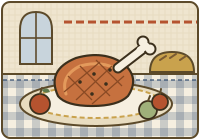
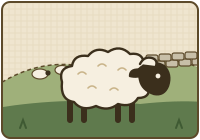
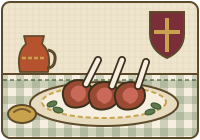
In a field it's a cow; on your plate it's beef. In the farmyard it's a pig; at dinner it's pork. Why does English need two words for the same animal?
The answer goes back to 1066, the year England got a new king, a new ruling class and, in the end, a new kind of language.
One year, three men who wanted the crown
In January 1066 King Edward the Confessor died without children. Three men immediately claimed the throne:
Harold Godwinson, the most powerful nobleman in England, who was crowned straight away as Harold II.
Harald Hardrada, King of Norway and a Viking warrior.
William, Duke of Normandy, a region in what is now northern France. He said Edward had promised him the crown years before.
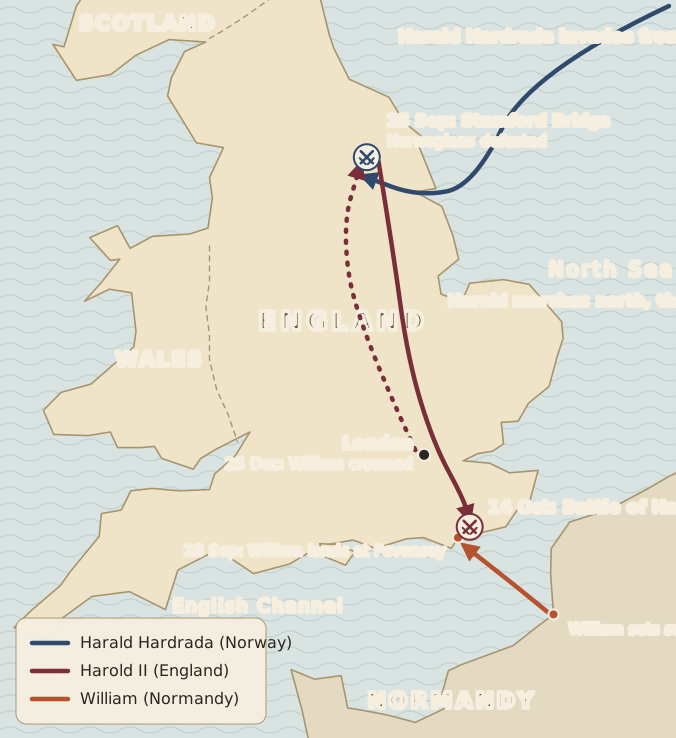
In September the Norwegians landed first, in the north. Harold marched his army up to meet them and won at Stamford Bridge. Only days later, William's fleet arrived on the south coast, and Harold had to rush his tired soldiers all the way back south.
In the autumn of 1066 Harold fought two battles in three weeks: first in the north against the Norwegians, then in the south against William.
JanEdward the Confessor dies and Harold II is crowned
25 SepBattle of Stamford Bridge: Harold beats the Norwegians and Harald Hardrada is killed
28 SepWilliam lands at Pevensey on the south coast
14 OctBattle of Hastings: Harold is killed and William wins
25 DecWilliam is crowned William I in Westminster Abbey, on Christmas Day
1086The Domesday Book is completed, twenty years after the conquest
This build-up explains the result. Harold had just fought one battle and then marched his army hundreds of miles back south, so his men were worn out before the fighting at Hastings even began.
The Battle of Hastings: one day that changed a kingdom
On 14 October 1066 the two armies met near Hastings in southern England. The fighting lasted all day, and by the evening Harold II was dead. William became King William I, remembered ever since as William the Conqueror.
No foreign army has managed to conquer England since.
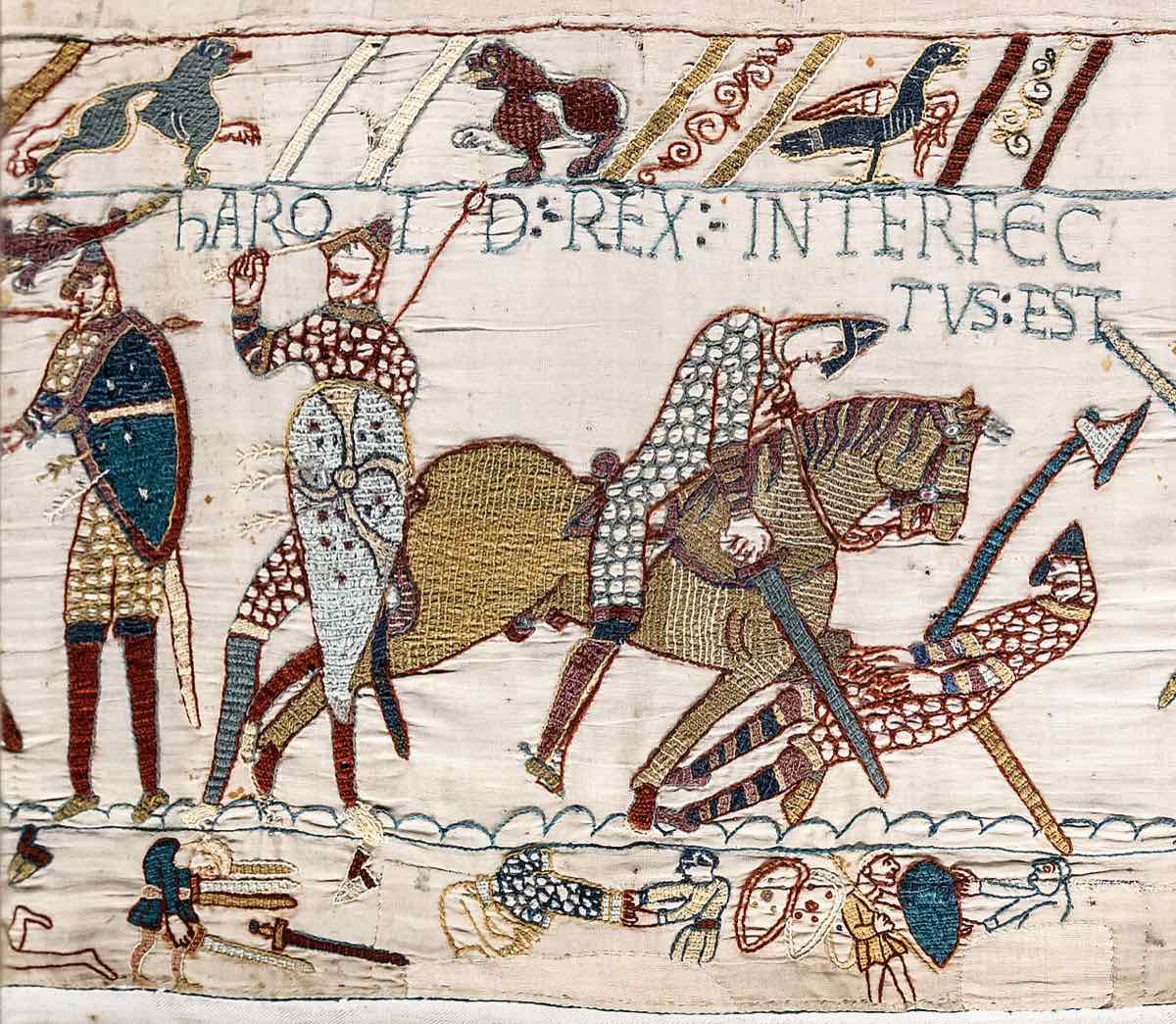
Bayeux Tapestry, scene 57. The Latin HIC HAROLD REX INTERFECTUS EST means "Here King Harold is killed". The famous story that Harold died from an arrow in the eye comes from this scene, where a soldier seems to be pulling an arrow from his face. Historians still argue about whether that figure is Harold at all, or whether Harold is the man being cut down by a horseman next to him.
Photo: Myrabella, public domain, via Wikimedia Commons
Quiz
In 1066, who defeated Harold, the Saxon king, at the Battle of Hastings?
Alfred the Great was an earlier king who fought the Vikings. Robert the Bruce and Edward I lived later, in the Middle Ages; you'll meet them in the next chapter.
Quiz
Is the statement below TRUE or FALSE?
Since the Norman Conquest of 1066, no foreign invasion of England has succeeded.
True. After 1066, no foreign army ever conquered England again.
The Bayeux Tapestry: a 70-metre comic strip
The story of the battle was stitched onto a strip of cloth almost 70 metres long: the Bayeux Tapestry. Despite the name, it isn't woven like a true tapestry. It's an embroidery, with woollen thread sewn onto linen. Soldiers, horses and ships march across it scene after scene, like a medieval comic strip.
Scene 38: William's fleet carries horses across the English Channel.
Bayeux Museum, public domain, via Wikimedia Commons
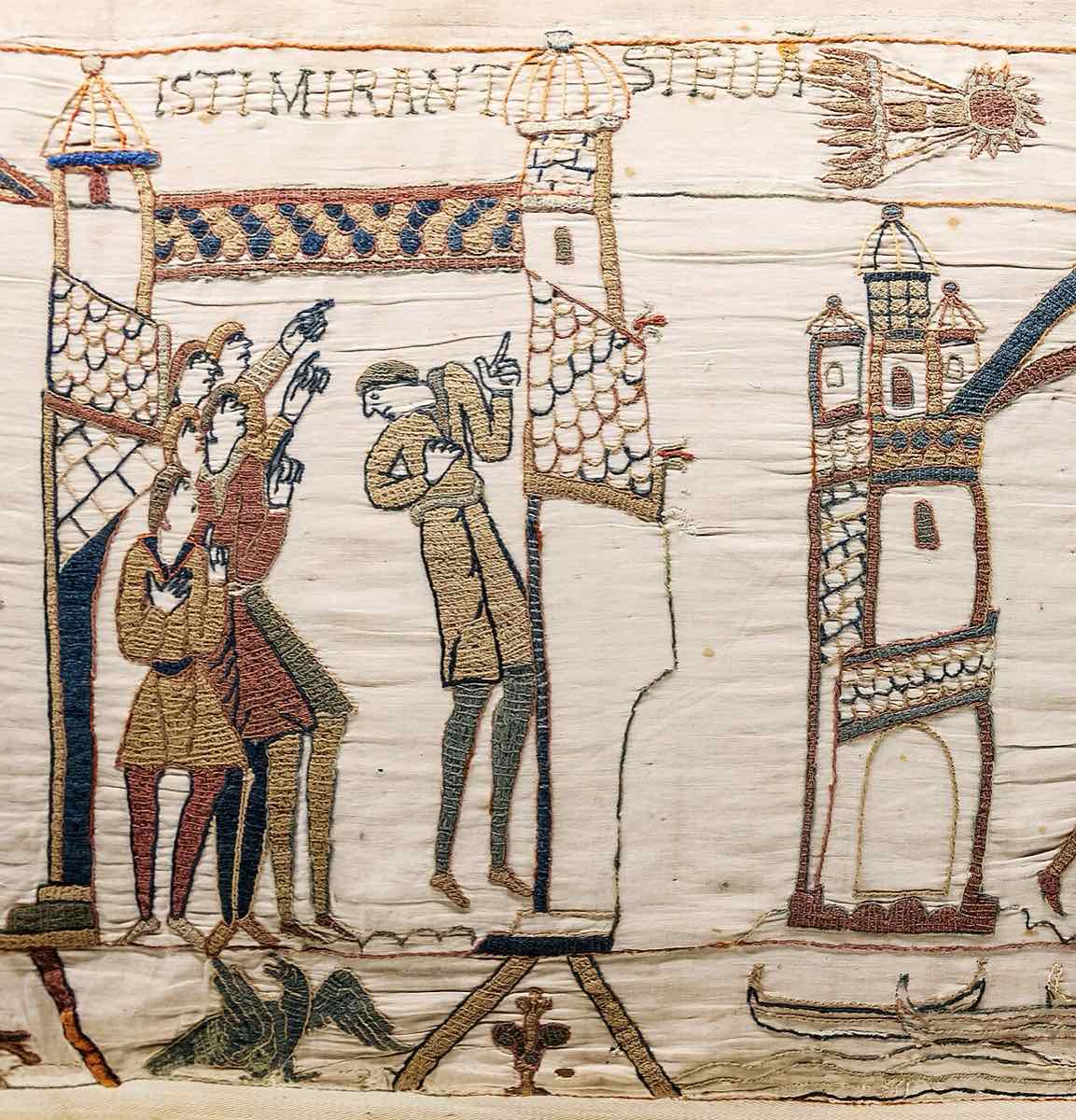
Even Halley's Comet, which appeared in the sky in spring 1066, made it into the tapestry. A group of men point upwards, and the Latin beside them says they are marvelling at the star. People at the time saw comets as a sign that something big was about to happen.
Scene 32: Halley's Comet is at the top right, with the Latin ISTI MIRANT STELLA.
Photo: Myrabella, public domain, via Wikimedia Commons
Quiz
Which of the following statements is correct?
The tapestry tells the story of Hastings. Bannockburn was the battle of 1314 in which Scotland defeated England; it's in the next chapter.
The Domesday Book: the king's great stocktake
Winning at Hastings did not end the fighting. For several years William crushed rebellions, most harshly in the north, and built castles across the country to keep control. Once England was firmly his, William I wanted to know exactly what he now owned. He sent officials all over the country to record four things about every town and village:
Towns and villages
Who lived there
Who owned the land
What animals they had
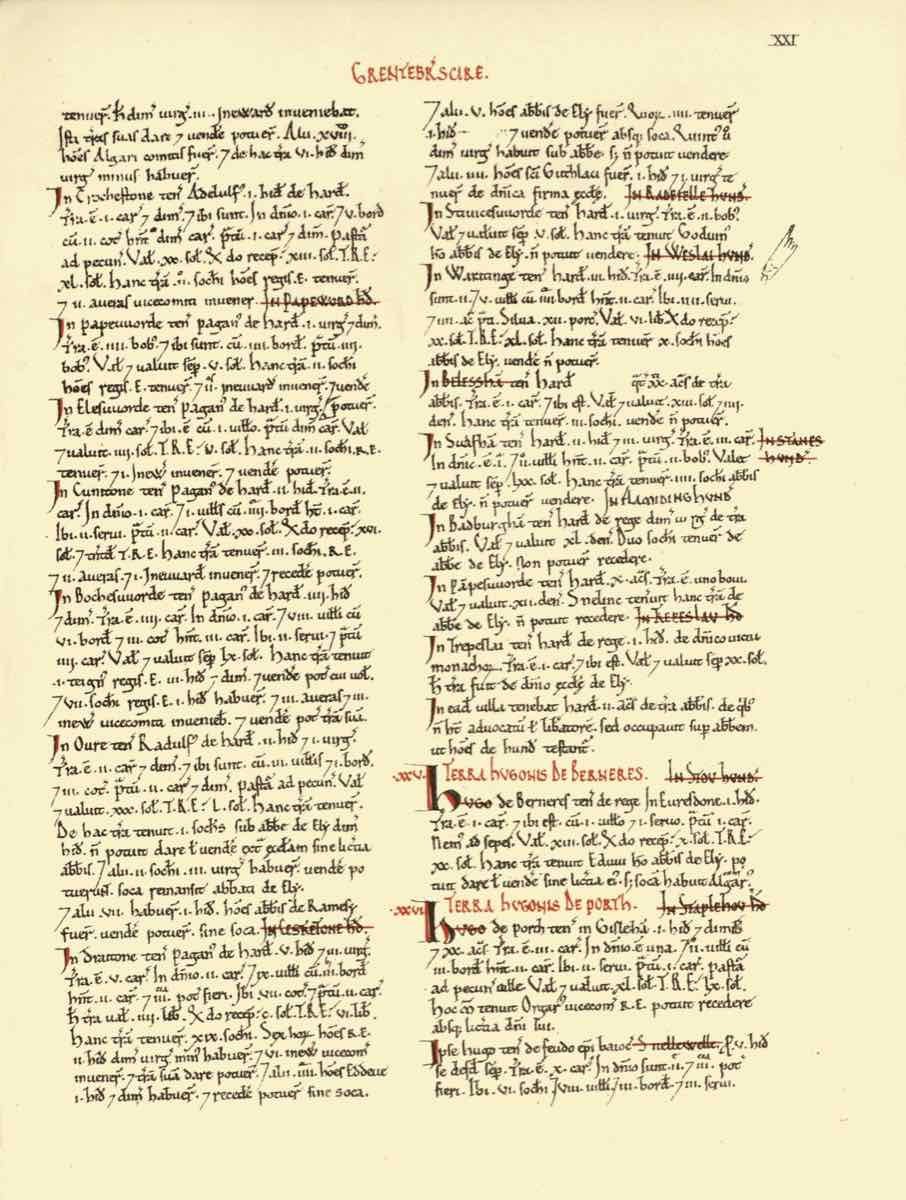
The result was the Domesday Book. It survives to this day, giving us a snapshot of English society just after the Norman Conquest. Its name comes from "doomsday", the Day of Judgement: people felt that, like the Last Judgement, what the book recorded was final, with no appeal and no changing it.
A page of the Domesday Book (Cambridgeshire), handwritten in Latin. The red letters are place names and headings.
Public domain, via Open Domesday (Anna Powell-Smith) and Wikimedia Commons
Quiz
What is the Domesday Book?
A describes Chaucer's The Canterbury Tales, B is Magna Carta (1215), and D is linked to William Caxton's printing press. All three are in the next chapter.
How English was born: French for the lords, Old English for the farmers
Now back to the question we started with. After the conquest, England had two languages side by side:
Over a few hundred years the two blended into a single English language. That's why modern English so often has a pair of words with similar meanings: one from French, one from Anglo-Saxon.
In the field: farmers spoke Old EnglishOn the table: nobles spoke French
cowOld English cū
→
beefFrench bœuf
pigOld English
→
porkFrench porc
sheepOld English
→
muttonFrench mouton
The pattern follows who did the work and who did the eating. The peasants looking after the cattle in the fields spoke English, so the living animal is a cow; the nobles eating the meat at the table spoke French, so the meat is beef. Pigs and sheep work the same way. Walter Scott made the idea famous in his 1819 novel Ivanhoe, and linguists say the real history is messier, but it's a handy way to remember that "cow" comes from Anglo-Saxon. Next time you order a beef burger, you're eating a little bit of 1066.
Quiz
Which TWO of these words come from Anglo-Saxon?
"Park" and "beauty" come from Norman French. A memory trick: apple, cow and summer are everyday words from farming life.
Quiz
Is the statement below TRUE or FALSE?
Following 1066, Anglo-Saxon was the language of the king and the nobles, and Norman French was the language of the peasants.
False: it was the other way round. The nobles spoke French and the peasants spoke Old English. Remember who ate the beef.
What about Wales and Scotland?
The Normans didn't stop at England.
Wales: the Normans conquered Wales at first, but over time the Welsh won land back.
Scotland: the Scots and Normans fought along the border. The Normans took some border land but did not invade Scotland.
William I died in 1087, but the kings who came after him kept his appetite for land. For the next four hundred years they fought over Wales, Scotland and Ireland, and in France as well. That is where the next chapter begins.
Quiz
Which of the following statements is correct?
The Normans never ruled the whole of Scotland.
Chapter summary
1066
Battle of Hastings: William defeats Harold II
William the Conqueror
Duke of Normandy who became King William I of England
Last successful invasion
No foreign invasion of England has succeeded since the Norman Conquest
Bayeux Tapestry
Embroidery commemorating Hastings; kept in France
Domesday Book
Record of England's towns, people, land and animals; it still survives
French + Anglo-Saxon
Blended into English. Park and beauty come from French; apple, cow and summer from Old English
Wales / Scotland
Wales conquered, then partly won back; Scotland not invaded

 Towns and villages
 Who lived there
 Who owned the land
 What animals they had