Anglo-Saxons and Vikings: How England Got Its Name
What does the word England actually mean?
It comes from the Old English Englaland: "the land of the Angles". The Angles were not native to Britain. They were settlers who crossed the sea after the Romans left, from what is now northern Germany and Denmark. This chapter begins as they come ashore. Then come Viking longships, a king who let some cakes burn, and a Danish king who is said to have told the waves to stop.
410The Roman army leaves; the Jutes, Angles and Saxons invade one after another
563St Columba founds a monastery on Iona
597St Augustine arrives in Canterbury from Rome
About 600The Anglo-Saxon kingdoms are mostly in place, mainly in what is now England
789The Vikings' first raid
793Vikings attack the monastery at Lindisfarne
800sKenneth MacAlpin unites the north; Alfred the Great defeats the Vikings
1016Cnut, a Dane, becomes King of England
1066The Norman Conquest (next chapter)
The Romans leave, three tribes arrive
After the Roman army left in AD 410, Britain was invaded once more, this time by tribes from northern Europe:
Jutes: from Jutland, in what is now Denmark.
Angles: from the area where Germany and Denmark meet today.
Saxons: from what is now northern Germany.
Their languages are the foundation of modern English. By about AD 600, the Anglo-Saxons had set up several kingdoms in Britain, most of them in what is now England.
But the Anglo-Saxons never ruledScotland, or parts of western Britain, including most of today's Wales.
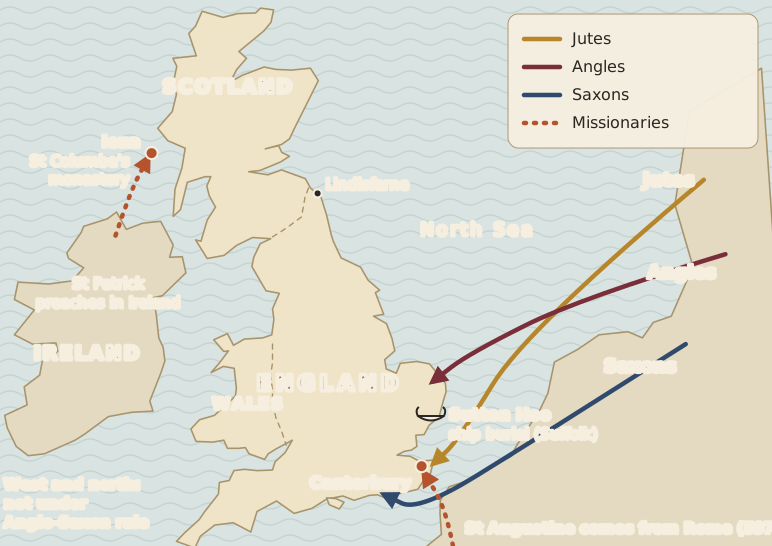
The three tribes crossed from mainland Europe (solid lines), and missionaries brought Christianity from two directions (dotted lines): from Ireland in the north and from Rome in the south. The arrows are only a rough guide. In reality, where people came from and where they settled was more mixed.
The newcomers also brought their own gods, and you still meet two of them every week. Wednesday is "Woden's day", and Thursday belongs to Thunor, the god of thunder, known in Norse myths as Thor.
Quiz
After the Romans left, Britain was invaded by tribes from northern Europe. Which TWO of the following were among them?
The three tribes were the Jutes, the Angles and the Saxons. The Normans didn't come until 1066, and the Picts already lived in what is now Scotland: they were the people Hadrian's Wall was built to keep out.
Quiz
Is the statement below TRUE or FALSE?
Scotland and large parts of Wales stayed outside Anglo-Saxon control.
True. The Anglo-Saxon kingdoms were mainly in what is now England. That is one reason why Celtic languages such as Welsh and Scottish Gaelic survived.
Sutton Hoo: a king's ship under a mound
At Sutton Hoo in Suffolk, in the east of England, lies the grave of an Anglo-Saxon king. When he died, he was laid in a ship together with treasure and armour, and the ship was buried under a huge mound of earth.
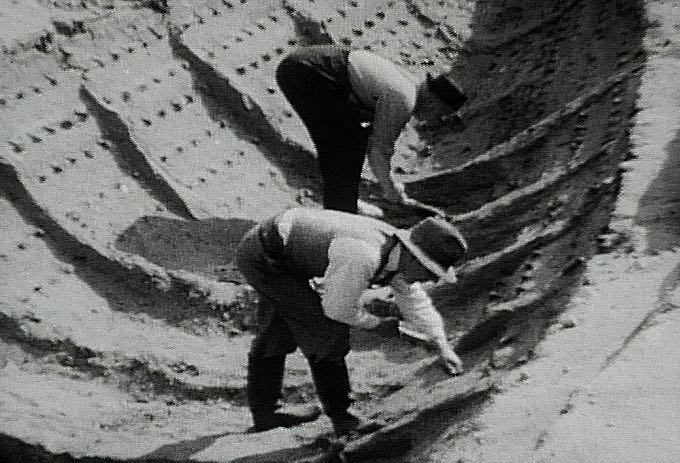
The dig in 1939. The wood had rotted away long before, leaving only the "print" of the ship in the sand and rows of iron rivets.
Still from a home movie by Harold John Phillips, public domain, via Wikimedia Commons
The mound was opened in 1939, when the landowner Edith Pretty asked Basil Brown, a self-taught archaeologist, to dig into it. He found a ship about 27 metres long. The acid soil had eaten away all the wood, but almost every iron rivet was still in place, so archaeologists could trace the shape of the whole ship from them.
Nobody wrote down the dead king's name. The most likely candidate is Rædwald, King of East Anglia, who died in the 620s. The dig itself later became a 2021 Netflix film, The Dig.
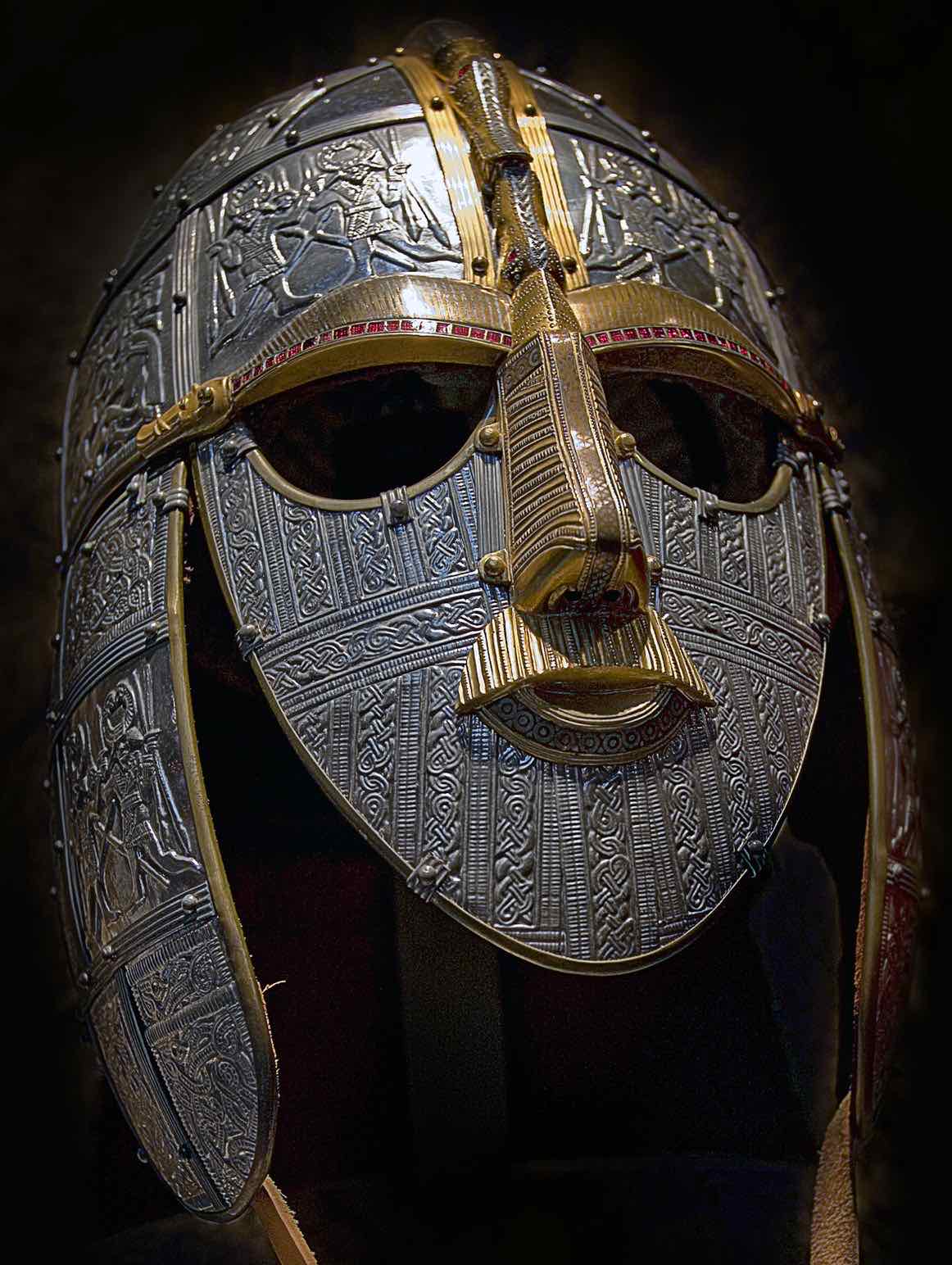
A replica of the Sutton Hoo helmet. The original was found broken into hundreds of pieces. It has been put back together and is in the British Museum.
Photo: Gernot Keller, CC BY-SA 2.5, via Wikimedia Commons
Quiz
Sutton Hoo is the burial place of an Anglo-Saxon king who was buried in a ship. In which modern county is it?
Sutton Hoo is in Suffolk. Wiltshire is Stonehenge, Orkney is Skara Brae and Dorset is Maiden Castle, all from the previous chapter.
Christianity arrives from two directions
Christianity had first reached Britain in Roman times, but when the Anglo-Saxons arrived, they were not Christians. During this period, missionaries (people sent to spread a religion) came to Britain to teach the Christian faith. They came by two routes, one in the north and one in the south:
In the north, from Ireland:
St Patrick, who later became the patron saint of Ireland.
St Columba, who set up a monastery on Iona, an island off the coast of what is now Scotland.
In the south, from Rome: St Augustine led a group of missionaries, and he became the first Archbishop of Canterbury.
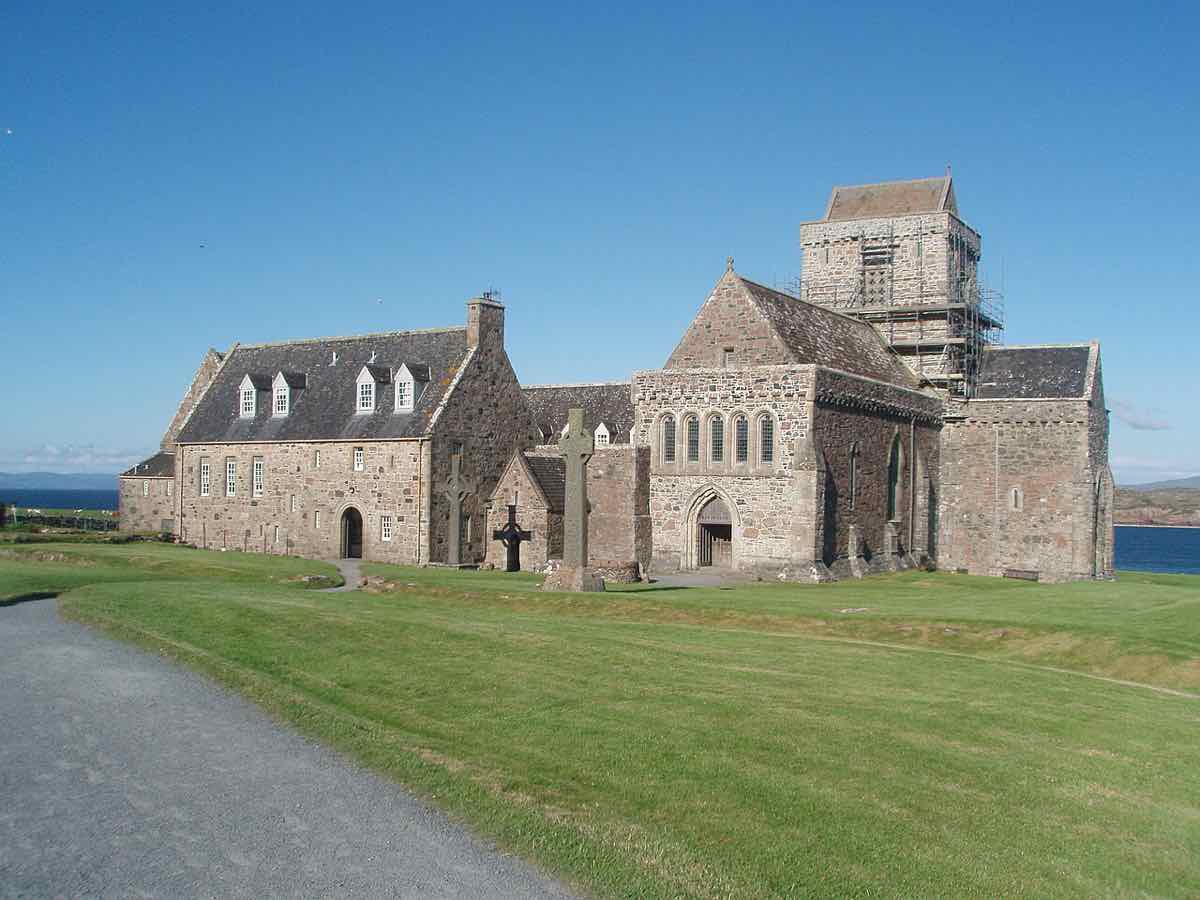
Iona Abbey today. St Columba's own monastery was built of wood. The stone building you see dates from the early 1200s and was restored in the 20th century.
Photo: Akela NDE, CC BY-SA 2.0 FR, via Wikimedia Commons
Why Rome cared about this far-off island is explained by a famous story. Pope Gregory I is said to have seen some fair-haired young slaves in a market in Rome and asked where they came from. Told they were Angles (Angli), he replied: "Not Angles, but angels (angeli)." The story was first written down about a hundred years later, so it is a legend, but it is easy to remember.
Gregory's missionary, St Augustine, landed in the kingdom of Kent in 597. The king's wife was already a Christian, so Augustine made Canterbury his base, and to this day the Archbishop of Canterbury is the spiritual head of the Church of England.
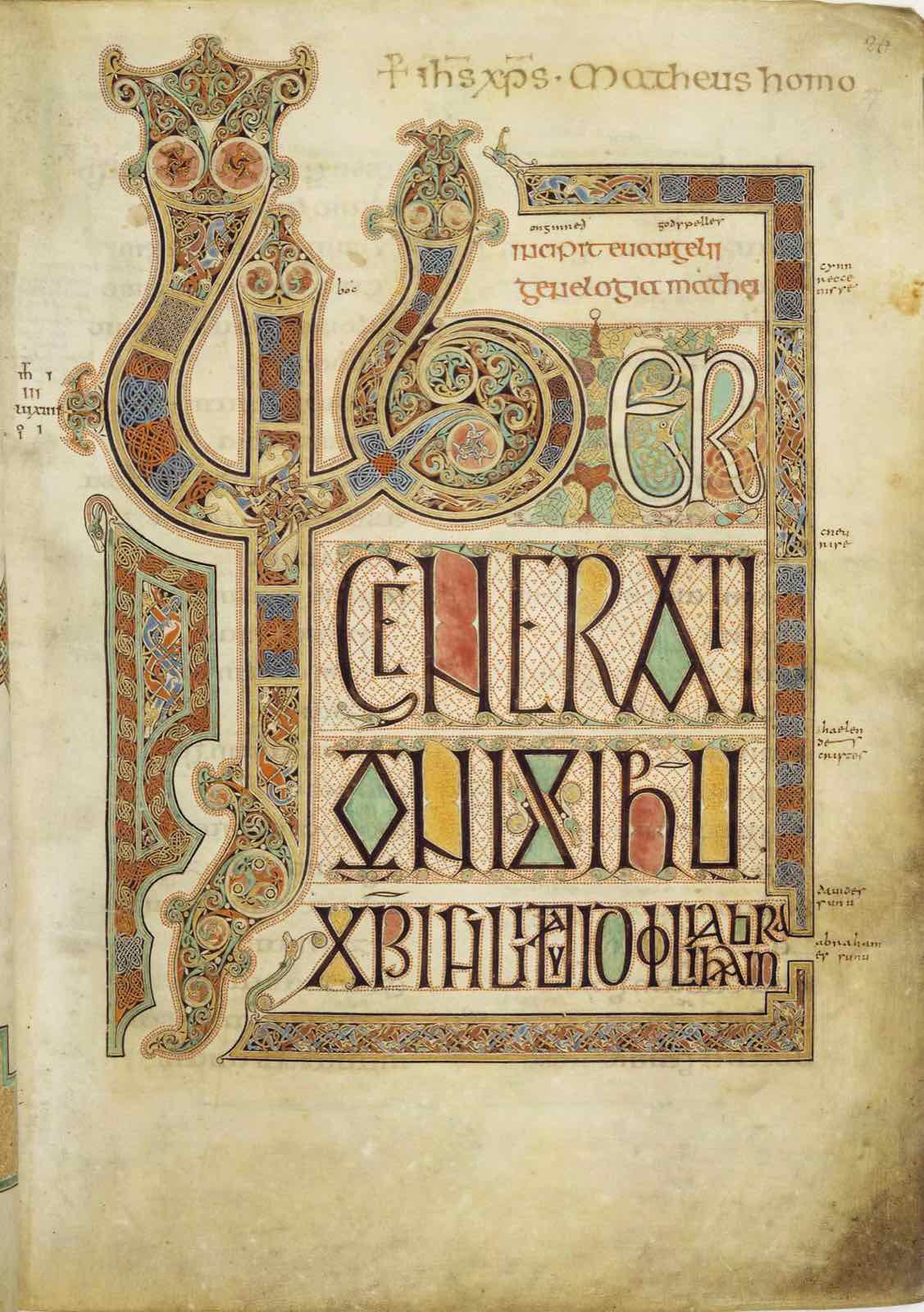
A page from the Lindisfarne Gospels, made in the early 700s on the island of Lindisfarne in north-east England. It shows what the monasteries of this period could achieve.
Probably painted by Eadfrith of Lindisfarne, British Library, public domain, via Wikimedia Commons
Quiz
Who became the first Archbishop of Canterbury?
St Augustine came from Rome, spread Christianity in the south and became the first Archbishop of Canterbury. St Patrick and St Columba came from Ireland and worked in the north. St David is the patron saint of Wales.
Quiz
Which of the following statements is correct?
A mixes up St Columba with St Augustine. A memory aid: Augustine and Archbishop both begin with A, while Columba and Iona both end in A.
The Vikings: raiders from the sea
For almost two centuries after St Augustine's arrival, monasteries and churches spread across the Anglo-Saxon kingdoms. Then a new danger came from across the sea. In AD 789 the Vikings came to Britain for the first time. Their homelands were Denmark, Norway and Sweden. At first they came to raid towns on the coast, taking goods and carrying people off as slaves. Later some of them stayed and built communities of their own in eastern England and in Scotland.
The first visit went badly from the start. The Anglo-Saxon Chronicle records three ships landing at Portland in Dorset, in the south of England. The king's local official (the reeve) took them for traders and rode out to tell them to report to the king's town, and they killed him on the spot. It is the first recorded Viking attack on England. Oddly, the Chronicle calls them "the first ships of Danish men" while saying they came from Hordaland, in Norway: at the time the English often called all Vikings "Danes".
Quiz
Which of the following statements is correct?
The Vikings set out from Denmark, Norway and Sweden, and their first raid on Britain was in 789. Normandy was William's homeland in 1066, and 410 is the year the Romans left.
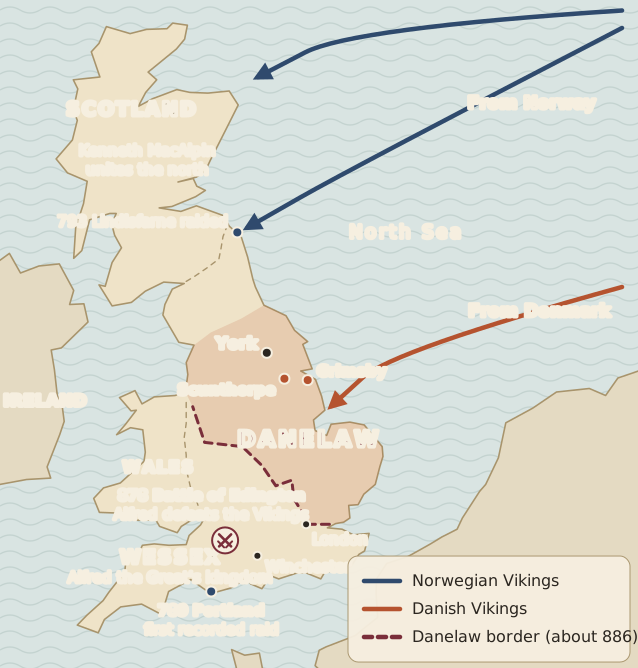
The Danelaw (pale red) was roughly the north-eastern half of England, beyond a line running north from London along the River Thames, the River Lea and the old Roman road called Watling Street. The border shown is approximate, and the real area changed over time.
Alfred the Great: the only native English king called "the Great"
Facing the Vikings, the Anglo-Saxon kingdoms of England came together under Alfred the Great, and he defeated the Vikings.
In 878 Alfred beat the Viking leader Guthrum at the Battle of Edington. Guthrum surrendered and was baptised as a Christian, with Alfred as his godfather.
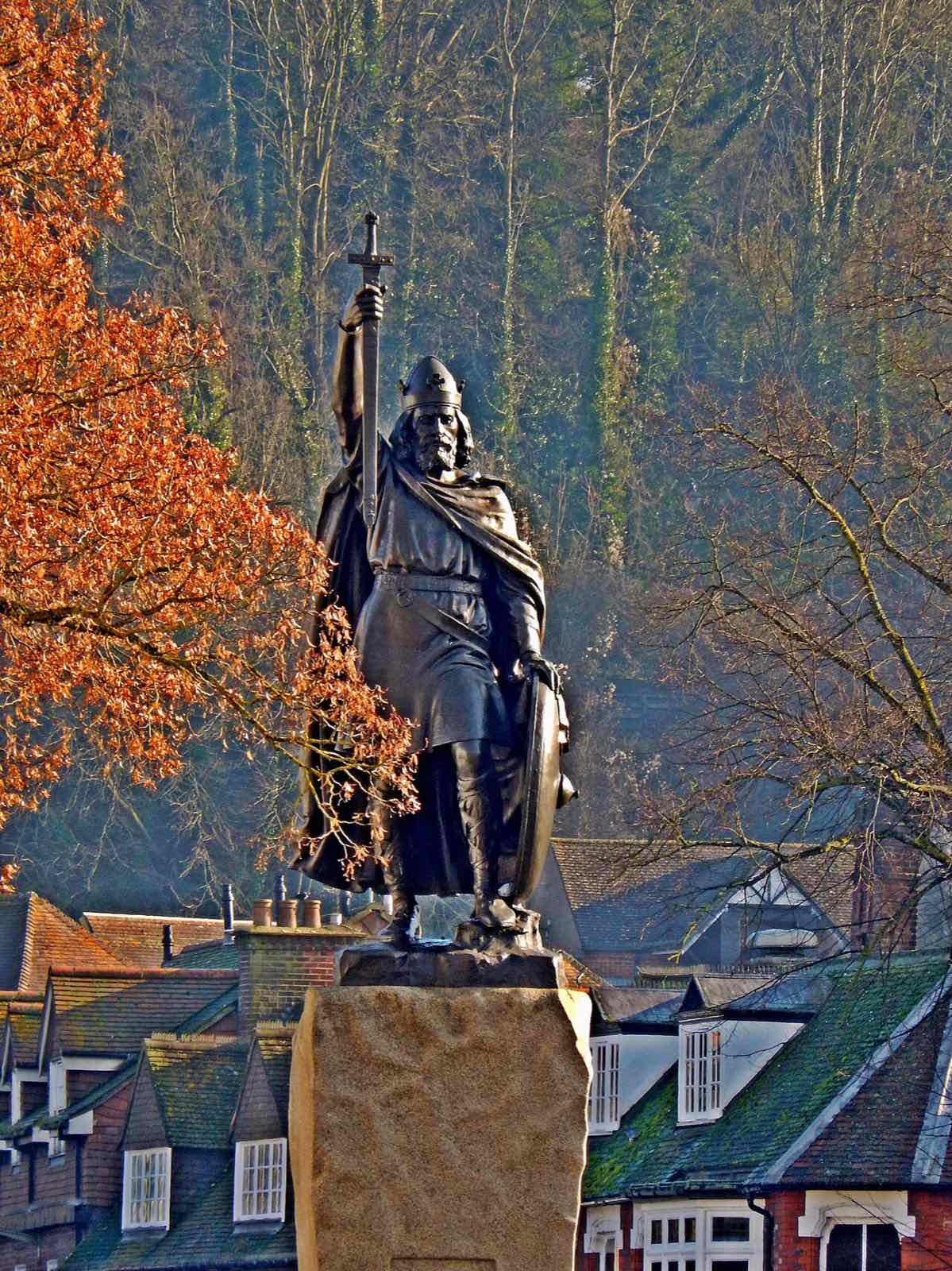
The statue of Alfred the Great in Winchester, an important city in his kingdom of Wessex.
Photo: NickDenbow, CC BY-SA 4.0, via Wikimedia Commons
Alfred came close to losing everything first. Early in 878 the Vikings caught him by surprise, and he had to hide in the marshes of south-west England. The story goes that he stayed with a peasant woman who asked him to watch some cakes (small loaves) baking by the fire. Alfred was so busy thinking about his kingdom that he let them burn, and the woman, who had no idea he was the king, told him off. It is a legend, not something written down at the time, but almost every British child has heard it.
Quiz
Which king united the Anglo-Saxon kingdoms in England and defeated the Vikings?
It was Alfred the Great. Cnut was a Danish king; Kenneth MacAlpin united the north, in what became Scotland; and Edward the Confessor was the king whose death in early 1066 opens the 1066 chapter.
The Danelaw: Vikings in place names
Many Vikings settled for good, above all in eastern and northern England. This area was called the Danelaw, which means the area where Danish law applied.
Even today, many place names there come from the Viking languages, such as Grimsby and Scunthorpe. Over time the Viking settlers blended in with the local people, and some became Christians.
-by
Old Norse for "village" or "farm" Grimsby, Derby
-thorpe
"a small outlying settlement" Scunthorpe
sky
from Old Norse
window vindauga = "wind eye"
Look closer and the Viking roots show up everywhere. In the Domesday Book, Scunthorpe is written Escumesthorpe, "Skuma's farm", and the -by in Grimsby is Old Norse for "village". Everyday words came too: sky, egg, knife and even they. Window was once vindauga, a "wind eye": a hole in the wall that let the wind in.
Quiz
Which TWO place names in England come from the Viking languages?
Look at the endings: -by and -thorpe come from the Vikings. The names Canterbury and Winchester come from older Anglo-Saxon and Latin.
Quiz
Is the statement below TRUE or FALSE?
The Danelaw was the area in the south-west of England where most Viking invaders settled.
False. The Danelaw was in the east and north of England. The south-west was Alfred the Great's kingdom of Wessex. Look at the map above: Grimsby and Scunthorpe are both in the east.
The north: the name "Scotland" appears
England was not the only target. In the north, the danger from the Vikings made people rally behind a single king: Kenneth MacAlpin, also known as Kenneth I. From this time on, people started to call the country Scotland.
Kenneth's royal family traced its ancestors back to the area around Iona, St Columba's island, so Iona later became the burial place of Scottish kings. Dozens of early kings of Scotland are said to lie in its graveyard.
Quiz
Fear of Viking raids led the people of the north to unite behind a single king. Who was he?
It was Kenneth MacAlpin (Kenneth I). Robert the Bruce was the Scottish king at the Battle of Bannockburn in 1314; you'll meet him in the Middle Ages chapter.
Cnut: the Danish king who told the waves to stop
Further south, after Alfred, Anglo-Saxon kings went on ruling what is now England, apart from one short period when Danish kings sat on the throne. The first of them was Cnut, also called Canute. He is often known as Cnut the Great.
Cnut became King of England in 1016. Later he also became King of Denmark and King of Norway, ruling a great kingdom around the North Sea until his death in 1035.
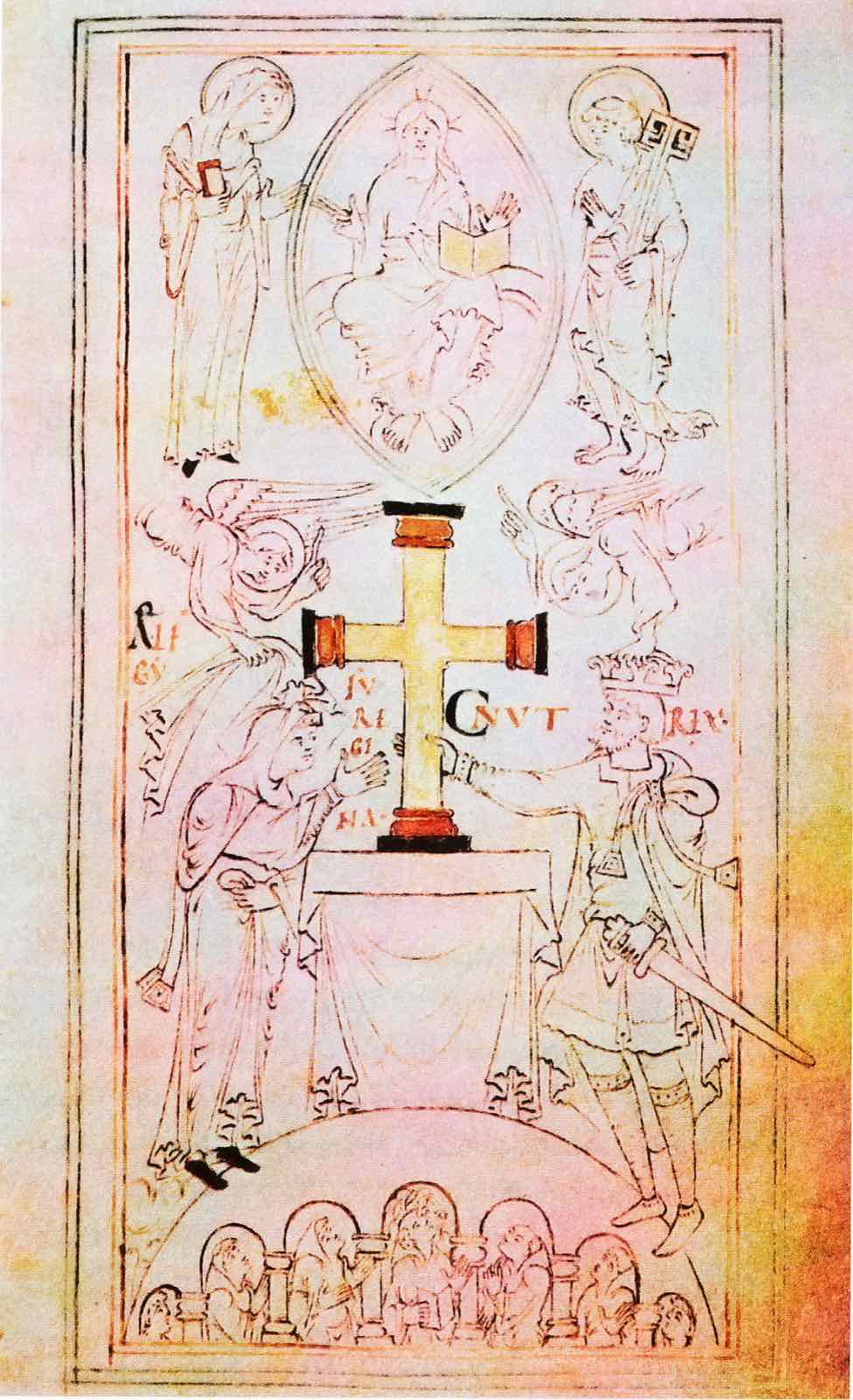
A manuscript picture from about 1031: King Cnut and Queen Emma give a gold cross to the New Minster abbey in Winchester.
An 11th-century scribe, British Library Stowe MS 944, public domain, via Wikimedia Commons
Cnut is best remembered for a story about the sea. He had his throne set down on the shore and ordered the rising tide to stop, and the water came in anyway and wet his feet. People often take this as a joke about his pride, but it originally meant the opposite: he was showing the courtiers who flattered him that a king's power has limits, and that only God can command the sea. The story first appears about a hundred years after his death, in the work of the 12th-century historian Henry of Huntingdon, so it is a legend.
After Cnut and his sons died, the throne went back to the Anglo-Saxons and passed to Edward the Confessor. When Edward died without children in January 1066, three men rushed to claim the crown. The next chapter starts there.
Quiz
Is the statement below TRUE or FALSE?
Cnut, also called Canute, was the first of the Danish kings who ruled England for a short period.
True. The test often writes Cnut and Canute as if they were different people, but they are the same person.
Chapter summary
Jutes, Angles, Saxons
Invaded from northern Europe after the Romans left; their languages are the basis of modern English
By AD 600
Anglo-Saxon kingdoms set up, mainly in today's England; most of Wales and Scotland stayed outside their rule
Sutton Hoo
Suffolk; an Anglo-Saxon king buried in a ship with treasure and armour
St Patrick / St Columba
Came from Ireland and worked in the north; Patrick is Ireland's patron saint, Columba founded a monastery on Iona
St Augustine
Came from Rome and worked in the south; the first Archbishop of Canterbury
AD 789 Vikings
From Denmark, Norway and Sweden; first came in 789 to raid coastal towns
Alfred the Great
United the Anglo-Saxon kingdoms and defeated the Vikings
Danelaw
The east and north of England; place names such as Grimsby and Scunthorpe come from Viking languages
Kenneth MacAlpin
Kenneth I; the north united under him and the name Scotland came into use