11th–14th centuries
Feudalism: land in return for loyalty
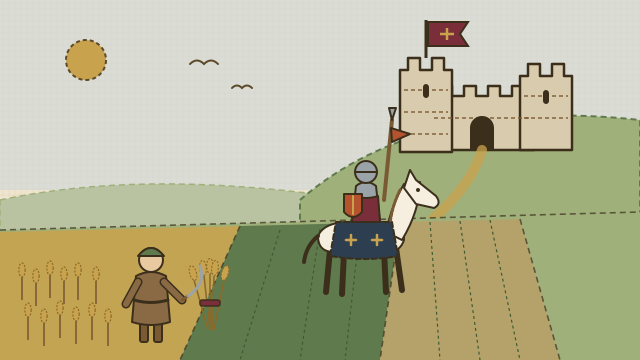
After the Normans conquered England in 1066, William the Conqueror and the kings who came after him all faced the same problem: how to keep control of their new land and always have soldiers ready to fight. The answer was to tie land and loyalty together. In this period, society was built around land. The Normans brought a land system called feudalism. The king handed out land to his lords, and in exchange the lords had to support him when he went to war. Everyone who held land had to supply a fixed number of men to fight. A few peasants owned land of their own, but the majority were serfs. A serf got a small strip of the lord's land to grow food on. In return, he had to work for the lord, and he wasn't free to leave.
The same system grew up in the south of Scotland. But in the north of Scotland and in Ireland, land belonged to members of clans (large, important families).
Under feudalism, everyone from the king down to the lords and the peasants was bound to the others by land, loyalty and service in war: those above handed out land, and those below gave soldiers and work. This order lasted for several hundred years, until the Black Death of the 14th century cut the population so sharply that peasants began to demand higher wages.
Quiz
Which of the following statements is correct?
Under feudalism the king gave land to the lords, and the lords sent men to fight for him. A is wrong: only some peasants had their own land. Most were serfs, who had to work for their lord and were not allowed to leave.