1947–1960s
From Empire to Commonwealth
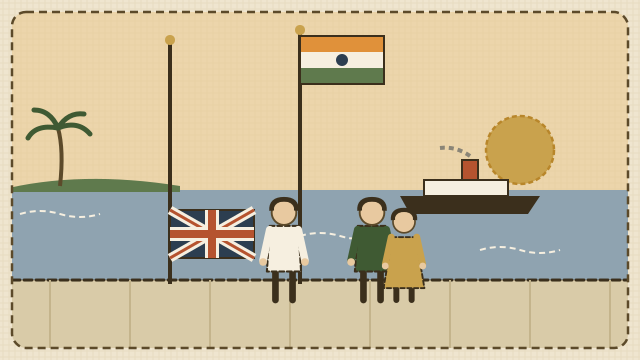
After the Second World War, while the welfare state was being built at home, the British Empire abroad began to break up. In 1947 Britain gave independence to nine countries, among them India, Pakistan and Ceylon (today's Sri Lanka). (The handbook lists Ceylon with 1947; in fact Ceylon became independent in February 1948. In the test, answer as the handbook does.) In the 20 years that followed, colonies in Africa, the Caribbean and the Pacific gained their independence too.
In the same period, Britain developed its own atomic bomb. It also joined NATO (the North Atlantic Treaty Organization), a new alliance set up to protect its members against an attack by the Soviet Union and its allies.
From 1951 to 1964 the Conservatives were in power. The economy recovered in the 1950s, and life for working people kept getting better. The Prime Minister, Harold Macmillan, gave a famous "wind of change" speech about decolonisation (colonies becoming independent) and independence for the countries of the Empire.
Macmillan gave that speech in February 1960, to the parliament of South Africa in Cape Town. Standing in front of a government that practised apartheid (keeping people apart by race), he said that a "wind of change" of African national feeling was blowing through the whole continent, and that people had to accept it, whether they liked it or not. His audience was not impressed.
Quiz
Which of the following statements is correct?
The countries that became independent in 1947 included India, Pakistan and Ceylon (now Sri Lanka). Canada, Australia and New Zealand were "dominions" that had governed themselves since long before; they did not become independent that year.