1644–1660
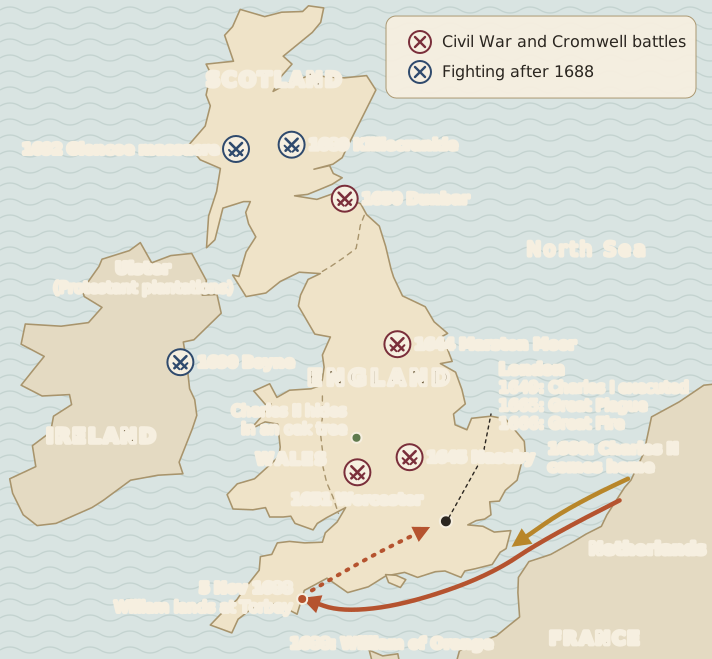
After the English Civil War broke out in 1642, King Charles I's army was beaten in two battles, at Marston Moor and at Naseby. By 1646 Parliament had clearly won.
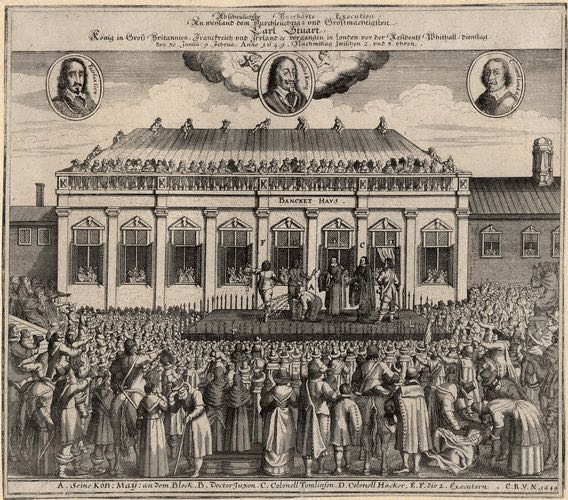
Charles I was held prisoner by Parliament's army, but he still refused to make any deal with Parliament. In 1649 he was executed.
The Commonwealth
England became a republic, known as the Commonwealth, with no king or queen. At first nobody was sure how the country should be run, and in practice the army was in control.
One of the army's generals, Oliver Cromwell, was sent to Ireland. A rebellion that had started there in 1641 was still going on, and there was also an army that fought for the king. Cromwell made the Irish obey the English Parliament, but his methods were so brutal that people in Ireland still argue about him today.
Scotland had never accepted the killing of Charles I. The Scots declared his son, Charles II, king and crowned him in Scotland. Charles II marched into England at the head of a Scottish army, but Cromwell beat him at Dunbar and again at Worcester. Charles fled from Worcester, at one point hiding up an oak tree, and finally escaped to Europe. Now Parliament controlled Scotland as well.
The oak tree was at Boscobel, in the middle of England, and the soldiers hunting for him passed right underneath. After he became king, the story was told again and again, and "The Royal Oak" became one of the most common pub names in Britain. Souvenir hunters slowly cut the original tree to pieces; the oak that stands there today is one of its descendants.
After Ireland and Worcester, everyone saw Cromwell as the new republic's leader. He took the title Lord Protector and ruled until he died in 1658. His son Richard then became Lord Protector, but he could not control either the army or the government. By now the country had gone 11 years without a monarch, and without Cromwell there was no obvious leader and no settled way of governing. Many people longed for stability, and talk turned to bringing back a king.
Cromwell was never king: in 1657 Parliament offered him the crown, and he turned it down. After Charles II came back, Cromwell's body was dug up and hanged, and his head was stuck on a pole on the roof of Westminster Hall, where it stayed for more than twenty years. It then passed from owner to owner for nearly three centuries until, in 1960, it was buried at Sidney Sussex College, Cambridge, where Cromwell had studied.
Quiz
Is the statement below TRUE or FALSE? Marston Moor and Naseby were the battles in which Cromwell defeated the Scottish army of Charles II.
False. Marston Moor and Naseby were battles of the English Civil War, where Parliament's army beat the army of Charles I; by 1646 Parliament had won. Cromwell defeated Charles II's Scottish army later, at Dunbar and Worcester.
Quiz
After Cromwell defeated him at Worcester, how did Charles II famously avoid being captured?
Charles II escaped from Worcester, at one point hiding in an oak tree, and then fled to Europe. He did not go to Ireland to join the Royalists. Escaping to the Isle of Skye is a story about a different prince: Bonnie Prince Charlie, after the Battle of Culloden in 1746.
Quiz
What title was given to Oliver Cromwell as the leader of the new republic?
Cromwell was Lord Protector. He refused the crown and was never king. The job of Prime Minister only appeared in the 18th century, under George I.
Quiz
Is the statement below TRUE or FALSE? After Charles I was executed in 1649, his son immediately became King Charles II of England.
False. After 1649 England was a republic, the Commonwealth, with no king. Charles II was crowned in Scotland, but Cromwell beat him and he had to live in exile in Europe. He only came back to rule England in 1660.