1603–1611
One king, two crowns
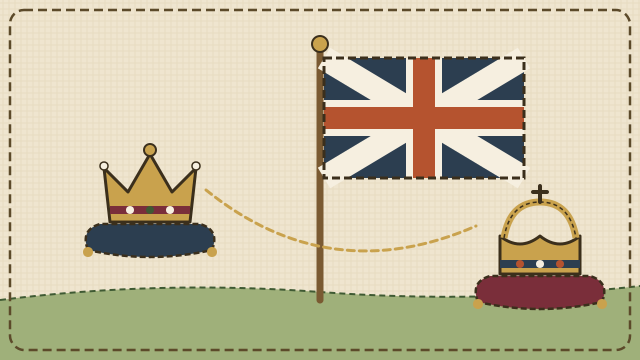
Elizabeth I never married, and when she died in 1603 she left no children. The throne went to a relative of hers: the son of Mary, Queen of Scots, who was already King James VI of Scotland. At the same time he took the crowns of England, Wales and Ireland, where he was known as James I.
From then on England and Scotland shared a king, but Scotland was still a separate country, with its own parliament and its own laws. Unlike his mother, James I was a Protestant.
That is why the same man has two numbers. Scotland had already had five kings called James, but England had never had one, so he was "the Sixth" in Scotland and "the First" in England. This happens a few more times later on, and the test likes to ask about it.
The King James Bible
One of the biggest achievements of James I's reign was a new English translation of the Bible. This is the King James Version, also called the Authorised Version, and it came out in 1611. It was not the first Bible in English, but many Protestant churches still use it today.
Printing it wasn't always smooth. In 1631 a London printer brought out a new edition but left the word "not" out of one of the Ten Commandments, so it told readers "Thou shalt commit adultery" (be unfaithful to your husband or wife). This edition became known as the "Wicked Bible". The printers were given a huge fine, most copies were destroyed, and only a handful survive today.
The Gunpowder Plot and the Union Flag
In 1605 a group of Catholics planned to blow up the Houses of Parliament and kill the Protestant king, James I. The plan failed, and Guy Fawkes, who was guarding the gunpowder, was caught on the spot. (The handbook says the Gunpowder Plot was led by Guy Fawkes. In fact the leader was Robert Catesby; Fawkes was the one caught on the spot, and his name became the famous one. In the test, answer as the handbook does.) People in Britain still remember it with fireworks every 5 November, on Bonfire Night.
In 1606 the flags of England and Scotland were put together to make the first Union Flag. The red dragon of Wales isn't on it, because by then Wales had already been joined to England by the laws of Henry VIII in the 1530s and 1540s.
Quiz
After Elizabeth I's death in 1603, which ruler inherited her throne and was known in England as James I?
James VI of Scotland was the same man as James I of England, and he was the son of Mary, Queen of Scots. William of Orange belongs to 1688, while Robert the Bruce and Henry Tudor are figures from the Middle Ages.
Quiz
Which of the following statements is correct?
The King James Version was not the first English Bible, though many Protestant churches still use it. "Not the first" details like this are a favourite trap.