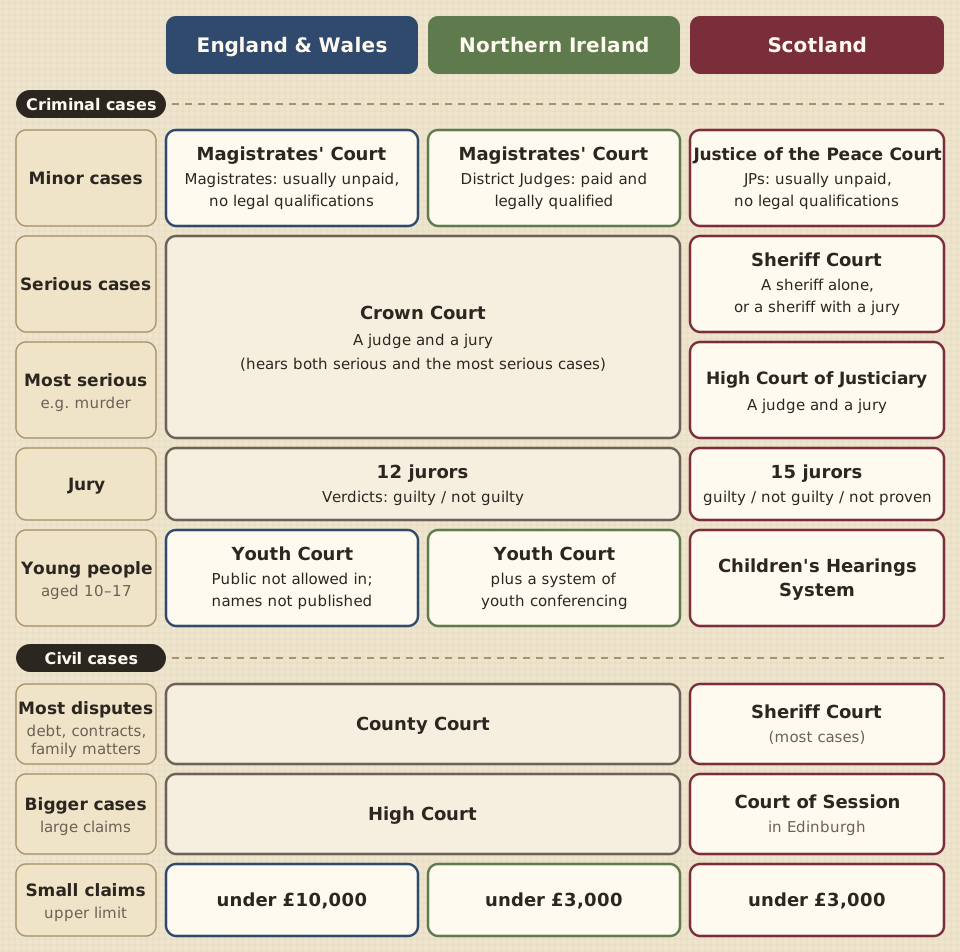
The UK doesn't have one court system but three: one for England and Wales, one for Scotland and one for Northern Ireland. They work in broadly the same way, but the names and details are different. These differences are a favourite in the test, so start with the chart below to see the whole picture.
The three court systems at a glance. Grey boxes are shared by England, Wales and Northern Ireland; red boxes are found only in Scotland.
Minor cases: over to the magistrates
Most minor criminal cases in England, Wales and Northern Ireland go to a Magistrates' Court. In Scotland, minor criminal cases go to a Justice of the Peace Court.
A magistrate, or in Scotland a Justice of the Peace (JP), is an ordinary local resident. Magistrates and JPs in England, Wales and Scotland usually receive no pay, and they don't need any legal qualifications. They are trained, and a legal adviser helps them in court. They decide whether the accused person is guilty, and if so, what the punishment should be.
Northern Ireland is different. There, a District Judge or a Deputy District Judge hears the case. These judges are paid, and they have legal qualifications.
This is where most criminal justice really happens. According to the website of the judiciary of England and Wales, almost every criminal case starts in a Magistrates' Court, and around 95% finish there too. The big TV-style trial with twelve jurors is actually quite rare.
Quiz
In Scotland, which court hears minor criminal offences?
In Scotland, minor criminal cases go to the Justice of the Peace Court. The Magistrates' Court is for England, Wales and Northern Ireland; the Crown Court tries serious criminal cases; and the County Court is a civil court.