The Industrial Revolution: the world's first industrial nation
Story 5 of 8
The new ideas of the Enlightenment did not only change how people thought. Soon they changed how people worked, too. Before the 18th century, most people in Britain worked on the land. There were also many cottage industries, where families made cloth or lace at home.
In the 18th and 19th centuries, industry in Britain grew very fast. This was the Industrial Revolution. Britain was the first country anywhere to industrialise in a big way. The key was new machines and steam power: farming and manufacturing both started to use machines, so work was faster and output much bigger.
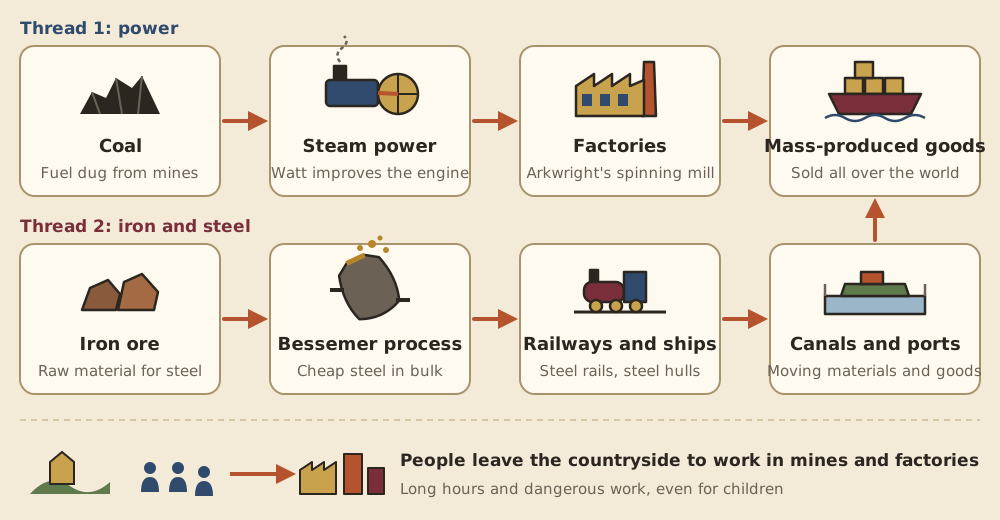
Two main threads of the Industrial Revolution: coal and steam made the factories run, and cheap steel sent railways and steamships across the world. People followed, moving from the countryside into the towns.
The new factories needed coal and other raw materials. Many people left the countryside to work in the mines and factories, and making things in factories overtook farming as the biggest source of jobs.
The Bessemer process made it possible to produce steel in large amounts, which helped the shipbuilding and railway industries to grow. To carry raw materials and goods to cities and ports, Britain also dug many canals, especially in the new industrial areas of the Midlands and the north of England.
But working conditions were terrible. No laws protected workers, who were often made to work long hours in dangerous places. Children worked too, and were treated like adults, sometimes even worse.
Arkwright: from barber to factory pioneer
Richard Arkwright (1732–1792) started out as a barber who could dye hair and make wigs. When wigs went out of fashion, he moved into textiles. He improved the carding machine (carding means combing the fibres so they are ready to be spun into thread). He also set up a spinning mill that used horses to drive a single machine, and later switched to steam engines. Arkwright is best remembered for running his factories in a very efficient and profitable way.
His mill at Cromford in Derbyshire, opened in 1771 and driven by water power, shows what that efficiency meant for the people inside. The workers did two shifts of 13 hours each, and the gates closed on the dot: anyone who was late was shut out for the day and lost a second day's pay as well. Arkwright employed whole families, including many children as young as seven. The mill is now part of the Derwent Valley Mills, a UNESCO World Heritage Site.
Shortly before Queen Victoria came to the throne, George and Robert Stephenson, a father and son, pioneered the steam locomotive. The railway network grew fast in the Victorian age, and railways were later built all over the Empire.
Quiz
Why were canals built during the Industrial Revolution?
Raw materials and manufactured goods needed better transport, so canals were dug to link factories with towns, cities and ports, especially in the new industrial areas of the Midlands and the north of England. Canals came before the great railway boom of the Victorian age, not after it, and they were built for goods, not for defence or long-distance passengers.
Quiz
What did the development of the Bessemer process make possible?
The Bessemer process was a way to mass-produce steel, which in turn boosted shipbuilding and the railways. Cotton cloth and spinning belong to Arkwright's story, and printing books goes back to Caxton in the 15th century.