1770s–1810s
Trade and colonies: even the curry house dates from this time
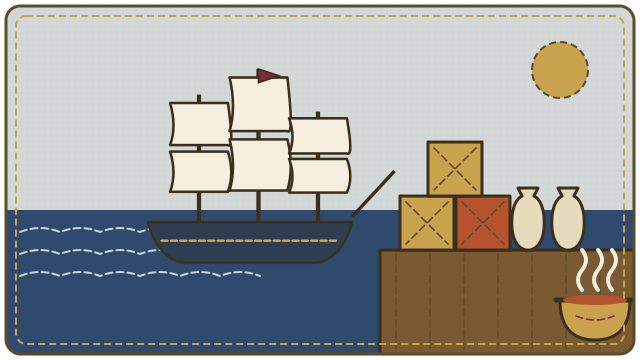
During the Industrial Revolution, Britain's factories needed huge amounts of raw materials, and more people to buy what they made, so Britain looked overseas. During this period Britain's power spread around the world:
- Captain James Cook charted (made maps of) Australia's coast, and Britain set up several colonies there.
- Britain took control of Canada.
- The East India Company started out simply as a trading company, but came to control large parts of India.
- Britain also began to set up colonies in southern Africa.
Britain traded with the whole world and brought in more and more goods: sugar and tobacco from North America and the West Indies, and textiles, tea and spices from India and Indonesia. Trading and settling overseas often brought Britain into conflict with other countries, above all France, which was also expanding around the world.
Britain's first curry house
Sake Dean Mahomet (1759–1851) grew up in the Bengal region of India and served in the Bengal army. He came to Britain in 1782. He later moved to Ireland, where in 1786 he ran away to marry an Irish girl called Jane Daly, and around the turn of the century he moved back to England.
In 1810 he opened Britain's first curry house: the Hindoostane Coffee House, on George Street in London. He and his wife also brought shampooing, an Indian head massage, to Britain.
The word shampoo itself comes from Hindustani, where it first meant "to press" or "to massage". The coffee house closed after only two years because of money problems, so Mahomet opened steam and massage baths in the seaside town of Brighton instead. They were a great success: people called him "Dr Brighton", and he was appointed "shampooing surgeon" to King George IV and King William IV. His travel book, published in 1794, is often described as the first book written in English by an Indian.
Quiz
Which explorer mapped the coast of Australia?
Captain James Cook mapped Australia's coast, and Britain then set up a few colonies there. Drake was a Tudor sea captain who sailed round the world and helped defeat the Spanish Armada. Nelson and Wellington were the commanders at Trafalgar and Waterloo.
Quiz
Which of the following statements is correct?
Mahomet opened the Hindoostane Coffee House in London in 1810, Britain's first curry house. The steam locomotive was the work of George and Robert Stephenson.