To see how Ireland came to be divided, we need to go back to the years just before the First World War, when the Irish question was coming to a head. The British government planned to give Ireland Home Rule: a parliament of its own, while staying part of the UK. Protestants in the north were strongly against it, and even threatened to fight it by force. Over the next ten years, tension kept rising:
1913The British government promises Ireland Home Rule and puts a Home Rule bill before Parliament; Protestants in the north threaten armed resistance
1914The First World War breaks out and the government puts off reform in Ireland; Irish nationalists are not willing to wait
1916The Easter Rising against British rule breaks out in Dublin; its leaders are executed under military law, and a guerrilla war against the British army and police follows
1921The two sides sign a peace treaty
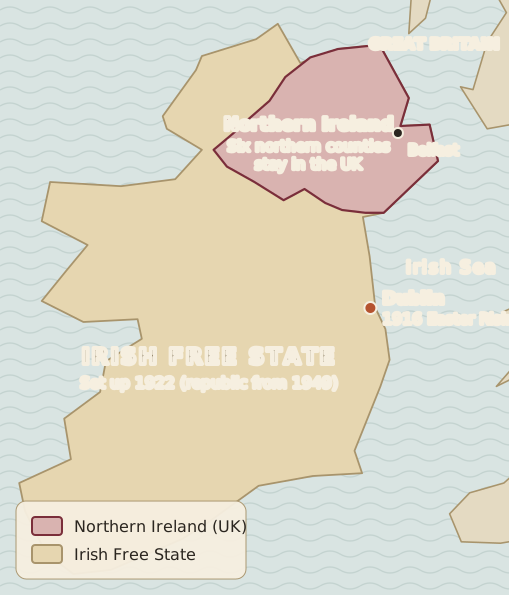
1922Ireland is split in two: six counties in the north, where most people are Protestant, stay in the UK as Northern Ireland; the rest becomes the Irish Free State
1949The Irish Free State becomes a republic
Ireland in 1922: six counties in the north-east became Northern Ireland and stayed in the UK; the rest of the island became the Irish Free State.
But some people, in both the north and the south, would not accept the split. They wanted the whole of Ireland to be one independent country. Years of division later turned into terrorist violence in Northern Ireland and elsewhere. This conflict is known as the Troubles.
Quiz
In which year did the Irish Free State become a republic?
1949. Keep the Irish dates in order: the Easter Rising in 1916, the peace treaty in 1921, the split into Northern Ireland and the Irish Free State in 1922, and a republic in 1949.
Quiz
Is the statement below TRUE or FALSE?
In 1922 the whole of Ireland left the United Kingdom and became the Irish Free State.
The word "whole" makes it false. The six mainly Protestant counties in the north stayed in the UK as Northern Ireland; only the rest became the Irish Free State.